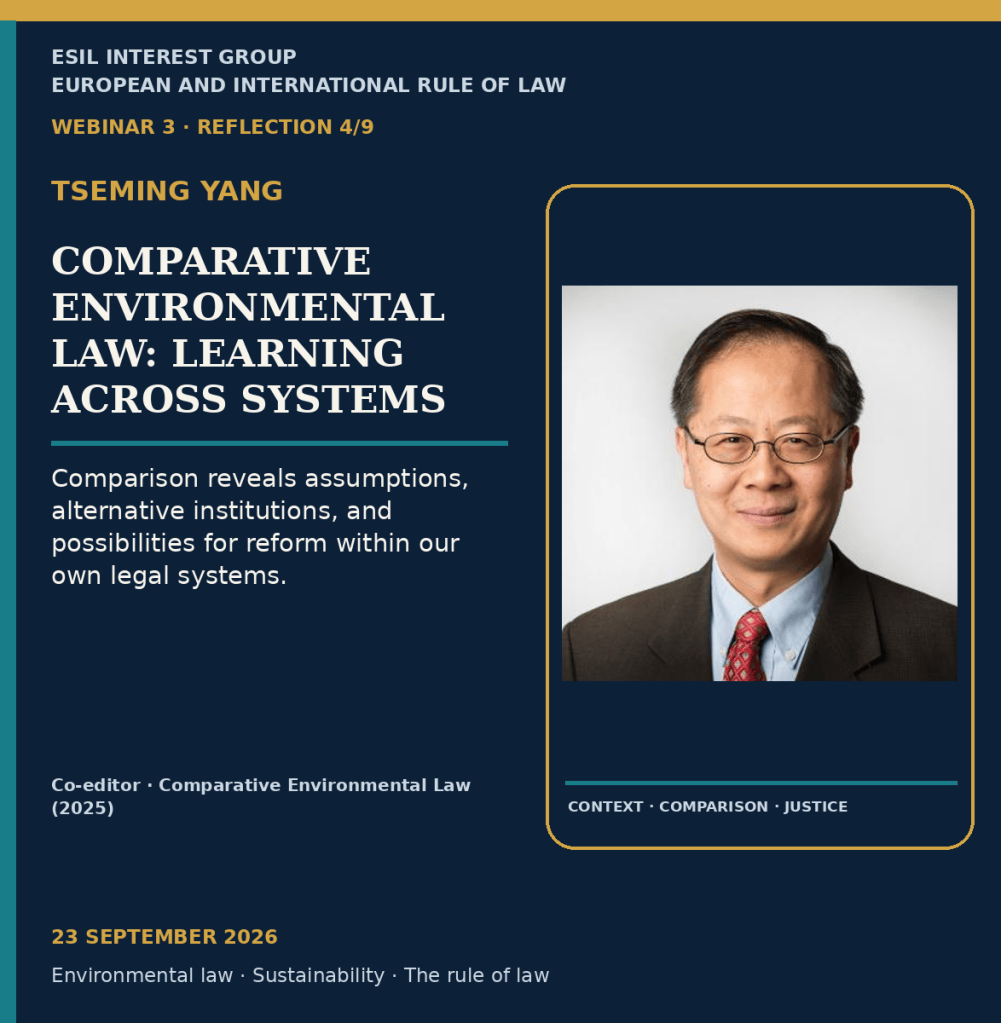

Tseming Yang: Comparative Environmental Law, Legal Cultures, and Learning Across Systems – Reflections on ESIL Webinar Series – Webinar 3 · Reflection 4/9
This post is Reflection 4 of 9 in our series revisiting the September 23, 2026, ESIL Webinar 3, From Environmental Law in Context to Comparative Environmental Governance: Justice, Sustainability, and the Rule of Law, highlighting the contributions of the authors and discussants and the broader questions emerging from their dialogue.
The full post is available at https://paolofarah.wordpress.com/2026/11/13/tseming-yang-comparative-environmental-law-legal-cultures-and-learning-across-systems-reflections-on-esil-webinar-3-webinar-3-%c2%b7-reflection-4-9/
The Video Recording of the Webinar is available at https://lnkd.in/gMzkVCAd
Webinar information, speakers, books, and selected bibliography:
https://lnkd.in/geH22The
Tseming Yang’s contribution to the September 23, 2026 – European Society of International Law (ESIL) Interest Group on European and International Rule of Law Webinar, entitled From Environmental Law in Context to Comparative Environmental Governance: Justice, Sustainability, and the Rule of Law, explained why comparative environmental law matters for legal understanding, legal reform, and professional practice. He presented Comparative Environmental Law, co-edited with Anastasia Telesetsky and Sara K. Phillips, as a contribution to an intersection of fields that still offers substantial opportunities for development.
Environmental law and comparative law each have extensive histories. Tseming argued that their intersection has received less sustained attention, particularly beyond the familiar comparison of North American and Western European systems. The edited volume seeks to broaden that inquiry across jurisdictions, perspectives, and environmental problems.
Understanding ourselves through other systems
One practical value of comparison is the ability to examine assumptions within one’s own legal order. Rules that appear natural or unavoidable from inside a jurisdiction can look different when other systems address a related problem through different institutions or legal foundations.
Tseming connected this insight to law reform, cross-border transactions, international cooperation, and treaty implementation. Lawyers and institutions need to understand how environmental obligations acquire meaning in different settings. Comparison can clarify what a mechanism is designed to accomplish and which aspects of its operation depend on local arrangements.
He also connected the two books through environmental rights. A rights-based perspective is prominent in many legal systems and in international environmental debate. Examining those approaches can reveal gaps in the way the subject is commonly understood in the United States.
Four analytical approaches
Tseming identified four useful frameworks. Functional equivalence asks whether different legal mechanisms address a similar social problem. His examples included public interest litigation, which can rest on different foundations while pursuing a related accountability function.
Legal history examines how institutions develop and evolve. Comparative legal cultures consider the relationship between law and other social institutions. Legal transplants investigate how mechanisms travel and what happens as they enter new institutional settings.
Environmental impact assessment supplied an example of legal diffusion. Tseming discussed the role of international and transnational institutions in encouraging environmental law reform and introducing assessment obligations. The widespread adoption of such a mechanism opens further questions about its different legal effects and practical operation.
These analytical approaches do not provide a single recipe for comparison. They offer ways to investigate similarity and difference, the movement of legal ideas, and the conditions under which institutions become effective.
A wider geography of environmental law
The breadth of the comparative inquiry was central to Tseming’s presentation. An approach organized primarily around a transatlantic perspective leaves important legal experiences and institutional possibilities outside the conversation.
Mekonnen Ayano welcomed the volume’s effort to move beyond that familiar frame. His question about comparative distance and contextual proximity gave Tseming an opportunity to explain how the books could work together. Comparison can challenge the status quo by showing that other ways of organizing environmental protection are available.
Tseming also acknowledged areas the volume could not fully cover, including a dedicated climate-change chapter and private environmental law. He presented those gaps as part of a wider research agenda for a developing field. The webinar consequently opened questions for further work rather than implying that the book exhausted the possibilities of comparison.
Technical regulation in historical perspective
His response to Rebecca and Carmen preserved a useful difference of emphasis. Earlier, more individualized legal tools could not adequately address modern environmental problems. Technical regulation developed partly in response to that limitation.
Tseming’s argument was that an almost exclusive focus on technocratic approaches now needs a broader human perspective. Learning from other jurisdictions can help reveal how rights, regulatory tools, and institutional practices might be brought into a more complete account of protection.
As Chair, Moderator, and Discussant, I found this historical perspective important for the rule-of-law conversation. It lets us evaluate institutional choices in relation to the problems they were meant to address while remaining open to reform when those choices become insufficient.
A concrete proposal for legal education
Tseming concluded by calling for greater exposure to different legal systems and legal cultures in American legal education, including non-European systems. Even a single class session could broaden the perspective through which students approach doctrine and professional practice.
His contribution thus connected comparative method to a practical educational task: help future lawyers recognize that their own legal arrangements are one set of institutional responses among others, and equip them to learn carefully from that diversity.
Event information and selected bibliography. Comparative Environmental Law.
Keywords/tags: Tseming Yang, comparative environmental law, functional equivalence, legal history, legal cultures, legal transplants, environmental impact assessment, public interest litigation, environmental rights
This post forms part of the ESIL Interest Group on European and International Rule of Law Webinar Reflections series, which offers accounts of individual contributions and the wider intellectual exchanges generated by each event.
Explore the Complete Webinar 3 Reflections Series
ESIL Interest Group on European and International Rule of Law Webinar Series
Webinar 3 — From Environmental Law in Context to Comparative Environmental Governance: Justice, Sustainability, and the Rule of Law
September 23, 2026
This nine-part series documents the contributions and intellectual exchanges developed during Webinar 3, examining environmental justice, comparative environmental governance, legal education, sustainability, institutional accountability, and the rule of law.
Reflection 1/9 — Environmental Law, Justice, and Comparative Governance: Reflections on ESIL Webinar 3
[Link forthcoming]
Reflection 2/9 — Rebecca Bratspies: Teaching Environmental Law Through History, Justice, and Power
[Link forthcoming]
Reflection 3/9 — Carmen G. Gonzalez: Environmental Justice in Every Topic, Every Tool, and Every Statute
[Link forthcoming]
Reflection 4/9 — Tseming Yang: Comparative Environmental Law, Legal Cultures, and Learning Across Systems
[Link forthcoming]
Reflection 5/9 — Sara K. Phillips: From Legal Mechanisms to Practical Influence in Environmental Governance
[Link forthcoming]
Reflection 6/9 — Mekonnen Ayano: How Much Distance for Comparison, How Much Proximity for Justice?
[Link forthcoming]
Reflection 7/9 — Chinonso Tansi Anozie: Humanizing Environmental Law and Connecting Sustainability to Energy Justice
[Link forthcoming]
Reflection 8/9 — Paolo Davide Farah: From Comparative Environmental Law to Comparative Environmental Governance—Beyond Rules, Across Institutions and Contexts
[Link forthcoming]
Reflection 9/9 — Paolo Davide Farah: Who Decides What Counts as Knowledge? Environmental Justice and Epistemic Accountability
[Link forthcoming]
Webinar information, speakers, books, and selected bibliography:
https://paolofarah.wordpress.com/2026/09/05/european-society-of-international-law-esil-interest-group-on-european-and-international-rule-of-law-webinar-series-webinar-3-from-environmental-law-in-context-to-comparative-environme/
The ESIL Interest Group on European and International Rule of Law Webinar Reflections Series is conceived, coordinated, and edited by Professor Paolo Davide Farah, Chair of the Interest Group and Chair and Moderator of the Webinar Series. The reflections document and critically engage with the contributions of Rebecca Bratspies, Carmen G. Gonzalez, Tseming Yang, Sara K. Phillips, Mekonnen Ayano, Chinonso Tansi Anozie, and Paolo Davide Farah, recognizing their respective scholarly perspectives and the wider intellectual exchanges generated during the webinar. The series seeks to preserve, develop, and disseminate these contributions as part of an ongoing international scholarly dialogue. The reflections are editorial accounts of the discussions and do not necessarily represent the official positions of the Interest Group or the individual participants.
The recording is now available here:
Paolo Davide Farah, Paolo Farah