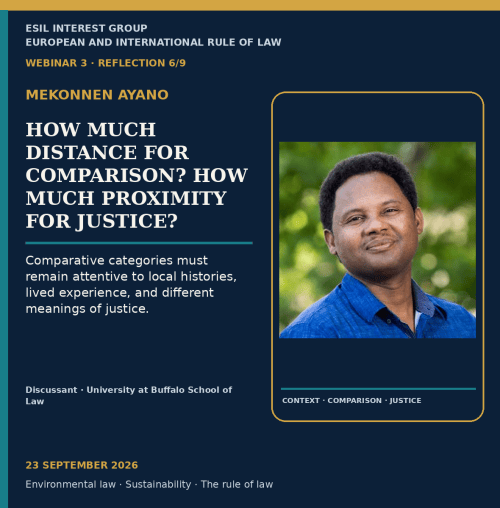

Mekonnen Ayano: How Much Distance for Comparison, How Much Proximity for Justice? – Reflections on ESIL Webinar 3 – Webinar 3 · Reflection 6/9
Mekonnen Ayano’s intervention as discussant in the September 23, 2026 – European Society of International Law (ESIL) Interest Group on European and International Rule of Law Webinar, entitled From Environmental Law in Context to Comparative Environmental Governance: Justice, Sustainability, and the Rule of Law, identified a productive tension between the two books in dialogue. Comparative Environmental Law invites us to look across jurisdictions and identify patterns. Teaching Environmental Law in Context asks us to move closer to histories, social realities, and lived experience. Each perspective reveals something important, and each can leave something outside the frame.
His question gave the discussion a memorable methodological center: “How much distance is necessary for comparison and how much proximity is necessary for justice?”
The value of analytical distance
Mekonnen welcomed the comparative volume’s attention to convergence, divergence, functional equivalence, legal transplants, and dialogical learning. Looking at other systems helps us learn about them and also about our own assumptions. A legal arrangement that appears distinctive from within one jurisdiction may become recognizable as one variation of a wider phenomenon.
He also welcomed the book’s movement beyond the traditional North American and European frame of comparison. A wider perspective can reveal institutional alternatives and experiences that familiar geographical boundaries overlook.
Some distance is necessary for this work. Comparison requires common categories and points of reference. Stepping back can reveal patterns of diffusion, innovation, and difference that a closely focused account may miss.
What distance can conceal
Mekonnen then asked what happens to the factors simplified away in order to make comparison possible. Local histories, inequalities, dispossession, and exclusions may be central to understanding how a legal institution operates. The contextual approach presses those matters into the legal analysis.
His concern did not assign exclusive ownership of context to one book or comparison to the other. He recognized their overlapping commitments. The point was to examine how the analytical perspective itself changes what becomes visible.
A comparative account may show how several systems organize a mechanism. A historical account may explain why it emerged in a particular place. The perspective of a person or community living with its consequences may reveal priorities that neither account captures adequately on its own.
A hydropower example
Mekonnen used a transnational river hydropower project to illustrate these different vantage points. Comparative analysis can identify institutional arrangements. Contextual inquiry can examine the histories within which those arrangements developed. Community experience can raise questions about poverty, development, and the immediate consequences of the project.
Climate, ecology, biodiversity, and the needs of a community facing severe poverty do not necessarily generate identical priorities. The example showed why comparison needs to preserve enough of that complexity to support a meaningful account of justice.
It also gave the webinar a way to consider the limits of common categories. An analytical tool can help organize inquiry while still requiring adjustment when it encounters a different social setting.
Justice as a methodological question
Mekonnen asked whether environmental justice should be a question of method or an additional topic in the comparative field. Does justice shape the categories, perspectives, and information through which comparison is conducted? Or is it studied only after those methodological decisions have already been made?
Carmen Gonzalez’s response clarified the deliberate methodological choice behind Teaching Environmental Law in Context. Justice was integrated into every topic because it changes how each topic is understood. Tseming Yang acknowledged the usefulness of the distance-and-proximity framing. Sara Phillips connected it to socio-legal and empirical approaches that can examine institutional practice and community participation.
The exchange made Mekonnen’s intervention a bridge between the books and a prompt for further research.
Flexible categories and different meanings of justice
In the closing round, Mekonnen returned to incommensurability. Justice in one setting may require something different in another. He called for attention to the balance between flexibility and rigidity and for methods that do not become overly attached to a particular category.
As Chair, Moderator, and Discussant, I understood this as a demanding task for comparative environmental governance. Learning across systems requires concepts that travel, but those concepts must remain responsive to the experiences and priorities encountered along the way.
Mekonnen’s contribution encourages comparison that is broad enough to reveal institutional possibilities and attentive enough to recognize what those possibilities mean in a particular place.
Event information and selected bibliography.
Keywords/tags: Mekonnen Ayano, comparative method, environmental justice, context, incommensurability, hydropower, law and development, Global South, lived experience
This post forms part of the ESIL Interest Group on European and International Rule of Law Webinar Reflections series, which offers accounts of individual contributions and the wider intellectual exchanges generated by each event.
This post forms part of the ESIL Interest Group on European and International Rule of Law Webinar Reflections series, which offers accounts of individual contributions and the wider intellectual exchanges generated by each event.
Explore the Complete Webinar 3 Reflections Series
ESIL Interest Group on European and International Rule of Law Webinar Series
Webinar 3 — From Environmental Law in Context to Comparative Environmental Governance: Justice, Sustainability, and the Rule of Law
September 23, 2026
This nine-part series documents the contributions and intellectual exchanges developed during Webinar 3, examining environmental justice, comparative environmental governance, legal education, sustainability, institutional accountability, and the rule of law.
Reflection 1/9 — Environmental Law, Justice, and Comparative Governance: Reflections on ESIL Webinar 3
[Link forthcoming]
Reflection 2/9 — Rebecca Bratspies: Teaching Environmental Law Through History, Justice, and Power
[Link forthcoming]
Reflection 3/9 — Carmen G. Gonzalez: Environmental Justice in Every Topic, Every Tool, and Every Statute
[Link forthcoming]
Reflection 4/9 — Tseming Yang: Comparative Environmental Law, Legal Cultures, and Learning Across Systems
[Link forthcoming]
Reflection 5/9 — Sara K. Phillips: From Legal Mechanisms to Practical Influence in Environmental Governance
[Link forthcoming]
Reflection 6/9 — Mekonnen Ayano: How Much Distance for Comparison, How Much Proximity for Justice?
[Link forthcoming]
Reflection 7/9 — Chinonso Tansi Anozie: Humanizing Environmental Law and Connecting Sustainability to Energy Justice
[Link forthcoming]
Reflection 8/9 — Paolo Davide Farah: From Comparative Environmental Law to Comparative Environmental Governance—Beyond Rules, Across Institutions and Contexts
[Link forthcoming]
Reflection 9/9 — Paolo Davide Farah: Who Decides What Counts as Knowledge? Environmental Justice and Epistemic Accountability
[Link forthcoming]
Webinar information, speakers, books, and selected bibliography:
https://paolofarah.wordpress.com/2026/09/05/european-society-of-international-law-esil-interest-group-on-european-and-international-rule-of-law-webinar-series-webinar-3-from-environmental-law-in-context-to-comparative-environme/
The ESIL Interest Group on European and International Rule of Law Webinar Reflections Series is conceived, coordinated, and edited by Professor Paolo Davide Farah, Chair of the Interest Group and Chair and Moderator of the Webinar Series. The reflections document and critically engage with the contributions of Rebecca Bratspies, Carmen G. Gonzalez, Tseming Yang, Sara K. Phillips, Mekonnen Ayano, Chinonso Tansi Anozie, and Paolo Davide Farah, recognizing their respective scholarly perspectives and the wider intellectual exchanges generated during the webinar. The series seeks to preserve, develop, and disseminate these contributions as part of an ongoing international scholarly dialogue. The reflections are editorial accounts of the discussions and do not necessarily represent the official positions of the Interest Group or the individual partici
The recording is now available here:
Paolo Davide Farah, Paolo Farah