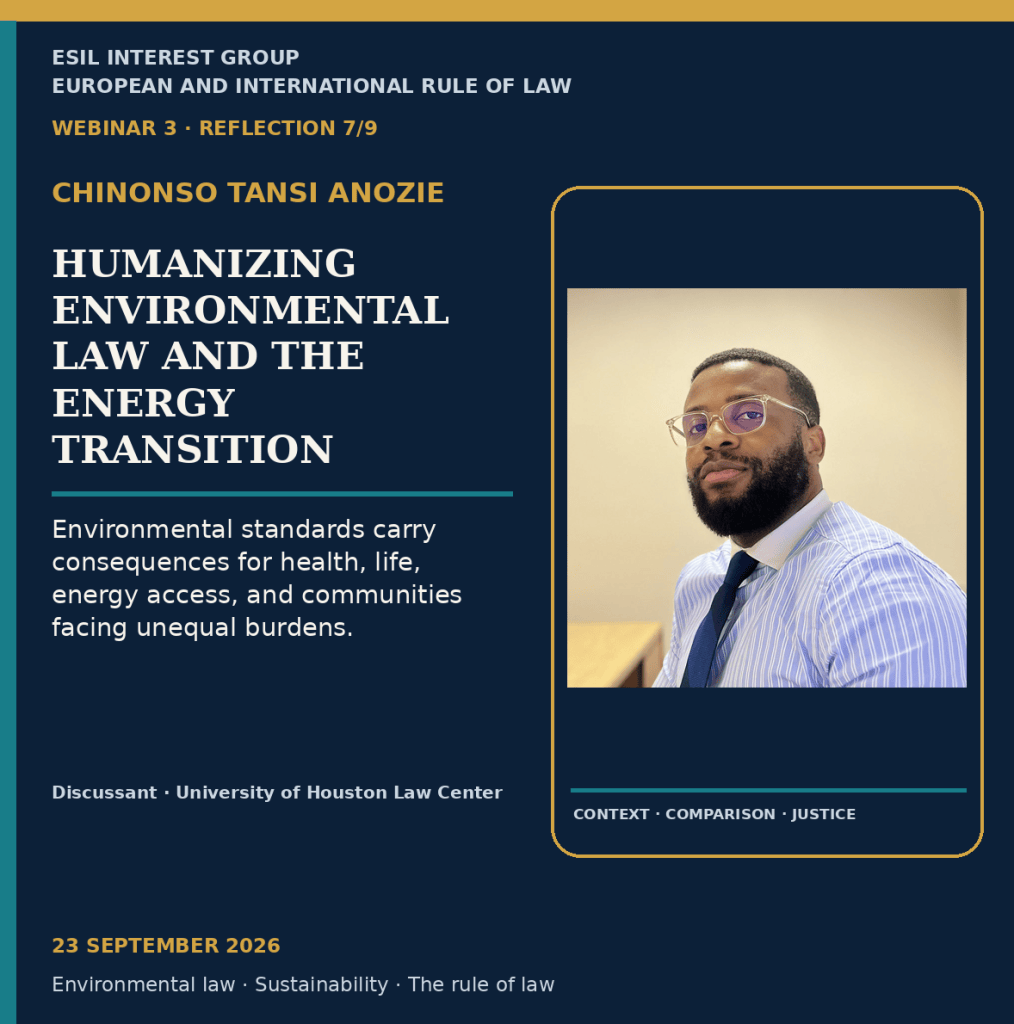


Chinonso Tansi Anozie: Humanizing Environmental Law and Connecting Sustainability to Energy Justice – Reflections on ESIL Webinar 3 – Webinar 3 · Reflection 7/9
Chinonso Tansi Anozie’s contribution as discussant in the September 23, 2026 – European Society of International Law (ESIL) Interest Group on European and International Rule of Law Webinar, entitled From Environmental Law in Context to Comparative Environmental Governance: Justice, Sustainability, and the Rule of Law, connected environmental doctrine to human consequences and then carried that inquiry into energy access, sustainability, and global coordination. He engaged both books while drawing on his teaching of environmental and energy law at the University of Houston Law Center.
His central response to Teaching Environmental Law in Context was the need to humanize environmental regulation. Ambient air-quality standards, water-quality standards, pollutant limits, and permits are technical instruments with consequences for health and life.
Understanding those consequences belongs within the legal analysis.
The people behind regulatory standards
Chinonso asked what environmental numbers represent for the people breathing the air and drinking the water. A standard is connected to whether a community can live safely in a particular place. Treating it only as a regulatory threshold can leave its purpose and distributional implications insufficiently examined.
He used the Houston area, including Pasadena and Baytown, to make the point concrete. Communities differ in their proximity to refineries and other sources of pollution. They also differ in their resources, political influence, and ability to resist or move away from environmental hazards.
Those differences affect the operation of environmental protection. They help explain why the same formal regulatory framework can be experienced differently by people in different places.
Individual consequences and aggregate calculations
Chinonso also questioned what happens when aggregate economic benefits appear to outweigh a severe consequence for a particular person. The distribution of harms remains relevant even when an overall calculation suggests a net benefit.
This concern connected his comments to Carmen Gonzalez’s critique of cost-benefit analysis and Rebecca Bratspies’s question about the purposes of environmental law. The discussion invited closer examination of who benefits, who is exposed, and whether the people bearing the risks have meaningful opportunities to influence the choice.
Chinonso pointed to the book’s teaching exercises as a practical resource for bringing these questions into the classroom. His interest in using an air-pollution exercise showed how the webinar’s conceptual discussion could inform immediate teaching practice.
Learning across systems with attention to conditions
Turning to Comparative Environmental Law, Chinonso welcomed the opportunity to learn from how different countries organize environmental protection. Comparison can help identify common approaches, differences, legal transplants, and experiences of success or failure.
He emphasized adaptation to local circumstances. A mechanism drawn from elsewhere must be considered in relation to the conditions of the jurisdiction in which it will operate. The comparative exercise therefore involves judgment about capacity, needs, and institutional fit.
This made his contribution a useful connection between comparative learning and the practical responsibilities of policymakers.
Energy poverty and global environmental coordination
Chinonso raised a further question about the possibilities of a more coordinated approach to greenhouse gas emissions. He considered how the development trajectories of poorer economies might interact with global mitigation efforts and asked what international institutions should contribute.
Energy access was central to that concern. Countries facing constraints on the availability and affordability of cleaner energy cannot be understood solely through demands for a particular technological pathway. Their needs and capacities form part of the institutional problem that a transition agenda must address.
His intervention was a proposal for further inquiry. The webinar did not establish a single global regulatory model or resolve how common objectives should be combined with different national conditions. Tseming Yang acknowledged climate change as an area for further comparative work.
Sustainability in environmental and energy law
In the closing round, Chinonso called for greater emphasis on sustainability in environmental and energy law teaching. He linked those fields to energy poverty, the Global South, environmental rights, and the difficulties of transition.
As Chair, Moderator, and Discussant, I connected Chinonso’s intervention with the broader questions of energy justice, just transition, and comparative environmental governance that I had developed in preparing the webinar’s Speaker and Moderator Guide, drawing also on my ongoing research in these areas. My preparatory questions had emphasized the need to evaluate climate and energy policies not only through aggregate environmental or economic outcomes, but also through their consequences for disadvantaged communities, the distribution of institutional authority, and the practical availability of participation, remedies, and community benefits.
Chinonso’s contribution enriched this framework by emphasizing the human consequences of environmental standards and by connecting the challenges of energy transition to energy poverty, development needs, and the institutional capacities of countries in the Global South. His intervention highlighted the importance of examining how common environmental objectives interact with unequal resources and different national circumstances. Read alongside the broader questions I introduced concerning just transition and institutional accountability, his analysis underscored that environmental governance must be evaluated not only by its formal regulatory commitments or aggregate achievements, but also by its capacity to protect vulnerable communities and support equitable and sustainable development.
Event information and selected bibliography.
Keywords/tags: Chinonso Tansi Anozie, environmental justice, human health, energy justice, sustainability, energy poverty, energy transition, Global South, comparative environmental law
This post forms part of the ESIL Interest Group on European and International Rule of Law Webinar Reflections series, which offers accounts of individual contributions and the wider intellectual exchanges generated by each event.
Explore the Complete Webinar 3 Reflections Series
ESIL Interest Group on European and International Rule of Law Webinar Series
Webinar 3 — From Environmental Law in Context to Comparative Environmental Governance: Justice, Sustainability, and the Rule of Law
September 23, 2026
This nine-part series documents the contributions and intellectual exchanges developed during Webinar 3, examining environmental justice, comparative environmental governance, legal education, sustainability, institutional accountability, and the rule of law.
Reflection 1/9 — Environmental Law, Justice, and Comparative Governance: Reflections on ESIL Webinar 3
[Link forthcoming]
Reflection 2/9 — Rebecca Bratspies: Teaching Environmental Law Through History, Justice, and Power
[Link forthcoming]
Reflection 3/9 — Carmen G. Gonzalez: Environmental Justice in Every Topic, Every Tool, and Every Statute
[Link forthcoming]
Reflection 4/9 — Tseming Yang: Comparative Environmental Law, Legal Cultures, and Learning Across Systems
[Link forthcoming]
Reflection 5/9 — Sara K. Phillips: From Legal Mechanisms to Practical Influence in Environmental Governance
[Link forthcoming]
Reflection 6/9 — Mekonnen Ayano: How Much Distance for Comparison, How Much Proximity for Justice?
[Link forthcoming]
Reflection 7/9 — Chinonso Tansi Anozie: Humanizing Environmental Law and Connecting Sustainability to Energy Justice
[Link forthcoming]
Reflection 8/9 — Paolo Davide Farah: From Comparative Environmental Law to Comparative Environmental Governance—Beyond Rules, Across Institutions and Contexts
[Link forthcoming]
Reflection 9/9 — Paolo Davide Farah: Who Decides What Counts as Knowledge? Environmental Justice and Epistemic Accountability
[Link forthcoming]
Webinar information, speakers, books, and selected bibliography:
https://paolofarah.wordpress.com/2026/09/05/european-society-of-international-law-esil-interest-group-on-european-and-international-rule-of-law-webinar-series-webinar-3-from-environmental-law-in-context-to-comparative-environme/
The ESIL Interest Group on European and International Rule of Law Webinar Reflections Series is conceived, coordinated, and edited by Professor Paolo Davide Farah, Chair of the Interest Group and Chair and Moderator of the Webinar Series. The reflections document and critically engage with the contributions of Rebecca Bratspies, Carmen G. Gonzalez, Tseming Yang, Sara K. Phillips, Mekonnen Ayano, Chinonso Tansi Anozie, and Paolo Davide Farah, recognizing their respective scholarly perspectives and the wider intellectual exchanges generated during the webinar. The series seeks to preserve, develop, and disseminate these contributions as part of an ongoing international scholarly dialogue. The reflections are editorial accounts of the discussions and do not necessarily represent the official positions of the Interest Group or the individual partici
The recording is now available here:

Paolo Davide Farah, Paolo Farah