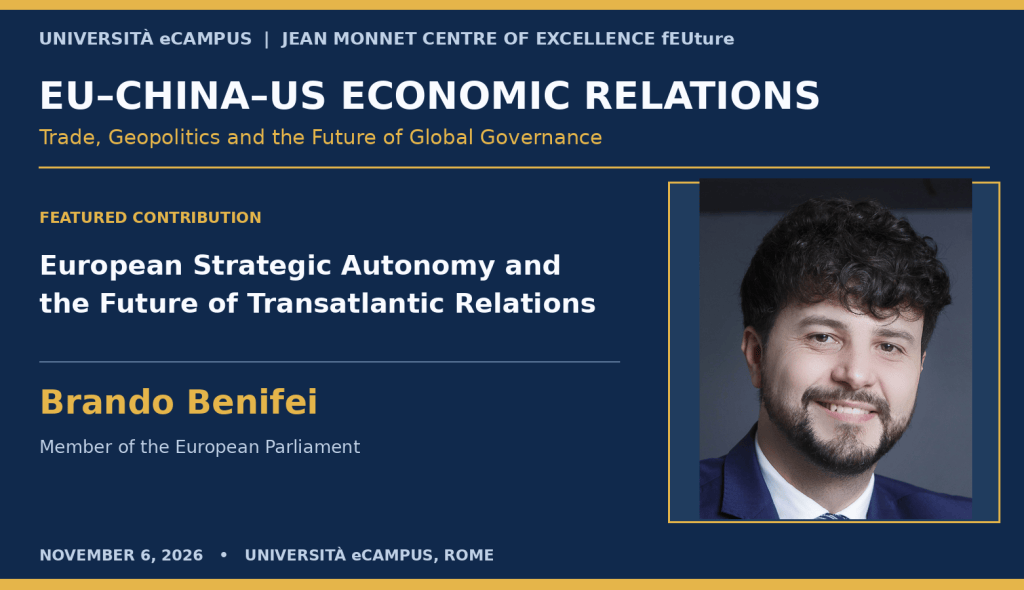


Brando Benifei: European Strategic Autonomy: Economic Security, Digital Sovereignty, and Cooperation with China and the United States – Workshop on EU–China–US Economic Relations: Trade, Geopolitics and the Future of Global Governance | Part 2
EU–China–US Economic Relations: Trade, Geopolitics and the Future of Global Governance | Part 2
Brando Benifei: Sovereignty Means Having Alternatives – What does European sovereignty mean when critical technologies, industrial supply chains, and digital infrastructure depend on actors outside the European Union?
At our November 6, 2026 Workshop on EU–China–US Economic Relations: Trade, Geopolitics and the Future of Global Governance, Brando Benifei, Member of the European Parliament and Chair of its Delegation for Relations with the United States, offered an institutional perspective informed by his work on international trade, transatlantic relations, and the EU Artificial Intelligence Act.
Drawing on his engagement with US lawmakers and a recent European Parliament trade delegation to Beijing, Brando examined the growing importance of economic security in European policymaking.
He discussed the shift from a framework centered primarily on economic efficiency toward one that gives greater weight to resilience, industrial capacity, strategic dependencies, and supply-chain security.
His intervention addressed initiatives concerning semiconductors, cloud and AI infrastructure, public procurement, and European industrial policy, while recognizing the tensions between domestic industrial support and international trade commitments.
One of his most important arguments was that strategic autonomy should not be confused with isolation.
European sovereignty, in his account, requires credible alternatives: the ability to diversify dependencies, negotiate without excessive external pressure, and preserve regulatory choices.
He also emphasized that stronger European political integration is necessary to translate these ambitions into effective policies.
Particularly relevant to our wider discussion was his observation that global governance of systemic AI risks cannot realistically exclude either the United States or China.
This connects directly to the question I raised during the workshop: how can Europe preserve its regulatory autonomy while remaining an active participant in an interconnected global economy?
Thank you, Brando, for contributing these valuable perspectives to our discussion.
 Full workshop report: [INSERT REPORT LINK]
#EuropeanUnion #StrategicAutonomy #EconomicSecurity #AIAct #Semiconductors #InternationalTrade #GlobalGovernance