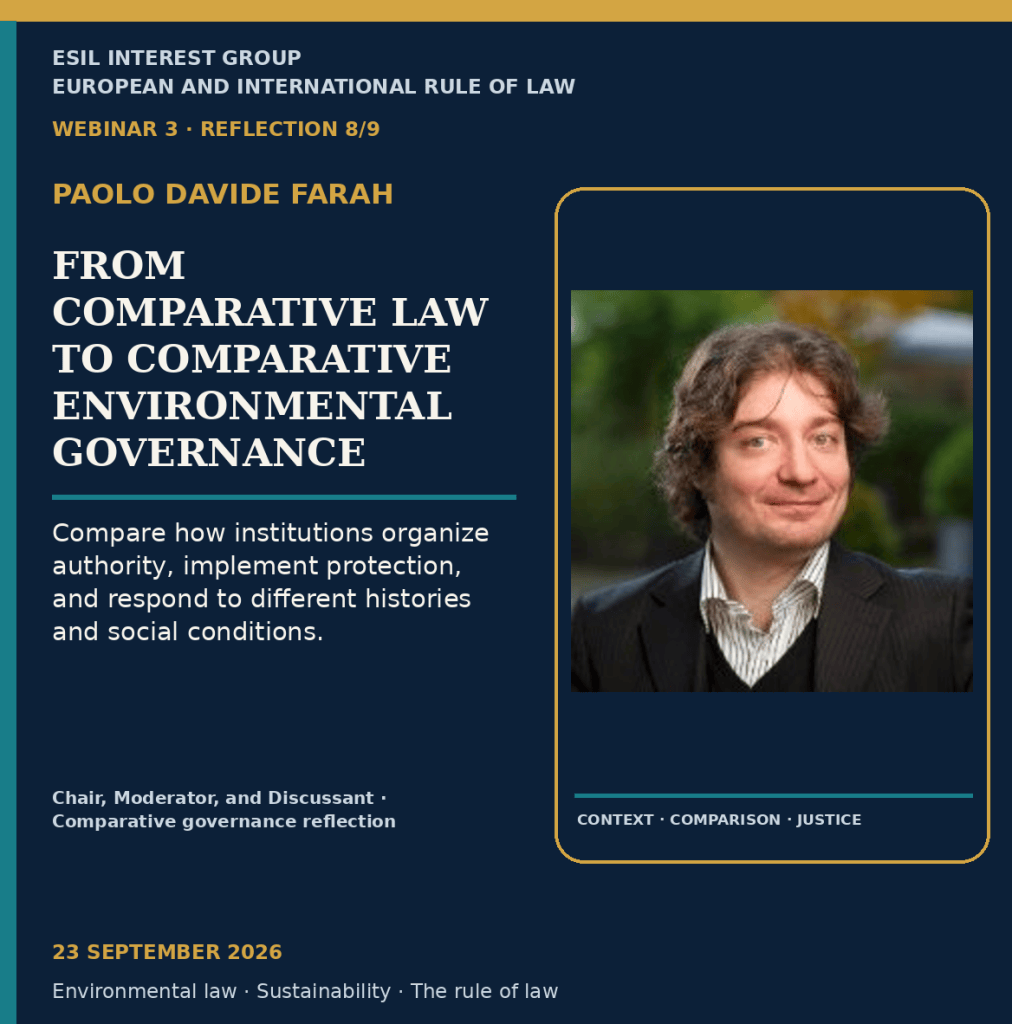
Paolo Davide Farah: From Comparative Environmental Law to Comparative Environmental Governance—Beyond Rules, Across Institutions and Contexts – Reflections on ESIL Webinar 3 – Webinar 3 · Reflection 8/9
Our September 23, 2026 – European Society of International Law (ESIL) Interest Group on European and International Rule of Law Webinar, entitled From Environmental Law in Context to Comparative Environmental Governance: Justice, Sustainability, and the Rule of Law, deliberately connected environmental law in context to comparative environmental governance. As organizer, Chair, Moderator, and Discussant, I wanted the two books to generate a conversation about the institutions and conditions through which environmental rules acquire practical meaning.
Teaching Environmental Law in Context and Comparative Environmental Law offered different routes into that inquiry. One examined doctrine alongside histories, social realities, and environmental justice. The other opened the comparison across jurisdictions and legal traditions. Bringing them together allowed us to ask what comparison should investigate and what information it needs in order to be useful.
Rules in their institutional setting
After the book presentations, I emphasized that environmental law is commonly organized as a specialized collection of statutes, regulations, judicial doctrines, scientific standards, and administrative procedures. Those materials are indispensable, but their operation depends on history, political economy, institutional capacity, scientific judgment, social conflict, and distributive choices.
A comparison of legal texts can therefore become the beginning of a larger investigation. We need to understand how authority is distributed among legislatures, agencies, courts, scientists, markets, and affected communities. We also need to examine how those institutions interact and what their decisions mean for the people living with the consequences.
This was the broader comparative theme in my contributions. It is closely connected to, but can be developed separately from, the epistemic-governance argument that I also introduced during the webinar.
Different routes into institutional comparison
Tseming Yang’s presentation identified tools for examining legal mechanisms across systems: functional equivalence, legal history, comparative legal cultures, and legal transplants. These tools help reveal why similar problems can produce different legal responses and why a mechanism’s meaning may change as it moves.
Sara Phillips made the question operational. Environmental impact assessment can appear across many systems while carrying different consequences. Mining governance can combine public regulation, assessment, contractual arrangements, corporate standards, and investment protections. The practical effects of one mechanism depend on how it interacts with the others.
Mekonnen Ayano added a methodological challenge. Comparison needs enough distance to reveal patterns and enough proximity to understand context and justice. The categories used across systems must be able to respond to different local meanings and priorities.
These contributions offered complementary ways to develop an institutional comparison. They also cautioned against assuming that a shared label or formal mechanism establishes equivalent protection.
History, power, and the purposes of protection
Rebecca Bratspies and Carmen Gonzalez showed how historical and contextual inquiry can make the purposes of environmental law clearer. Their presentations connected regulatory tools to cumulative harms, community experience, and the choices through which protection is organized.
Rebecca’s discussion of the status quo asked which existing burdens escape demands for justification. Carmen’s examination of assessment and valuation methods showed how institutional choices can affect the distribution of protection. These questions belong within a comparison of governance because they help explain what a legal arrangement is doing in practice.
Chinonso Tansi Anozie widened the frame to sustainability, energy access, and the conditions of transition. His contribution illustrated why a comparative analysis needs to consider different development needs and institutional capacities alongside common environmental objectives.
Legal pluralism and interdisciplinary inquiry
Responding to Sara’s comments, I connected the conversation to legal pluralism and to work across public policy, philosophy, legal theory, the social sciences, and the humanities. I also identified science, technology, and society research as an important area of engagement for environmental law.
These connections matter because environmental decisions often involve several forms of authority and several kinds of institutional practice. Legal categories interact with scientific assessment, public administration, economic arrangements, and community norms. Courts and agencies are part of that wider setting.
An interdisciplinary approach can help lawyers investigate those relationships while retaining the precision of legal analysis. It also opens questions for empirical inquiry into how protection, participation, and accountability actually operate.
A wider comparative agenda
The webinar reinforced my view that comparative environmental governance offers a useful frame for learning across legal systems. It asks how institutions organize protection, how they distribute authority and responsibility, and how their arrangements respond to different histories and social conditions.
This reflection develops that institutional and methodological aspect of my contributions. The next addresses the distinct question of epistemic accountability: how environmental institutions decide which knowledge is relevant, whose expertise is credible, and which perspectives remain outside the decision process.
Event information and selected bibliography.
Keywords/tags: Paolo Davide Farah, comparative environmental governance, institutional design, legal pluralism, interdisciplinary research, science technology and society, environmental justice, context and comparison, rule of law
This post forms part of the ESIL Interest Group on European and International Rule of Law Webinar Reflections series, which offers accounts of individual contributions and the wider intellectual exchanges generated by each event.
Explore the Complete Webinar 3 Reflections Series
ESIL Interest Group on European and International Rule of Law Webinar Series
Webinar 3 — From Environmental Law in Context to Comparative Environmental Governance: Justice, Sustainability, and the Rule of Law
September 23, 2026
This nine-part series documents the contributions and intellectual exchanges developed during Webinar 3, examining environmental justice, comparative environmental governance, legal education, sustainability, institutional accountability, and the rule of law.
Reflection 1/9 — Environmental Law, Justice, and Comparative Governance: Reflections on ESIL Webinar 3
[Link forthcoming]
Reflection 2/9 — Rebecca Bratspies: Teaching Environmental Law Through History, Justice, and Power
[Link forthcoming]
Reflection 3/9 — Carmen G. Gonzalez: Environmental Justice in Every Topic, Every Tool, and Every Statute
[Link forthcoming]
Reflection 4/9 — Tseming Yang: Comparative Environmental Law, Legal Cultures, and Learning Across Systems
[Link forthcoming]
Reflection 5/9 — Sara K. Phillips: From Legal Mechanisms to Practical Influence in Environmental Governance
[Link forthcoming]
Reflection 6/9 — Mekonnen Ayano: How Much Distance for Comparison, How Much Proximity for Justice?
[Link forthcoming]
Reflection 7/9 — Chinonso Tansi Anozie: Humanizing Environmental Law and Connecting Sustainability to Energy Justice
[Link forthcoming]
Reflection 8/9 — Paolo Davide Farah: From Comparative Environmental Law to Comparative Environmental Governance—Beyond Rules, Across Institutions and Contexts
[Link forthcoming]
Reflection 9/9 — Paolo Davide Farah: Who Decides What Counts as Knowledge? Environmental Justice and Epistemic Accountability
[Link forthcoming]
Webinar information, speakers, books, and selected bibliography:
https://paolofarah.wordpress.com/2026/09/05/european-society-of-international-law-esil-interest-group-on-european-and-international-rule-of-law-webinar-series-webinar-3-from-environmental-law-in-context-to-comparative-environme/
The ESIL Interest Group on European and International Rule of Law Webinar Reflections Series is conceived, coordinated, and edited by Professor Paolo Davide Farah, Chair of the Interest Group and Chair and Moderator of the Webinar Series. The reflections document and critically engage with the contributions of Rebecca Bratspies, Carmen G. Gonzalez, Tseming Yang, Sara K. Phillips, Mekonnen Ayano, Chinonso Tansi Anozie, and Paolo Davide Farah, recognizing their respective scholarly perspectives and the wider intellectual exchanges generated during the webinar. The series seeks to preserve, develop, and disseminate these contributions as part of an ongoing international scholarly dialogue. The reflections are editorial accounts of the discussions and do not necessarily represent the official positions of the Interest Group or the individual participants.
The recording is now available here:

Paolo Davide Farah, Paolo Farah