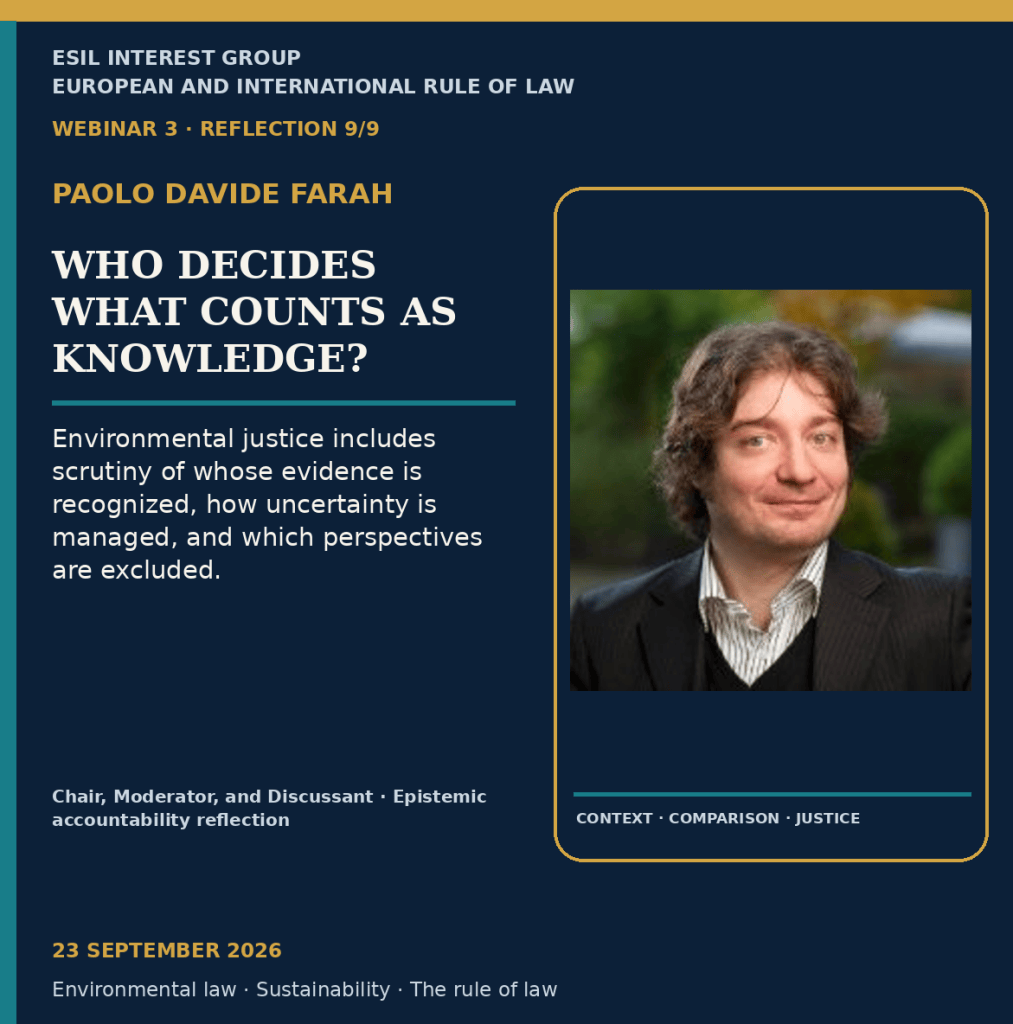

Paolo Davide Farah: Who Decides What Counts as Knowledge? Environmental Justice and Epistemic Accountability | ESIL Webinar Series · Webinar 3 – Reflection 9/9
Who decides what counts as knowledge in environmental law? Who determines which scientific models are credible, which risks are legally relevant, whose experiences constitute admissible evidence, and which uncertainties justify regulatory intervention?
These questions were central to the framework of epistemic governance that I brought to the third webinar of the European Society of International Law (ESIL) Interest Group on European and International Rule of Law, held on September 23, 2026, and entitled From Environmental Law in Context to Comparative Environmental Governance: Justice, Sustainability, and the Rule of Law. As organizer, Chair, Moderator, and Discussant, I drew on my ongoing research concerning the relationship between knowledge, expertise, institutional authority, and legal legitimacy to explore how environmental law governs not only environmental conduct, but also the production, evaluation, and recognition of knowledge.
Before an institution decides what should be prohibited, permitted, regulated, or compensated, it must first establish what the relevant environmental problem is. It must determine which evidence counts, whose expertise is credible, how environmental risks are defined, and how much uncertainty is acceptable. These decisions shape which environmental harms become legally visible, which forms of knowledge acquire institutional authority, and which communities are able to participate meaningfully in regulatory decision-making.
The contributions of Rebecca Bratspies, Carmen G. Gonzalez, Tseming Yang, Sara K. Phillips, Mekonnen Ayano, and Chinonso Tansi Anozie provided distinct perspectives through which these questions could be further examined, challenged, and developed. Their interventions enriched the discussion and helped illuminate the relationship between environmental justice, comparative governance, and epistemic accountability, while the overarching framework of epistemic governance drew on my existing research and the intellectual questions I had introduced in preparing and moderating the webinar.
Environmental law and the visibility of harm
My first proposition was that environmental law helps determine which harms become legally visible. Institutions encounter scientific information, community experience, uncertainty, and competing accounts of a problem through categories and procedures that shape what they can recognize.
The relationship between law and knowledge therefore needs examination within environmental governance. A question about protection is also a question about the information through which the need for protection is established.
Rebecca Bratspies and Carmen Gonzalez’s discussion offered concrete examples of why this matters. Cumulative exposure can disappear from an assessment organized around individual chemicals or facilities. A community’s reports can receive a different response from an institutionally recognized account. Historical inquiry can reveal how the accepted problem definition emerged.
The epistemic dimension of environmental justice
My second proposition concerned power. Environmental justice asks who bears burdens and receives benefits. It also asks who has the institutional power to define a problem and establish the authoritative knowledge about it.
The recognition of an environmental claim can depend on whether the people making it can enter the relevant process and challenge its assumptions. Decisions about expertise and credibility affect which groups become visible within law and which remain outside its effective protection.
This connects community participation to more than the opportunity to submit information. The question is whether affected people can influence how a problem is described, what evidence is sought, and how the institution evaluates it.
Comparing the allocation of epistemic authority
My third proposition connected this inquiry to comparative environmental law. Comparison can examine the allocation of authority among scientists, courts, agencies, communities, Indigenous knowledge holders, legislators, and markets.
Different systems may organize that authority differently even when their statutes address similar problems. Investigating those arrangements can reveal how knowledge becomes authoritative and how particular perspectives gain or lose institutional influence.
Sara Phillips’s response brought this concern into the practical setting of environmental assessment. Her proposed empirical inquiry asked whether communities can shape evidence, define issues, and influence decisions. Mekonnen Ayano’s intervention added a related methodological point: analytical distance and comparative categories affect what researchers can observe.
A conversation about methods and institutional choices
Carmen Gonzalez responded directly to my comments by examining cost-benefit analysis and quantitative risk assessment. Her account showed why methods should be studied through their history, assumptions, informational limits, and distributional effects. These choices influence what institutions treat as a regulatory problem.
Rebecca asked who determines the problem that environmental law is meant to solve and whose stories receive attention. Sara connected recognized knowledge to competing normative arrangements and differences in authority. Their responses developed the epistemic inquiry through distinct examples and methods.
The exchange did not produce a uniform institutional blueprint. It did establish a set of questions that can be carried into legal education, comparative research, and the evaluation of administrative practice.
Epistemic accountability
In the closing round, I proposed epistemic accountability as my priority. Environmental institutions should make transparent what knowledge counts, what expertise is recognized, how uncertainty is managed, and which perspectives are excluded.
That proposal concerns the reasons and processes through which a decision is made. Transparency about a final outcome needs to be accompanied by the ability to understand and scrutinize its evidentiary foundations. The proposal also invites attention to how affected people can challenge exclusions and assumptions that shape the result.
For me, environmental justice must therefore include epistemic justice. The people living with an environmental decision need meaningful opportunities to contest how their experience is understood and how the problem is framed.
This final reflection complements the preceding post on comparative environmental governance. Together, they develop two connected contributions from the webinar: the institutional organization of environmental protection and the accountability of the knowledge through which that protection is defined.
Event information and selected bibliography. Epistemic Governance.
Keywords/tags: Paolo Davide Farah, epistemic governance, epistemic accountability, epistemic justice, environmental justice, scientific expertise, Indigenous knowledge, community knowledge, evidence, rule of law
This post forms part of the ESIL Interest Group on European and International Rule of Law Webinar Reflections series, which offers accounts of individual contributions and the wider intellectual exchanges generated by each event.
Explore the Complete Webinar 3 Reflections Series
ESIL Interest Group on European and International Rule of Law Webinar Series
Webinar 3 — From Environmental Law in Context to Comparative Environmental Governance: Justice, Sustainability, and the Rule of Law
September 23, 2026
This nine-part series documents the contributions and intellectual exchanges developed during Webinar 3, examining environmental justice, comparative environmental governance, legal education, sustainability, institutional accountability, and the rule of law.
Reflection 1/9 — Environmental Law, Justice, and Comparative Governance: Reflections on ESIL Webinar 3
[Link forthcoming]
Reflection 2/9 — Rebecca Bratspies: Teaching Environmental Law Through History, Justice, and Power
[Link forthcoming]
Reflection 3/9 — Carmen G. Gonzalez: Environmental Justice in Every Topic, Every Tool, and Every Statute
[Link forthcoming]
Reflection 4/9 — Tseming Yang: Comparative Environmental Law, Legal Cultures, and Learning Across Systems
[Link forthcoming]
Reflection 5/9 — Sara K. Phillips: From Legal Mechanisms to Practical Influence in Environmental Governance
[Link forthcoming]
Reflection 6/9 — Mekonnen Ayano: How Much Distance for Comparison, How Much Proximity for Justice?
[Link forthcoming]
Reflection 7/9 — Chinonso Tansi Anozie: Humanizing Environmental Law and Connecting Sustainability to Energy Justice
[Link forthcoming]
Reflection 8/9 — Paolo Davide Farah: From Comparative Environmental Law to Comparative Environmental Governance—Beyond Rules, Across Institutions and Contexts
[Link forthcoming]
Reflection 9/9 — Paolo Davide Farah: Who Decides What Counts as Knowledge? Environmental Justice and Epistemic Accountability
[Link forthcoming]
Webinar information, speakers, books, and selected bibliography:
https://paolofarah.wordpress.com/2026/09/05/european-society-of-international-law-esil-interest-group-on-european-and-international-rule-of-law-webinar-series-webinar-3-from-environmental-law-in-context-to-comparative-environme/
The ESIL Interest Group on European and International Rule of Law Webinar Reflections Series is conceived, coordinated, and edited by Professor Paolo Davide Farah, Chair of the Interest Group and Chair and Moderator of the Webinar Series. The reflections document and critically engage with the contributions of Rebecca Bratspies, Carmen G. Gonzalez, Tseming Yang, Sara K. Phillips, Mekonnen Ayano, Chinonso Tansi Anozie, and Paolo Davide Farah, recognizing their respective scholarly perspectives and the wider intellectual exchanges generated during the webinar. The series seeks to preserve, develop, and disseminate these contributions as part of an ongoing international scholarly dialogue. The reflections are editorial accounts of the discussions and do not necessarily represent the official positions of the Interest Group or the individual participants.
The recording is now available here:
Paolo Davide Farah, Paolo Farah