
ESIL Webinar 3 — Complete Nine-Part Reflections Series and Concluding Synthesis: Environmental Justice, Comparative Governance, Sustainability, and the Rule of Law
European Society of International Law (ESIL)
Interest Group on European and International Rule of Law
Webinar 3 — September 23, 2026
From Environmental Law in Context to Comparative Environmental Governance: Justice, Sustainability, and the Rule of Law
Nine Reflections, One Continuing Scholarly Conversation
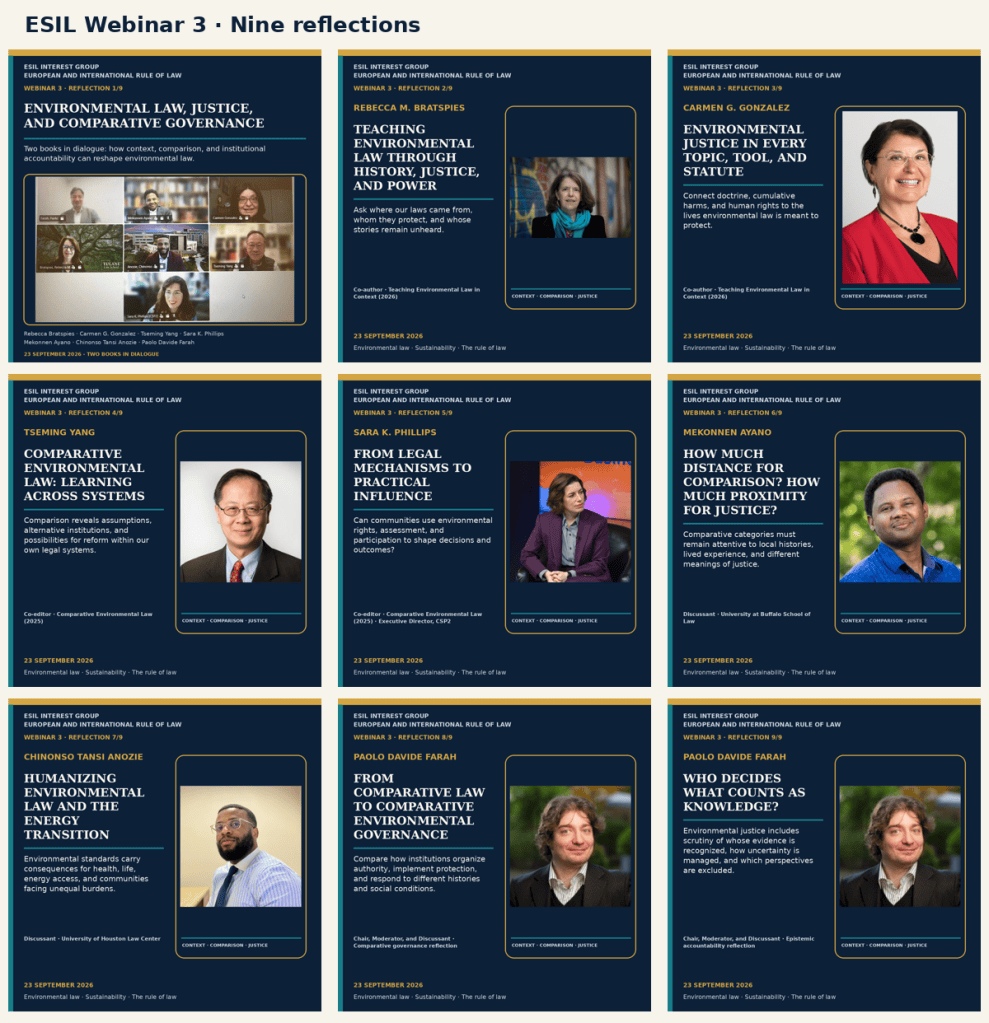
Between November 10 and November 18, 2026, I published a nine-part series of scholarly reflections following the third webinar of the ESIL Interest Group on European and International Rule of Law, which I conceived, organized, chaired, and moderated on September 23, 2026.
The webinar brought together six distinguished scholars and practitioners to discuss two important publications:
- Rebecca M. Bratspies and Carmen G. Gonzalez, Teaching Environmental Law in Context (Edward Elgar Publishing, 2026).
- Tseming Yang, Anastasia Telesetsky, and Sara K. Phillips (eds.), Comparative Environmental Law (Edward Elgar Publishing, 2025).
The discussion explored how contextual and comparative approaches can deepen our understanding of environmental law, environmental justice, sustainability, legal education, institutional accountability, and the rule of law.
The subsequent nine reflections were conceived not simply as summaries of individual presentations, but as an opportunity to preserve, develop, and critically engage with the intellectual exchanges generated during the webinar.
This concluding post brings together all nine published reflections, with direct links to each contribution, alongside the complete webinar recording and supporting scholarly materials.
The Complete Nine-Part Reflections Series
Reflection 1/9 — November 10, 2026
Environmental Law, Justice, and Comparative Governance: Reflections on ESIL Webinar 3
An introduction to the webinar’s intellectual framework and the connections between contextual environmental legal education, comparative environmental governance, justice, sustainability, and the rule of law.
Reflection 2/9 — November 11, 2026
Rebecca Bratspies: Teaching Environmental Law Through History, Justice, and Power
Rebecca Bratspies examines how history, power, and the experiences of affected communities can transform environmental legal education and reveal the assumptions underlying regulatory systems.
Reflection 3/9 — November 12, 2026
Carmen G. Gonzalez: Environmental Justice in Every Topic, Every Tool, and Every Statute
Carmen G. Gonzalez develops an approach that places environmental justice throughout environmental law rather than treating it as a separate or peripheral subject, questioning how regulatory tools distribute environmental protection and burdens.
Reflection 4/9 — November 13, 2026
Tseming Yang: Comparative Environmental Law, Legal Cultures, and Learning Across Systems
Tseming Yang explores the intellectual and practical possibilities of comparative environmental law, including the relationships between legal traditions, institutional diversity, regulatory learning, and environmental protection.
Reflection 5/9 — November 14, 2026
Sara K. Phillips: From Legal Mechanisms to Practical Influence in Environmental Governance
Sara K. Phillips examines the practical operation of environmental legal mechanisms, particularly environmental impact assessment, mining governance, Indigenous participation, and the distinction between formal legal rights and meaningful influence over decisions.
Reflection 6/9 — November 15, 2026
Mekonnen Ayano: How Much Distance for Comparison, How Much Proximity for Justice?
Mekonnen Ayano raises a fundamental methodological question about the relationship between comparative legal analysis and contextual justice, exploring how different perspectives reveal or obscure histories, inequalities, development needs, and lived experiences.
Reflection 7/9 — November 16, 2026
Chinonso Tansi Anozie: Humanizing Environmental Law and Connecting Sustainability to Energy Justice
Chinonso Tansi Anozie connects environmental regulation to its human consequences, examining energy poverty, environmental and energy justice, sustainable development, and the challenges facing communities and countries in the Global South.
Reflection 8/9 — November 17, 2026
My first concluding reflection develops the conceptual transition from comparing environmental legal rules to examining the wider institutional, political, social, and epistemic relationships through which environmental governance operates.
It emphasizes legal pluralism, institutional authority, interdisciplinary research, and the importance of examining regulatory practices and outcomes across different contexts.
Reflection 9/9 — November 18, 2026
My final reflection connects the webinar’s intellectual exchanges with my broader research on epistemic governance.
It asks who determines which knowledge counts in environmental decision-making, whose expertise is recognized, how environmental risks become legally visible, and whether affected communities can challenge the assumptions and evidentiary frameworks underlying regulatory decisions.
The reflection develops the idea of epistemic accountability as an essential dimension of environmental justice and the rule of law.
Concluding Synthesis: From Environmental Law to Environmental Governance and Epistemic Accountability
Taken together, the nine reflections reveal several closely connected intellectual themes.
First, environmental law must be understood in context. Historical experience, social inequality, institutional power, and the distribution of environmental burdens are not external considerations. They shape how legal rules emerge, operate, and affect communities.
Second, comparative environmental law must move beyond the formal comparison of statutes and regulatory mechanisms. Understanding environmental governance requires examining institutions, implementation, competing normative systems, legal cultures, and the practical consequences of regulatory choices.
Third, environmental justice is both a substantive and methodological concern. It affects not only how environmental harms and benefits are distributed but also which questions researchers ask, which perspectives they adopt, and which experiences their analyses recognize.
Fourth, legal pluralism and institutional complexity are central to environmental governance. State regulation, international obligations, corporate practices, community norms, Indigenous legal orders, and scientific institutions can interact in ways that complicate conventional accounts of legal authority and accountability.
Fifth, environmental governance requires epistemic accountability. Environmental institutions do not merely apply rules to pre-existing problems. They also participate in defining problems, recognizing evidence, selecting expertise, evaluating uncertainty, and determining whose knowledge can influence decisions.
This final point connects the entire series to a broader question: Who has the authority to define environmental problems, determine what counts as reliable knowledge, and decide which communities and interests receive legal recognition and protection?
The answers matter for environmental justice, democratic participation, institutional legitimacy, and the international rule of law.
The webinar and the subsequent reflections do not suggest that a single model of environmental governance can resolve these challenges. Rather, they demonstrate the importance of sustained dialogue among legal scholars, scientists, policymakers, practitioners, and affected communities.
Watch the Complete Webinar and Explore the Publications
Full webinar recording: Watch ESIL Webinar 3 on YouTube
Complete program, speakers, featured books, and bibliography: ESIL Webinar 3 – Event Information
A Continuing Scholarly Resource
I am grateful to Rebecca Bratspies, Carmen G. Gonzalez, Tseming Yang, Sara K. Phillips, Mekonnen Ayano, and Chinonso Tansi Anozie for their contributions to the webinar and the intellectual exchanges that made this reflections series possible.
I hope that bringing the nine contributions together in one place will make the series more accessible and useful for research, teaching, and further international scholarly collaboration.
The ESIL Interest Group on European and International Rule of Law Webinar Reflections Series is conceived, coordinated, and edited by Professor Paolo Davide Farah, University of Tulsa College of Law, Chair of the Interest Group and Chair and Moderator of the Webinar Series.
The reflections are editorial accounts of the discussions and do not necessarily represent the official positions of the Interest Group or the individual participants.
#ESIL #InternationalLaw #EnvironmentalLaw #EnvironmentalJustice #ComparativeEnvironmentalLaw #EnvironmentalGovernance #RuleOfLaw #Sustainability #EpistemicGovernance #LegalPluralism

