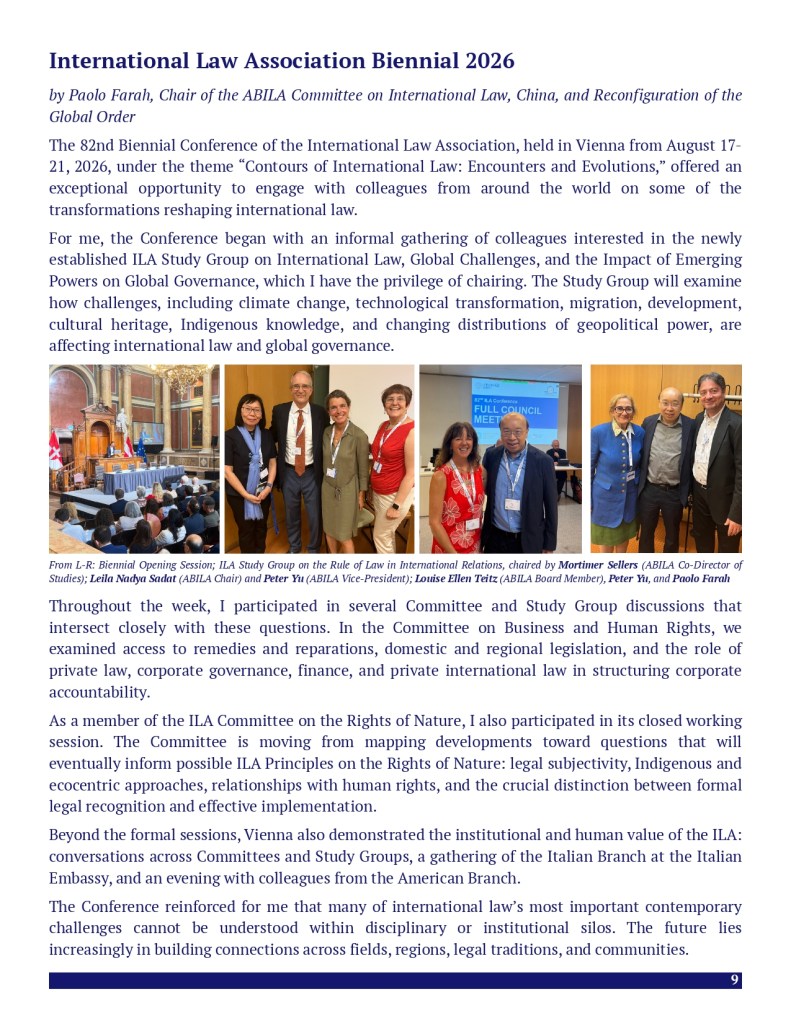
Building Connections Across International Law: Reflections from the ILA Vienna Conference in the ABILA Summer/Fall Newsletter
I am pleased to share that the Summer/Fall 2026 Newsletter of the American Branch of the International Law Association (ABILA) includes my reflections on the 82nd Biennial Conference of the International Law Association, held in Vienna from August 17–21, 2026 under the theme “Contours of International Law: Encounters and Evolutions.”
The full post is available at https://paolofarah.wordpress.com/2026/10/07/building-connections-across-international-law-reflections-from-the-ila-vienna-conference-in-the-abila-summer-fall-newsletter/
The full Summer/Fall 2026 ABILA Newsletter is available here: https://paolofarah.wordpress.com/wp-content/uploads/2026/10/summerfall-26-newsletter-web.pdf
My contribution, “International Law Association Biennial 2026,” reflects on a week that brought together many of the questions that increasingly shape my own research and institutional work: the transformation of international law in a more plural and multipolar world, the growing importance of emerging powers, technological and environmental change, human rights, Indigenous knowledge, corporate accountability, and new understandings of the relationship between humanity and nature.
The Vienna Conference was particularly significant because it provided the first opportunity for in-person discussions around the newly established ILA Study Group on “International Law, Global Challenges, and the Impact of Emerging Powers on Global Governance,” which I have the privilege of chairing.
The Study Group begins from a deliberately broad question: how are major global transformations changing international law itself and the institutions through which global governance operates?
Climate change, technological transformation and artificial intelligence, migration, development, cultural heritage, Indigenous knowledge, and changing distributions of geopolitical and economic power may appear to belong to separate legal fields. Increasingly, however, they intersect. Understanding those intersections—and the different perspectives brought by emerging powers, the Global South, regional institutions, Indigenous communities, and different legal traditions—is central to the work we hope to develop through the Study Group.
Vienna also offered an important opportunity to engage across other areas of the ILA’s work. In the Committee on Business and Human Rights, discussions addressed remedies and reparations, domestic and regional legislation, and the roles of private law, corporate governance, finance, and private international law in structuring corporate accountability.
As a member of the ILA Committee on the Rights of Nature, I also participated in its working discussions as the Committee moves from mapping legal developments toward deeper questions concerning legal subjectivity, Indigenous and ecocentric approaches, the relationship between Rights of Nature and human rights, and the difference between formal legal recognition and effective implementation.
What became particularly clear across these different conversations was that many of the central challenges confronting international law can no longer be understood within isolated doctrinal or institutional silos.
Questions about development are also questions about climate and energy. Questions about technology are increasingly questions about human rights, knowledge, inequality, sovereignty, and governance. Debates about emerging powers are simultaneously debates about legal pluralism, international institutions, development models, and the distribution of authority within the global order.
For that reason, one sentence from my Newsletter reflection perhaps best captures what I took away from Vienna:
The future of international law increasingly lies in building connections across fields, regions, legal traditions, and communities.
I am grateful to the American Branch of the International Law Association for providing the opportunity to contribute these reflections and for highlighting the work taking place across the ILA following the Vienna Biennial.
The conversations begun in Vienna are continuing, and I look forward to developing many of them further through the new ILA Study Group and through dialogue across the Association’s Committees, Study Groups, Branches, and wider international legal community.
The full post is available at https://paolofarah.wordpress.com/2026/10/07/building-connections-across-international-law-reflections-from-the-ila-vienna-conference-in-the-abila-summer-fall-newsletter/
The full Summer/Fall 2026 ABILA Newsletter is available here: https://paolofarah.wordpress.com/wp-content/uploads/2026/10/summerfall-26-newsletter-web.pdf
Paolo Davide Farah, Paolo Farah