What Happens When Governments Increasingly Rely on AI Systems that They May Not Have The Capacity to Fully Understand, Audit, or Contest?
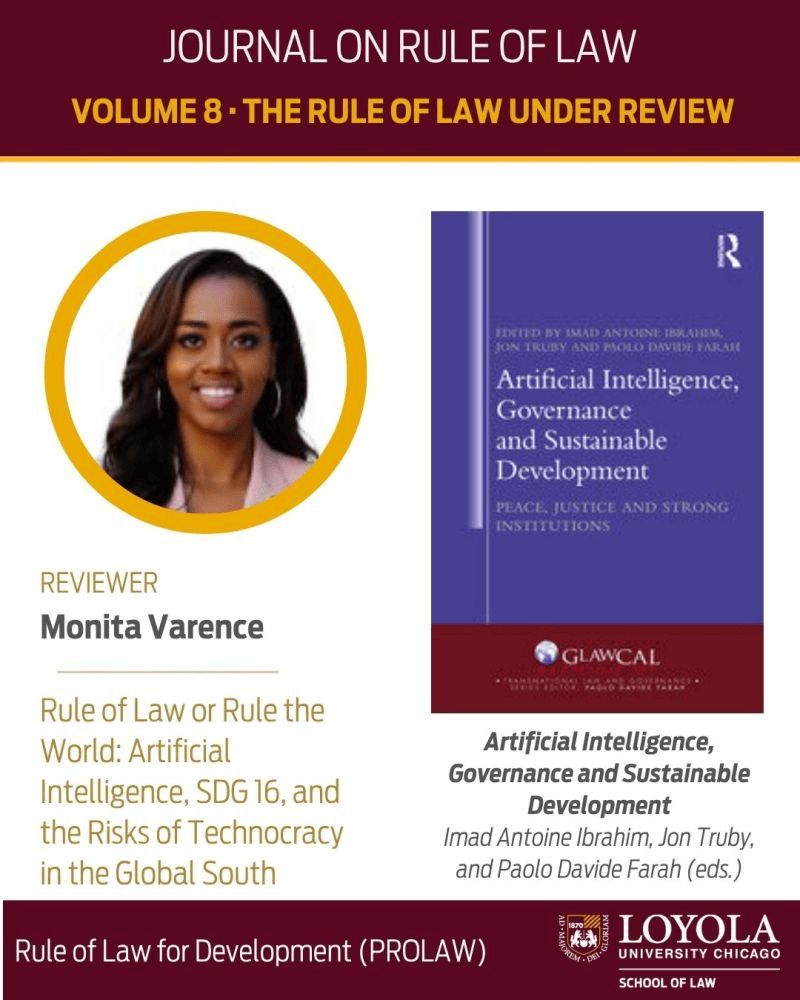
A thoughtful new review of our Routledge and gLAWcal – Global Law Initiatives for Sustainable Development volume, Artificial Intelligence, Governance and Sustainable Development: Peace, Justice and Strong Institutions, by Monita Varence LLM, LLB, BBA in the Journal on Rule of Law, brings particular attention to this question through the relationship between AI governance, institutional capacity, and sovereignty in the Global South.
The full book review can be found here.
The review highlights an important tension running through the volume: AI can offer significant opportunities for more effective institutions, access to justice, anti-corruption efforts, and governance, while at the same time creating new rule-of-law risks when states and public institutions lack the legal, technical, or institutional capacity to scrutinize the systems on which consequential decisions increasingly depend.
This is especially visible in the problem of opacity and the AI “black box.” Technological dependence can become a governance and sovereignty problem when governments cannot adequately assess the assumptions, data, biases, and design choices embedded in externally developed systems.
Many thanks to Monita Varence for such a thoughtful and critically engaged review, and to the Rule of Law Institute, Loyola University Chicago, its PROLAW program, and the Journal on Rule of Law for publishing and sharing it.
The full book review can be found here.
My thanks as well to all the contributors whose scholarship made this collective project possible.

Rule of Law Institute, Loyola University Chicago
AI is already touching courts, corruption enforcement, and criminal justice systems. The rule-of-law question isn’t whether it can help, it’s what happens when governments can’t audit the systems making the decisions.
Monita Varence BBA, LLM reviews Artificial Intelligence, Governance and Sustainable Development: Peace, Justice and Strong Institutions (eds. Imad Antoine Ibrahim, Jon Truby, Paolo Davide Farah), which examines AI’s relationship to Sustainable Development Goal 16: governance, access to justice, corruption, criminal justice, social media, and data systems.
Varence’s core argument: AI can support rule of law institutions only where legal, ethical, and institutional safeguards come first. Her sharpest focus is the Global South, where limited technical and regulatory capacity can leave governments dependent on opaque systems they cannot fully audit, turning a technological risk into a governance and sovereignty problem.
 Rule of Law or Rule the World: Artificial Intelligence, SDG 16, and the Risks of Technocracy in the Global South https://bit.ly/4hwJgxc
#PROLAWJournal #Review #AI #AIGovernance #SDG16 #RuleOfLaw
