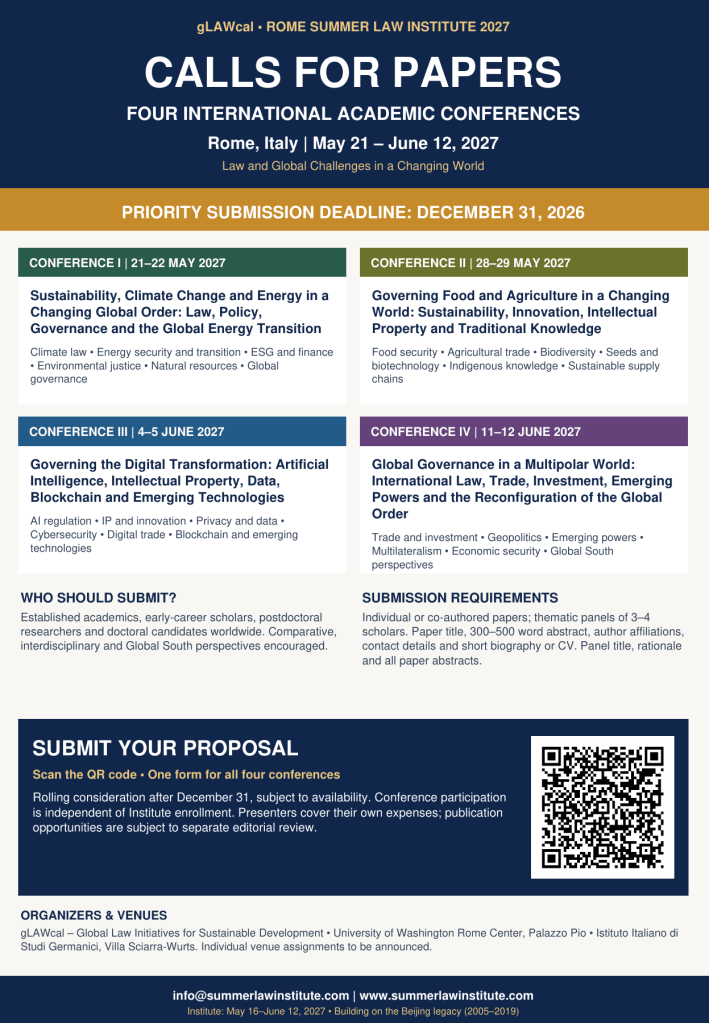
CALLS FOR PAPERS – Four International Academic Conferences | Rome Summer Law Institute 2027
Rome, Italy | May 16–June 12, 2027
The Rome Summer Law Institute 2027 invites submissions for its international academic conference series in Rome, Italy. The conferences form part of a four-week international academic initiative bringing together scholars, students, practitioners, policymakers, representatives of international organizations, civil society and other institutions from around the world. Each conference is an international scholarly forum in its own right, open independently of enrollment in the Institute’s study-abroad program or affiliation with its partner institutions.
Priority deadline: December 31, 2026
Unified submission form: https://docs.google.com/forms/d/e/1FAIpQLSdlYr_e47333xrbrimxb9KXd6ta2_p40uRjQayse6OBoYqYNA/viewform?usp=publish-editor
Conference 1 – Sustainability, Climate Change and Energy in a Changing Global Order: Law, Policy, Governance and the Global Energy Transition
Friday 21 and Saturday 22 May 2027 | Week One
Climate change and the transformation of global energy systems are reshaping law, public policy, markets, international relations, development strategies, and understandings of sustainability. At the same time, geopolitical tensions, technological change, rapidly increasing electricity demand, concerns about energy security and affordability, and differing national approaches to decarbonization are challenging existing models of global climate and energy governance.
The conference seeks contributions examining these transformations from legal, economic, political, technological, environmental, and interdisciplinary perspectives.
Possible topics include, but are not limited to:
- international and comparative climate change law and governance;
- the Paris Agreement and evolving international climate architecture;
- climate litigation and climate-related human rights;
- energy security, energy sovereignty, and the energy transition;
- renewable energy law, policy, markets, and investment;
- oil, gas, coal, and the role of fossil fuels during the transition;
- electricity markets, grids, storage, and infrastructure;
- nuclear energy and emerging energy technologies;
- hydrogen, carbon capture, and other transition technologies;
- artificial intelligence, data centers, and rapidly increasing electricity demand;
- climate finance and sustainable finance;
- trade, investment, subsidies, and the energy transition;
- critical minerals and clean-energy supply chains;
- energy justice, environmental justice, and a just transition;
- climate change, development, and the Global South;
- cities, subnational governments, and multilevel climate governance;
- corporate climate responsibility and ESG;
- European Union climate and energy policy;
- United States climate and energy law and policy;
- China and other emerging powers in global climate and energy governance;
- comparative approaches to energy transition and decarbonization;
- the Sustainable Development Goals and the future of sustainable development; and
- broader questions concerning sustainability, climate, energy, and transformations in global governance.
Proposals approaching these questions from law, economics, political science, international relations, public policy, business, environmental studies, technology studies, or other relevant disciplines are welcome. Comparative, interdisciplinary, and transnational approaches are particularly encouraged.
Conference 2 – Governing Food and Agriculture in a Changing World: Sustainability, Innovation, Intellectual Property and Traditional Knowledge
Friday 28 and Saturday 29 May 2027 | Week Two
Food and agricultural systems stand at the intersection of some of the most pressing contemporary challenges: climate change, food security, biodiversity loss, technological innovation, international trade, intellectual property protection, cultural heritage, Indigenous and traditional knowledge, rural development, public health, and inequality.
At the same time, developments in biotechnology, digital agriculture, artificial intelligence, agricultural data, gene editing, and new forms of food production are transforming both agricultural markets and the legal frameworks governing innovation.
The conference seeks to bring together scholars working across these fields and across different regions of the world.
Topics may include:
- food security and the right to food;
- international and comparative food law;
- agricultural law and policy;
- sustainable agriculture and sustainable food systems;
- climate change and agriculture;
- biodiversity, genetic resources, and benefit sharing;
- intellectual property rights and agriculture;
- patents, plant varieties, seeds, and agricultural biotechnology;
- geographical indications and traditional products;
- Indigenous peoples, traditional knowledge, and cultural heritage;
- international trade in food and agricultural products;
- WTO agricultural disciplines;
- agricultural subsidies and food security;
- EU agricultural and food policy;
- food regulation and food safety;
- biotechnology, gene editing, and genetically modified organisms;
- digital agriculture, artificial intelligence, and agricultural data;
- technology transfer and agricultural innovation;
- land, natural resources, and rural development;
- food systems and the Sustainable Development Goals;
- global agricultural supply chains;
- business, human rights, and food production;
- food sovereignty;
- North-South dimensions of agricultural governance;
- the role of international organizations in food and agricultural governance; and
- intersections among intellectual property, development, trade, environment, and food security.
Contributions from law, economics, development studies, political science, international relations, agricultural studies, public policy, business, technology, and related disciplines are welcome.
Conference 3 – Governing the Digital Transformation: Artificial Intelligence, Intellectual Property, Data, Blockchain and Emerging Technologies
Friday 4 and Saturday 5 June 2027 | Week Three
Artificial intelligence is transforming economic activity, scientific research, education, creative production, government, legal services, communications, and everyday life. These developments raise fundamental questions concerning intellectual property, privacy, data governance, cybersecurity, competition, human rights, accountability, democratic governance, and the appropriate relationship between technological innovation and regulation.
The conference will examine these questions comparatively and internationally, bringing together perspectives from law and other disciplines.
Topics may include, among others:
- regulation and governance of artificial intelligence;
- comparative AI regulation;
- the EU AI Act and European digital regulation;
- United States approaches to AI governance;
- AI governance in China and other jurisdictions;
- generative AI and intellectual property;
- copyright, authorship, and AI-generated works;
- patents, innovation, and machine-generated inventions;
- trademarks and digital markets;
- training data, text and data mining, and licensing;
- AI, privacy, and personal data;
- algorithmic discrimination and fundamental rights;
- automated decision-making and administrative governance;
- AI accountability, liability, and safety;
- cybersecurity and cyber governance;
- platform governance and intermediary responsibility;
- the Digital Services Act and Digital Markets Act;
- competition law and digital markets;
- blockchain, smart contracts, and decentralized technologies;
- digital assets and emerging financial technologies;
- data governance and cross-border data flows;
- AI and international law;
- AI, international trade, and technological competition;
- digital sovereignty;
- AI and sustainable development;
- environmental and energy implications of AI and data centers;
- AI in legal practice and legal education;
- AI, misinformation, democracy, and public discourse;
- technology and human rights;
- technological governance in the Global South; and
- broader theoretical questions concerning law, technology, power, knowledge, and society.
Conference 4 – Global Governance in a Multipolar World: International Law, Trade, Investment, Emerging Powers and the Reconfiguration of the Global Order
Friday 11 and Saturday 12 June 2027 | Week Four
The international legal and economic order is undergoing significant transformation. The growing role of emerging powers, renewed geopolitical competition, challenges to multilateral institutions, changing patterns of international trade and investment, competing approaches to development, technological rivalry, climate and energy transitions, and new forms of South-South cooperation are reshaping the institutions and assumptions of global governance.
The conference seeks to examine these transformations without presupposing a single account of the emerging international order. It welcomes doctrinal, theoretical, empirical, comparative, historical, and interdisciplinary approaches.
Potential topics include:
- changing structures of international law and global governance;
- multilateralism and institutional reform;
- emerging powers and international institutions;
- China and the international legal order;
- the United States, European Union, and changing global governance;
- BRICS and alternative or complementary governance institutions;
- Global South approaches to international law and governance;
- international trade law and WTO reform;
- trade wars, economic security, and geoeconomics;
- industrial policy and subsidies;
- international investment law and investment dispute settlement;
- foreign investment screening and national security;
- Belt and Road Initiative and international economic law;
- infrastructure investment and development;
- sovereign debt and development finance;
- sanctions and economic statecraft;
- supply chains and economic resilience;
- technology competition and digital trade;
- climate measures and international economic law;
- energy security and international economic governance;
- sustainable development and international law;
- business and human rights;
- international organizations and institutional legitimacy;
- regionalism and competing models of economic integration;
- North-South and South-South economic relations;
- fragmentation and pluralism in international law;
- sovereignty and transformations of the international order;
- international law and geopolitical competition; and
- the future of the rules-based international economic and legal system.
International participation and eligibility
Established academics, early-career scholars, postdoctoral researchers and doctoral candidates from all regions of the world are invited to submit. Contributions from relevant disciplines and diverse legal systems, methodologies and intellectual traditions are welcome. Comparative, interdisciplinary, transnational and Global South perspectives, including contributions from institutions and countries underrepresented in international academic conferences, are particularly encouraged.
Individual papers and thematic panel proposals
Individual and co-authored papers are welcome. Proposals for coordinated thematic panels bringing together three or four scholars are also encouraged. Panel proposals should include a panel title, a brief explanation of its intellectual coherence, the proposed participants and their affiliations, and the title and abstract of each proposed paper. Panel proposals remain subject to academic selection; the organizers may suggest adjustments to panel composition.
Submission requirements and selection
For each paper, please provide:
- A 300–500 word abstract.
- Paper title.
- Author name(s), institutional affiliation(s) and contact information.
- A short biographical statement or CV for each author.
Priority submission deadline: December 31, 2026. Subsequent proposals will be considered on a rolling basis, subject to availability.
Common submission form for all four conferences:
Please identify the conference for which the proposal is intended. For coordinated panels, identify the common panel title and proposed participants in the submission materials. If the form does not accommodate the complete panel proposal, contact [email protected] for instructions.
Proposals will be reviewed on scholarly quality, originality, relevance, intellectual coherence and contribution to the geographical, institutional, disciplinary, methodological and career-stage diversity of the program.
Conference format
Selected authors will be invited to present their work in Rome in thematic panels bringing together scholars from different jurisdictions, disciplines and academic traditions. The conferences will foster interaction among researchers, students, practitioners, policymakers, international organizations, civil society and other stakeholders. Further details concerning panels, commentators, keynote speakers and related activities will be announced as arrangements develop.
Relationship to the Rome Summer Law Institute
The Institute runs from May 16 to June 12, 2027, combining teaching, executive education, research, conferences, institutional engagement and scholarly exchanges across four interconnected thematic weeks:
- Week One: Sustainability, Climate Change and Energy.
- Week Two: Food, Agriculture, Intellectual Property and Sustainable Development.
- Week Three: Artificial Intelligence, Intellectual Property, Blockchain and Digital Transformation.
- Week Four: Global Governance, Trade, Investment, Emerging Powers and a Changing International Order.
The Rome program builds on gLAWcal’s experience developing international academic and educational initiatives, including the Beijing Summer Law Institute (2005–2019). The conferences complement the teaching program by bringing students into direct contact with current scholarship and international academic debate. Conference acceptance does not require enrollment in the Institute, create an obligation to teach, constitute a faculty appointment, or imply financial support.
Travel, accommodation and financial support
Unless specific arrangements are communicated separately, presenters are responsible for international and domestic transportation, accommodation, meals, incidental expenses, visa and immigration-related expenses, travel and health insurance, and all other participation costs.
Submission, acceptance or an invitation to present does not create any entitlement to travel funding, accommodation, reimbursement, honoraria or other financial assistance from gLAWcal, the Institute, conference venues or participating institutions. Applicants are encouraged to seek support from home universities, research centers, professional associations, grant programs and other external sources. Any subsequently available limited funding will be communicated separately and subject to its own eligibility and selection requirements. Applicants should not assume such funding will become available.
Publication and further scholarly collaboration
The organizers intend to explore publication and dissemination opportunities for selected papers, potentially including journal symposia, special issues, edited volumes, working papers and other scholarly formats. Any publication opportunity will be subject to a separate editorial selection and review process, including peer review where applicable. Acceptance for presentation does not guarantee publication. Further details will be announced as arrangements develop.
Organizers, institutional collaboration and venues
The conference series is organized in connection with the Rome Summer Law Institute 2027, an initiative in cooperation among University of Washington Rome Center, the Istituto Italiano di Studi Germanici, gLAWcal – Global Law Initiatives for Sustainable Development (United Kingdom), and a developing international network of universities, research centers, institutions and organizations. Additional partners will be announced as arrangements are confirmed.
Academic and conference activities are planned in Rome at the following venues, as appropriate to each event:
- University of Washington Rome Center, Palazzo Pio, Piazza del Biscione 95, Rome, Italy.
- Istituto Italiano di Studi Germanici, Villa Sciarra-Wurts, Rome, Italy.
The precise venue for each conference will be communicated separately.
Further information and inquiries
Email: [email protected]
Program announcement and materials: https://paolofarah.wordpress.com/2026/07/25/launching-the-rome-summer-law-institute-2027-law-and-global-challenges-in-a-changing-world/
WordPress Blog: https://paolofarah.wordpress.com/
Website: http://www.summerlawinstitute.com/
Substack: https://paolofarah.substack.com/