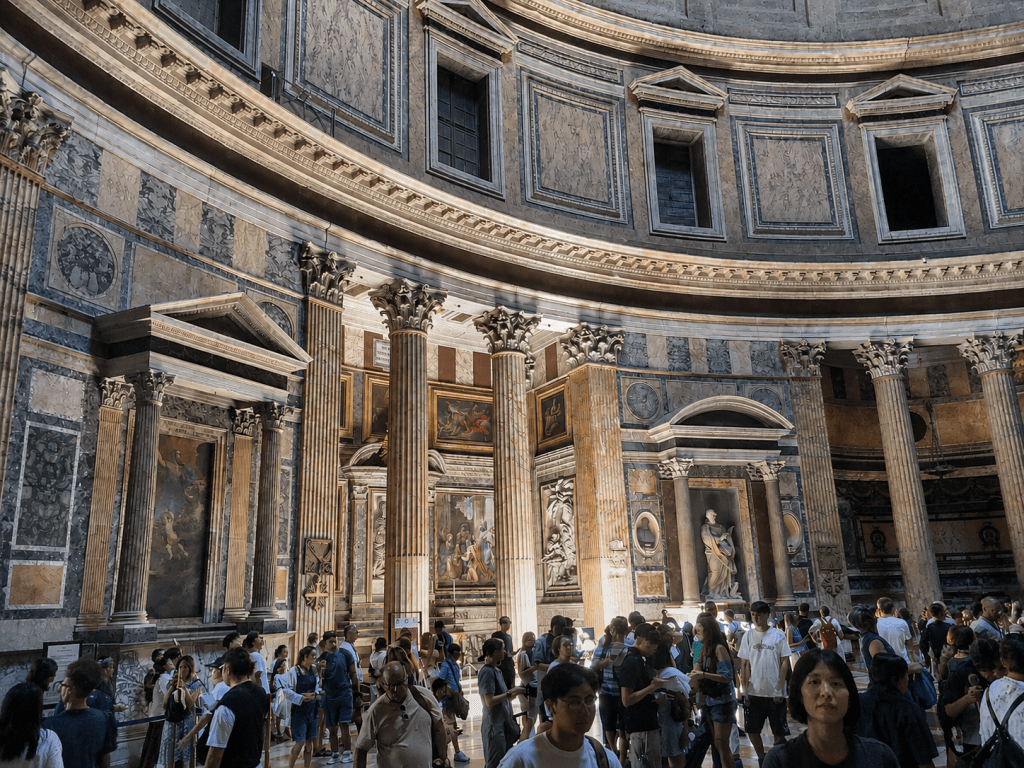
From Sacred Space to Public Institution: The Legal Life of the Pantheon
Most visitors see the Pantheon as one of the world’s greatest architectural masterpieces. Lawyers may see something different: a remarkable convergence of multiple legal regimes operating simultaneously within a single monument.
Every day, thousands of visitors enter the Pantheon without realizing that this extraordinary building is governed not by a single legal framework, but by a complex interaction of institutions, jurisdictions, and bodies of law.
The Pantheon invites questions across numerous legal fields, including constitutional law, cultural heritage law, administrative law, property law, canon law, tourism law, environmental law, public international law, and human rights law.
Who owns the Pantheon? Which authorities regulate its preservation? How are religious functions reconciled with public access? How should the law balance freedom of worship, cultural heritage protection, tourism management, public finance, accessibility, and conservation? What role do international instruments concerning cultural heritage play alongside domestic legal frameworks?
These questions demonstrate that monuments are not simply historical artifacts. They are governed spaces where different legal orders interact continuously.
The Pantheon therefore illustrates a broader phenomenon extending far beyond Rome. Increasingly, governance requires understanding how multiple legal regimes coexist, overlap, and sometimes compete within the same institutional and physical space.
Viewed from this perspective, the Pantheon becomes much more than an archaeological monument. It becomes a laboratory for understanding the complexity of contemporary governance itself.
For those interested, I have shared a longer reflection on my WordPress blog: https://paolofarah.wordpress.com/2026/07/01/from-sacred-space-to-public-institution-the-legal-life-of-the-pantheon/
#Pantheon #Rome #CulturalHeritage #GlobalGovernance #EpistemicGovernance #InternationalLaw #RuleOfLaw #Geopolitics #Sustainability #ArtificialIntelligence #ClimateChange #EnergyTransition #LegalHistory
This series includes the following posts:
The Pantheon and the Endurance of Civilizations: Reflections on Governance, Knowledge, and Global Order – https://paolofarah.wordpress.com/2026/06/28/the-pantheon-and-the-endurance-of-civilizations-reflections-on-governance-knowledge-and-global-order/
From Ancient Rome to Contemporary Constitutional Debates: Religion, Governance, and the Public Sphere – https://paolofarah.wordpress.com/2026/06/29/from-ancient-rome-to-contemporary-constitutional-debates-religion-governance-and-the-public-sphere/
Cultural Heritage, Constitutional Identity, and the Governance of Memory – https://paolofarah.wordpress.com/2026/06/30/cultural-heritage-constitutional-identity-and-the-governance-of-memory/
From Sacred Space to Public Institution: The Legal Life of the Pantheon – https://paolofarah.wordpress.com/2026/07/01/from-sacred-space-to-public-institution-the-legal-life-of-the-pantheon/
Paolo Davide Farah, Paolo Farah
Suggested Bibliography
- Epistemic Governance, available on SSRN: https://papers.ssrn.com/sol3/papers.cfm?abstract_id=6487038
- Conflict between Intellectual Property Rights and Human Rights: A Case Study on Intangible Cultural Heritage
94 Oregon Law Review 125 (2015) - When John Locke Meets Lao Tzu: The Relationship between Intellectual Property, Biodiversity and Indigenous Knowledge and the Implications for Food Security
33 Duke Environmental Law & Policy Forum 297 (2024)