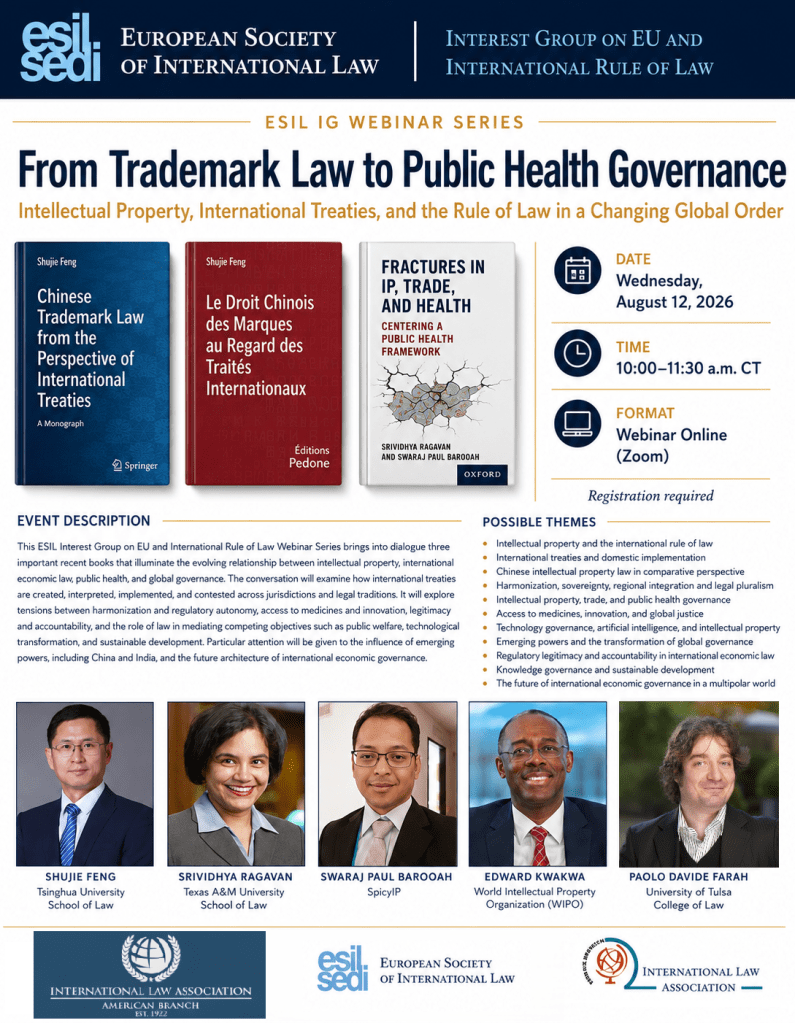

From Trademark Law to Public Health Governance: Intellectual Property, International Treaties, and the Rule of Law in a Changing Global Order
The European Society of International Law Interest Group on European and International Rule of Law is pleased to announce the next event in its Webinar Series:
Wednesday, August 12, 2026
10:00–11:30 a.m. Central Time
11:00 a.m.–12:30 p.m. Eastern Time
Online
Participation is free and open to all, but advance registration is required.
Register
About the Webinar
This webinar brings into dialogue three important recent books that illuminate the evolving relationship between intellectual property, international economic law, public health, development, and global governance:
- Shujie Feng, Chinese Trademark Law from the Perspective of International Treaties (Springer Nature, 2026);
- Shujie Feng, Le Droit Chinois des Marques au Regard des Traités Internationaux (Éditions Pedone, 2024); and
- Srividhya Ragavan and Swaraj Paul Barooah, Fractures in IP, Trade, and Health: Centering a Public Health Framework (Oxford University Press, 2025).
Although these works address different dimensions of intellectual property law, they share a common concern with how international legal norms are created, interpreted, implemented, adapted, and contested across jurisdictions and legal traditions.
Shujie Feng’s English- and French-language monographs examine the development of Chinese trademark law through the lens of international treaty obligations. They explore how China has engaged with and adapted international intellectual property standards while balancing domestic legal, economic, institutional, and social priorities.
In parallel, Srividhya Ragavan and Swaraj Paul Barooah examine the structural tensions at the intersection of intellectual property, international trade, development, and public health. Their work advances a governance framework that places public health more centrally within international economic regulation and debates concerning access to medicines, innovation, inclusion, and global justice.
Taken together, these books offer a distinctive opportunity to consider intellectual property law not merely as a specialized legal field, but as a central component of contemporary global governance. They raise broader questions concerning treaty implementation, legal pluralism, harmonization, sovereignty, regulatory autonomy, access to justice, legitimacy, accountability, and the role of law in mediating competing objectives such as innovation, economic development, public welfare, access to medicines, protection of traditional and Indigenous knowledge, and technological transformation.
Participants
Shujie Feng
Tsinghua University School of Law
Shujie Feng will discuss his recent English- and French-language monographs on Chinese trademark law, international treaty obligations, domestic implementation, and the interaction between international standards and Chinese legal development.
Srividhya Ragavan
Texas A&M University School of Law
Srividhya Ragavan will address the relationship between intellectual property, international trade, public health, development, access to medicines, innovation, and institutional reform.
Swaraj Paul Barooah
SpicyIP
Swaraj Paul Barooah will contribute perspectives on intellectual property regulation, public health, access, inclusion, knowledge governance, and the social and developmental consequences of international intellectual property regimes.
Discussant: Edward Kwakwa
Assistant Director General, Global Challenges and Partnerships Sector
World Intellectual Property Organization
Drawing on his extensive experience at WIPO, Edward Kwakwa will reflect on the institutional and policy questions raised by the books, including treaty implementation, international cooperation, development, public health, emerging technologies, global partnerships, and the evolving architecture of international intellectual property governance.
Chair, Moderator, and Discussant: Paolo Davide Farah
The University of Tulsa College of Law
Professor Paolo Davide Farah will chair and moderate the conversation and will also participate as a substantive discussant.
Drawing on his scholarship and publications on Chinese law, Chinese intellectual property law, intellectual property and development, Indigenous peoples, international economic law, emerging technologies, and global governance, Professor Farah will engage directly with the arguments advanced in the three books. His contribution will examine the relationship between international intellectual property standards and domestic legal development; China’s engagement with international treaty obligations; the role of China, India, and other emerging powers in shaping international economic governance; and the implications of intellectual property regimes for development, public health, access to medicines, technological transformation, Indigenous knowledge, regulatory legitimacy, and the international rule of law.
The discussion will therefore bring together not only the authors’ perspectives, but also the complementary scholarly and institutional reflections of Professor Farah and Edward Kwakwa.
Questions and Themes
The conversation will explore how intellectual property regimes increasingly serve as sites in which fundamental questions concerning the international rule of law emerge and evolve.
Particular attention will be devoted to:
- intellectual property and the international rule of law;
- international treaties and domestic implementation;
- Chinese intellectual property law in comparative perspective;
- harmonization, sovereignty, regional integration, and legal pluralism;
- intellectual property, trade, development, and public health governance;
- access to medicines, innovation, and global justice;
- Indigenous peoples, traditional knowledge, cultural heritage, and intellectual property;
- technology governance, artificial intelligence, and intellectual property;
- emerging powers and the transformation of global governance;
- regulatory legitimacy and accountability in international economic law;
- knowledge governance and sustainable development; and
- the future of international economic governance in a multipolar world.
The webinar will also consider the relationship between international commitments and domestic implementation, the interaction between global legal standards and local regulatory priorities, and the governance challenges posed by digitalization, artificial intelligence, and other emerging technologies.
Particular attention will be given to the growing influence of China, India, and other emerging actors in shaping the future architecture of international intellectual property and economic governance.
The discussion will further examine the ways in which intellectual property law affects Indigenous peoples, traditional knowledge, access to knowledge, development priorities, public welfare, technological innovation, and the distribution of authority between international institutions and domestic legal systems.
By bringing together perspectives from international law, Chinese and comparative law, intellectual property law, trade law, public health, development, Indigenous knowledge governance, technology regulation, and institutional practice, the webinar seeks to foster an interdisciplinary dialogue on the capacity of the international rule of law to respond to the challenges of an increasingly interconnected, multipolar, and rapidly changing global order.
Organization and Co-Sponsorship
The event is organized as part of the ESIL Interest Group on European and International Rule of Law Webinar Series, conceived and chaired by Professor Paolo Davide Farah, Chair of the ESIL Interest Group on European and International Rule of Law, who will serve as chair, moderator, and discussant for this conversation.
The webinar is co-sponsored by:
- the American Branch of the International Law Association Committee on International Law, China, and the Reconfiguration of the Global Order; and
- the International Law Association Study Group on International Law, Global Challenges, and the Impact of Emerging Powers on Global Governance.
Event Information
Date: Wednesday, August 12, 2026
Time: 10:00–11:30 a.m. Central Time / 11:00 a.m.–12:30 p.m. Eastern Time
Format: Online webinar via Zoom
Participation: Free and open to all
Registration: Required
Register Here
Please circulate this announcement among colleagues, students, researchers, practitioners, policymakers, and others interested in international law, Chinese and comparative law, intellectual property, public health, trade, development, Indigenous peoples, technology governance, emerging powers, and the future of global governance.
Paolo Davide Farah, Paolo Farah