AI Governance Is Everywhere — But the Deeper Question Is How AI Is Transforming Governance
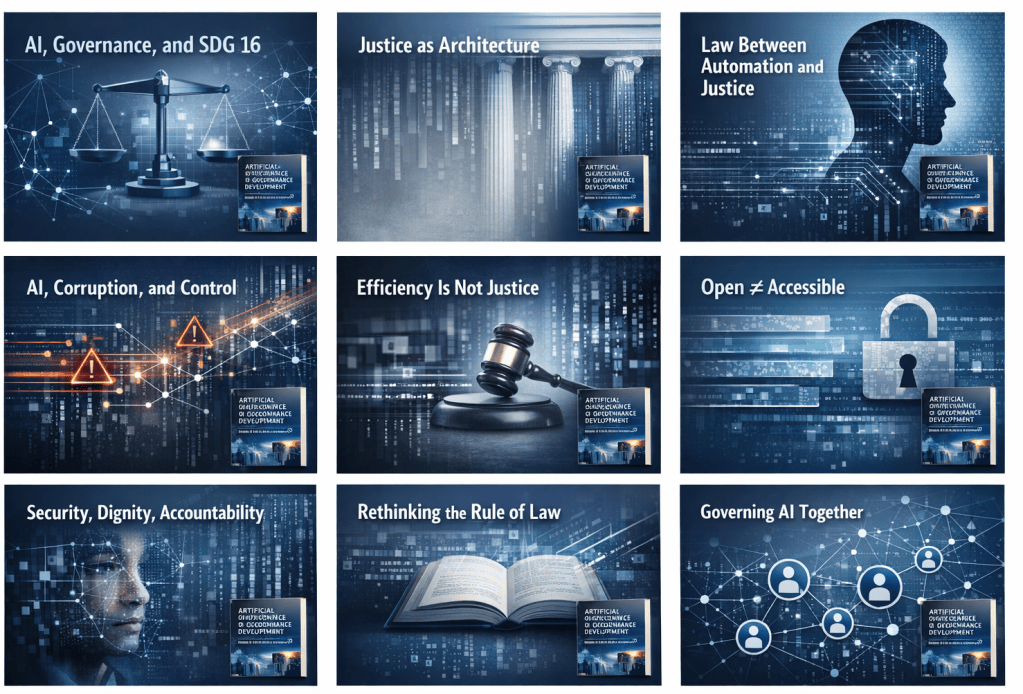
As the conversation around artificial intelligence moves rapidly beyond questions of innovation and ethics toward governance, institutional design, accountability, constitutionalism, and the rule of law, I thought this was a good moment to bring back a series I published earlier this year on Artificial Intelligence, Governance, and SDG 16: Peace, Justice and Strong Institutions
Between February and March 2026, I explored a question that seems even more pressing today:
What happens when AI does not simply need to be governed, but begins to transform governance itself?
Across the series, I developed several interconnected arguments:
• AI is not simply a technology; it is a governance challenge.
• AI governance is architectural: institutional choices can increasingly be embedded directly into technological systems.
• Law may increasingly operate at “execution speed,” as rules move from interpretation toward automated implementation.
• In that environment, law itself can begin to function as infrastructure, raising new questions about authority, sovereignty, discretion, and legitimacy.
• Efficiency is not justice, just as openness does not necessarily mean accessibility.
• AI can strengthen institutions, but it can also redistribute and concentrate power, including through systems of surveillance, criminal justice, and anti-corruption enforcement.
• Ultimately, the rule of law itself must be reconsidered when public and private decision-making is increasingly mediated by automated systems.
This is why I used SDG 16 — Peace, Justice and Strong Institutions — as the normative framework for the series. The important question is not merely whether AI systems are efficient, accurate, or innovative, but whether the institutions they reshape remain legitimate, accountable, accessible, and just.
The central proposition running through the series remains:
– The challenge is no longer only how we govern AI. It is how AI is transforming governance.
And perhaps the question that concerns me most:
– Can legitimacy, accountability, discretion, and justice survive when law begins to operate at execution speed?
For those interested in revisiting the full series, the synthesis post brings together the arguments and links to all of the individual contributions: https://lnkd.in/gseaxDmH
The series builds on my research connected with Artificial Intelligence, Governance and Sustainable Development: Peace, Justice and Strong Institutions (Routledge, 2026) and my broader work on the intersections among science, technology, law, governance, and the rule of law.
With AI governance now moving to the center of legal, institutional, and public debate, I look forward to continuing this conversation.
#ArtificialIntelligence#AIGovernance#RuleOfLaw#AIRegulation#SDG16#DigitalGovernance#TechnologyLaw#Constitutionalism#GlobalGovernance#SustainableDevelopment