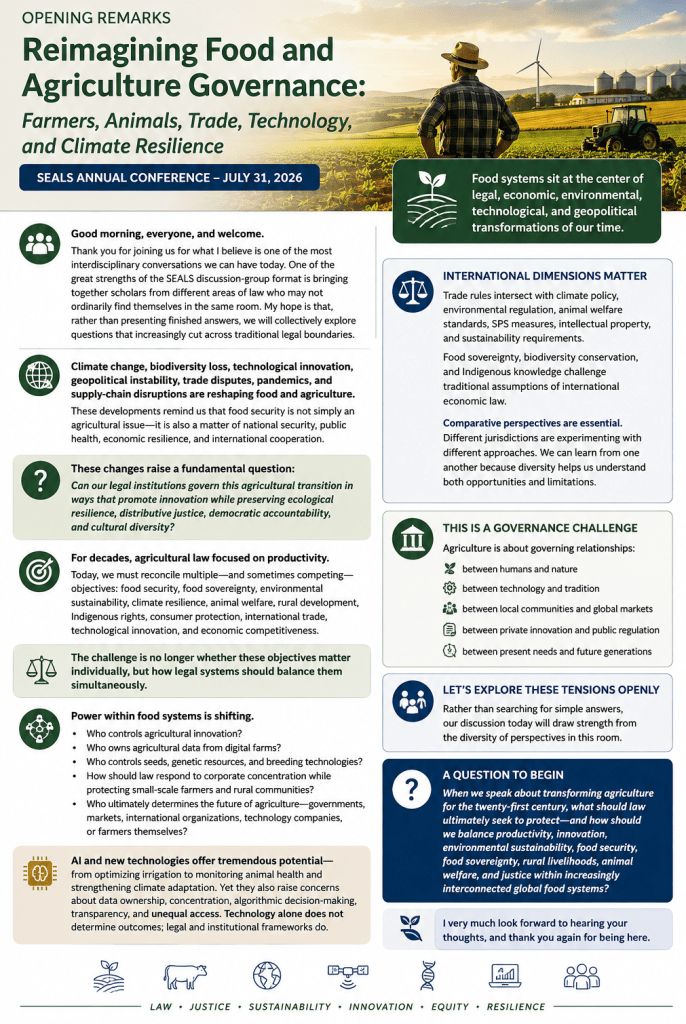
Opening Remarks
Reimagining Food and Agriculture Governance: Farmers, Animals, Trade, Technology, and Climate Resilience
2026 Southeastern Association of Law Schools (SEALS) Annual Conference – July 31, 2026
Good morning, everyone, and welcome.
Thank you all for joining us for what I believe is one of the most interdisciplinary conversations we can have today. I also want to thank each of you for taking the time to participate. One of the great strengths of the SEALS discussion-group format is that it brings together scholars from different areas of law who may not ordinarily find themselves in the same room. My hope is that, rather than presenting finished answers, we will collectively explore questions that increasingly cut across traditional legal boundaries.
Food and agriculture might once have been viewed as specialized fields. Today, however, they sit at the center of some of the most significant legal, economic, environmental, technological, and geopolitical transformations of our time.
Climate change is altering agricultural production across the globe. Biodiversity loss is threatening ecosystems upon which food systems depend. Artificial intelligence, biotechnology, precision agriculture, robotics, and digital platforms are changing how food is produced, monitored, traded, and consumed. Global value chains continue to reshape relationships among producers, processors, retailers, consumers, and governments. At the same time, geopolitical instability, trade disputes, pandemics, and supply-chain disruptions have reminded us that food security is not simply an agricultural issue—it is also a matter of national security, public health, economic resilience, and international cooperation.
These developments raise an increasingly fundamental question:
Can our legal institutions govern this agricultural transition in ways that promote innovation while preserving ecological resilience, distributive justice, democratic accountability, and cultural diversity?
This question immediately forces us to confront another challenge.
For decades, agricultural law often focused primarily on increasing productivity. More recently, food security became a dominant objective. Today, however, we recognize that productivity alone is insufficient. We are increasingly asked to reconcile multiple—and sometimes competing—objectives: food security, food sovereignty, environmental sustainability, climate resilience, animal welfare, rural development, Indigenous rights, consumer protection, international trade, technological innovation, and economic competitiveness.
The challenge, therefore, is no longer whether these objectives matter individually, but how legal systems should balance them simultaneously.
Our discussion today also invites us to reflect on changing distributions of power within food systems.
Who controls agricultural innovation?
Who owns agricultural data generated by increasingly digital farms?
Who controls seeds, genetic resources, and breeding technologies?
How should law respond to growing concentration among multinational agribusinesses while protecting the interests of small-scale farmers and rural communities?
And perhaps more fundamentally, who determines the future of agriculture?
Governments?
Markets?
International organizations?
Technology companies?
Farmers themselves?
These questions become even more complex as artificial intelligence enters agriculture.
AI can help optimize irrigation, predict crop diseases, improve resource efficiency, monitor animal health, and strengthen climate adaptation. Yet these same technologies also generate new concerns regarding data ownership, market concentration, algorithmic decision-making, transparency, and unequal access to technological innovation.
Technology alone does not determine outcomes.
The legal and institutional frameworks within which these technologies operate will largely determine whether they reduce inequalities or reinforce existing concentrations of economic and technological power.
Our discussion would also be incomplete without considering international dimensions.
Trade rules increasingly intersect with climate policies, environmental regulation, animal welfare standards, sanitary and phytosanitary measures, intellectual property rights, and sustainability requirements.
Questions surrounding food sovereignty, domestic agricultural support, biodiversity conservation, and Indigenous knowledge increasingly challenge traditional assumptions regarding international economic law.
Comparative perspectives are therefore particularly valuable.
Different jurisdictions are experimenting with different approaches to balancing innovation, sustainability, competitiveness, and social protection. There is much we can learn from one another, not because one model is necessarily superior, but because the diversity of legal approaches allows us to better understand both opportunities and limitations.
Finally, this discussion is fundamentally about governance.
Agriculture has never been solely about producing food.
It is about governing relationships:
between humans and nature;
between technology and tradition;
between local communities and global markets;
between private innovation and public regulation;
between present needs and future generations.
These relationships increasingly require legal institutions capable of thinking across disciplines, jurisdictions, and policy domains.
Rather than searching for simple answers, I hope our conversation today will explore these tensions openly.
The richness of this discussion will come from the diversity of perspectives represented in this room.
So let me begin with a broad question that captures many of today’s themes:
When we speak about transforming agriculture for the twenty-first century, what should law ultimately seek to protect—and how should we balance productivity, innovation, environmental sustainability, food security, food sovereignty, rural livelihoods, animal welfare, and justice within increasingly interconnected global food systems?
I very much look forward to hearing your thoughts, and thank you again for being here.
Discussion Group Description
Title – Reimagining Food and Agriculture Governance: Farmers, Animals, Trade, Technology, and Climate Resilience
Friday, July 31, 2026 9:00 a.m.–12:00 p.m.
Food and agricultural systems are being reshaped by climate change, biodiversity loss, technological innovation, geopolitical instability, and growing concern over the distribution of power throughout global food chains. This discussion group examines how law can govern the agricultural transition while protecting farmers, workers, animals, consumers, Indigenous peoples, and vulnerable communities. Participants will explore the interaction among farmers’ rights, animal welfare, international trade, food sovereignty, food security, intellectual property, agricultural technology, land use, and environmental sustainability. Particular attention will be given to the effects of artificial intelligence, biotechnology, digital agriculture, data ownership, and corporate concentration on small-scale producers and rural communities. The group will consider whether existing domestic and international institutions can reconcile productivity and innovation with ecological resilience, distributive justice, cultural diversity, and democratic control over food systems. Possible Discussion Questions 1. What should be the principal objective of agricultural law and policy: productivity, food security, food sovereignty, ecological sustainability, rural development, or some combination of these goals? 2. How can legal systems protect small-scale farmers and agricultural workers during transitions toward more technologically intensive and climate-resilient production? 3. Are current international trade rules compatible with food sovereignty, animal welfare, biodiversity protection, and domestic measures supporting sustainable agriculture? 4. How should law regulate ownership and control of agricultural data, seeds, genetic resources, traditional knowledge, and artificial-intelligence systems used in farming? 5. Do technological innovations such as precision agriculture, biotechnology, alternative proteins, and automated farming democratize agricultural production or increase corporate concentration? 6. How should animal welfare and animal rights be incorporated into agricultural, environmental, trade, and food-safety regulation? 7. What forms of legal recognition should be given to Indigenous knowledge, traditional agricultural practices, and community-based food systems? 8. How should the costs of climate adaptation and ecological transition be distributed among governments, agribusinesses, consumers, farmers, and international institutions? 9. What institutional reforms would be necessary to coordinate food, trade, climate, biodiversity, health, and development policies more effectively?
Paolo Farah, Paolo Davide Farah