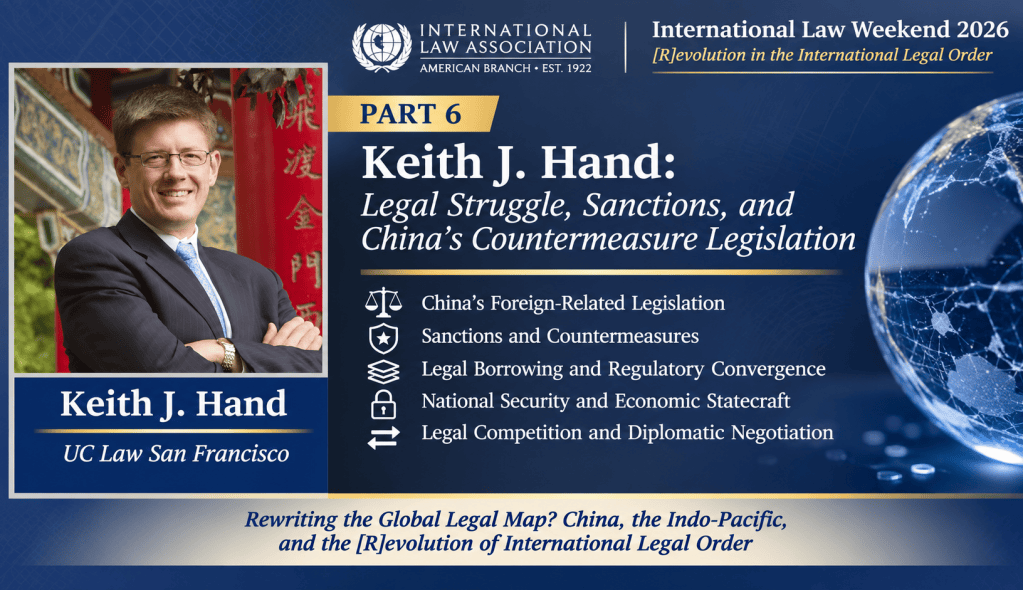


Rewriting the Global Legal Map? China, the Indo-Pacific, and the [R]evolution of International Legal Order — ABILA International Law Weekend 2026 — PART 6 – Keith J. Hand: Legal Struggle, Sanctions, and China’s Countermeasure Legislation — Legal Borrowing, National Security, and Geopolitical Competition
Can domestic legislation become an instrument of geopolitical confrontation while simultaneously promoting regulatory convergence and creating opportunities for diplomatic negotiation?
This question emerged from the contribution of Professor Keith J. Hand, University of California College of the Law, San Francisco, during the panel I organized, chaired, and moderated on October 24, 2026, at Fordham University School of Law in New York City.
The panel, “Rewriting the Global Legal Map? China, the Indo-Pacific, and the [R]evolution of International Legal Order,” formed part of International Law Weekend 2026, organized by the American Branch of the International Law Association (ABILA).
The session was sponsored by the ABILA Committee on International Law, China, and the Reconfiguration of the Global Order, which I chair.
This sixth installment of my series examines Professor Hand’s opening presentation and his subsequent interventions during our moderated exchanges and the audience discussion.
His analysis provided an important perspective on the growing use of domestic legal instruments in international competition, particularly China’s development of foreign-related legislation, sanctions, economic countermeasures, and regulatory mechanisms intended to respond to external political and economic pressure.
More broadly, his contribution raised questions concerning the relationship between law and geopolitical power, the circulation of regulatory models, and the changing boundaries between domestic legal authority and international economic governance.
1. From Legal Warfare to Legal Struggle
Professor Hand began by tracing the historical development of China’s strategic thinking concerning the use of law in international competition.
His presentation drew upon research including “Waging External Struggle through Law: China’s Evolving Legal Strategies and Pelosi’s Taiwan Visit.”
He explained that Chinese approaches to using legal instruments for strategic purposes have roots in military and political doctrines developed during the late twentieth and early twenty-first centuries.
These approaches initially included the incorporation of legal warfare into broader military strategies, alongside psychological and public-opinion operations.
However, Professor Hand emphasized that the role of law in China’s external strategy should not be understood exclusively through military confrontation.
He preferred the concept of “legal struggle”, which better captures the use of legal instruments within broader political, economic, and diplomatic competition, including during peacetime.
This distinction is analytically important.
Law may operate not simply as a mechanism for resolving disputes or facilitating international cooperation but also as an instrument through which governments seek to influence foreign actors, protect strategic interests, and strengthen their bargaining positions.
In this context, domestic legislation increasingly becomes part of the infrastructure of international relations.
2. U.S.–China Competition and the Expansion of China’s Legal Capacity
Professor Hand situated the development of China’s contemporary countermeasure legislation within the intensification of U.S.–China competition.
Since approximately 2016, successive American administrations have increasingly relied on trade restrictions, investment controls, technology-related measures, sanctions, and other regulatory instruments in their relations with China.
These developments demonstrated the extensive capacity of the United States to exercise international economic influence through domestic law.
They also exposed asymmetries between the respective legal and regulatory capacities of the two countries.
According to Professor Hand’s analysis, Chinese authorities responded by seeking to develop a more comprehensive legal framework capable of supporting reciprocal measures.
This development included an expanding body of legislation concerning foreign sanctions, export controls, investment restrictions, and the extraterritorial application of Chinese law.
The objective was not simply to respond to particular external measures but also to establish a broader legal capacity that could be deployed when Chinese authorities considered their national interests threatened.
This process illustrates how geopolitical competition can stimulate domestic legal innovation.
It also raises an important question concerning the relationship between international power and regulatory development:
To what extent does the expansion of one state’s legal capacity encourage competing states to reproduce or adapt similar instruments?
3. Legal Borrowing and Regulatory Convergence During Geopolitical Confrontation
One of the most significant observations in Professor Hand’s presentation concerned the relationship between China’s emerging legal framework and existing U.S. regulatory instruments.
He explained that many Chinese measures have identifiable parallels in American legislation and regulation.
China’s development of sanctions, export controls, and related countermeasures therefore involves substantial elements of legal borrowing.
Yet this borrowing occurs within an increasingly confrontational geopolitical relationship.
This produces an important paradox.
Countries may adopt increasingly similar legal instruments precisely because they are competing with one another.
Regulatory convergence does not necessarily reflect agreement concerning political objectives, economic governance, or the legitimacy of particular international measures.
Instead, legal borrowing may strengthen the capacity of competing states to challenge one another through comparable regulatory mechanisms.
This observation connected Professor Hand’s presentation with Professor Gregory Shaffer’s analysis of transnational legal ordering and Professor Carrie Shu Shang’s examination of regulatory learning during technological competition.
It also related closely to my own research on legal pluralism, legal transplantation, and regulatory competition.
The circulation of legal models does not automatically produce shared political commitments.
Legal arrangements may become more similar in form while remaining profoundly different in their objectives, implementation, and consequences.
Consequently, legal convergence should not be confused with political cooperation or institutional harmonization.
4. China’s Anti-Foreign Sanctions Law: Legal Authority and Strategic Flexibility
Professor Hand devoted particular attention to China’s 2021 Anti-Foreign Sanctions Law.
The legislation authorizes Chinese authorities to adopt countermeasures against certain foreign actions considered harmful to China’s interests or constituting interference in its internal affairs.
Professor Hand emphasized several important features of this framework.
First, the legislation employs relatively broad standards for determining when countermeasures may be justified.
Second, it provides substantial discretion concerning whether and how particular measures should be implemented.
Third, certain provisions allow the authorities to extend responses beyond narrowly defined categories of foreign sanctions.
He discussed, in particular, the relationship between Article 3 and Article 15 of the legislation.
These provisions illustrate how broadly formulated statutory language can provide considerable flexibility in responding to foreign political and economic developments.
The resulting framework allows Chinese authorities to adjust countermeasures according to changing strategic circumstances.
Professor Hand also emphasized the importance of the official legal justification accompanying these measures.
Chinese authorities frequently present countermeasure legislation as a defensive response intended to protect sovereignty, resist foreign interference, and uphold an international order grounded in the United Nations system and international law.
This creates a relationship between domestic legal authority, international legal discourse, and geopolitical strategy.
The use of legal instruments is therefore accompanied by competing claims concerning the legitimacy of international conduct.
5. Taiwan, Sanctions, and the Extraterritorial Reach of Domestic Law
Professor Hand illustrated these developments through China’s response to Nancy Pelosi’s August 2022 visit to Taiwan.
He examined how Chinese authorities combined military and diplomatic responses with legal measures targeting particular individuals and activities.
His analysis highlighted the use of domestic legal instruments to reinforce broader political and strategic objectives.
He also discussed subsequent developments involving measures directed toward persons accused by Chinese authorities of supporting Taiwan independence.
These examples demonstrated how legal measures may operate alongside diplomatic pressure, military signaling, and economic restrictions.
The relationship between domestic legal instruments and international competition becomes particularly visible when legislation seeks to influence individuals or activities situated beyond the state’s territory.
This raises questions concerning extraterritoriality, jurisdiction, international legal obligations, and the relationship between national-security objectives and individual legal protections.
It also illustrates why the legal form of geopolitical responses matters.
Legal measures can create specific institutional responsibilities, administrative procedures, and potential consequences for individuals and companies.
6. Corporate Sanctions, Technology Dependencies, and Critical Minerals
Professor Hand extended his analysis to restrictions affecting foreign corporations.
He discussed measures targeting American companies involved in arms sales to Taiwan, including Lockheed Martin and Raytheon, and the use of China’s unreliable entity framework and other sanctions-related instruments.
An important distinction concerned the practical effectiveness of these measures.
Certain sanctions may be primarily symbolic when the targeted companies have limited exposure to the Chinese market.
Other measures can have direct consequences for commercial operations, technological supply chains, or access to essential components.
Professor Hand illustrated this distinction through the example of Skydio, an American drone manufacturer affected by Chinese restrictions in 2024.
He explained how dependencies involving Chinese-sourced components could translate regulatory restrictions into concrete operational difficulties.
This example demonstrates how the effectiveness of sanctions depends not merely upon formal legal authority but also upon the economic relationships and technological dependencies connecting the relevant actors.
Similar considerations apply to China’s restrictions involving critical minerals.
As international competition increasingly concerns semiconductors, advanced technologies, energy systems, and strategic materials, domestic regulatory frameworks can acquire substantial international effects.
Their consequences may extend beyond bilateral political relationships to affect global supply chains, private companies, and third countries.
7. Can Legal Countermeasures Encourage Diplomatic Negotiation?
Following Professor Hand’s opening presentation, I raised a question concerning the relationship between legal confrontation and de-escalation.
Can law provide mechanisms for managing international conflict, or does the proliferation of countermeasure legislation risk institutionalizing geopolitical escalation?
This question also connected with Professor Shaffer’s discussion of transnational legal ordering.
The circulation of legal norms does not necessarily generate cooperative outcomes.
Similar legal instruments may instead facilitate reciprocal restrictions and reinforce strategic competition.
Professor Hand’s subsequent intervention introduced an important qualification.
Although the measures he examined are clearly competitive and confrontational, their application can also create incentives for diplomatic dialogue.
He referred to reciprocal restrictions involving critical minerals and technology-related trade during 2024 and 2025.
In his analysis, the escalation of these measures contributed to negotiations between China and the United States and to decisions to suspend certain restrictions.
This suggests that countermeasure legislation may simultaneously serve different functions.
It can increase economic pressure, demonstrate political resolve, and strengthen negotiating positions.
At the same time, the economic consequences of reciprocal restrictions may encourage governments to seek negotiated arrangements.
Legal confrontation and diplomatic negotiation are therefore not necessarily mutually exclusive.
However, this does not establish that escalation will always produce de-escalation.
The outcome depends upon political circumstances, economic interdependence, institutional incentives, and the willingness of governments to negotiate.
This distinction was particularly relevant to our broader discussion of whether contemporary international legal change represents cooperation, conflict, or more complex forms of coexistence.
8. Private Actors: Between Legal Constraints and Political Influence
Another important exchange concerned the role of businesses and other private actors in the implementation of geopolitical measures.
During our moderated discussion, I asked how we could identify meaningful participation by host states, companies, and affected communities in the development and application of international legal arrangements.
Professor Hand discussed the relevance of scholarship on sharp power and the ways in which legal and regulatory instruments can influence the behavior of foreign organizations.
Companies operating across jurisdictions may face overlapping or conflicting legal obligations.
A foreign corporation implementing sanctions imposed by its home government may simultaneously encounter legal risks under Chinese countermeasure legislation.
These circumstances require complex compliance strategies and risk assessments.
Professor Hand also explained that companies facing such pressures may have incentives to seek changes in their home governments’ policies.
Domestic legal instruments can therefore influence international political relationships indirectly through private actors.
At the same time, Chinese legislation may provide domestic companies with mechanisms to seek remedies against certain foreign restrictive measures.
He referred to the role of Chinese courts and legal professionals in the implementation of these frameworks.
Private actors are consequently not simply passive recipients of governmental decisions.
They may be constrained by legal obligations while also acquiring opportunities to influence political decisions or pursue legal remedies.
This observation connected closely with Professor Shaffer’s argument concerning the importance of disaggregating states and identifying the actors responsible for implementing international legal arrangements.
It also reinforced my broader concern with the relationship between public and private authority.
9. Domestic Political Legitimacy and the Legalization of Foreign Policy
During the audience discussion, Professor Hand returned to the domestic political dimensions of China’s countermeasure legislation.
He explained how the development of these legal instruments can reinforce official narratives concerning China’s construction of a socialist rule-of-law state.
Domestic legislation provides an institutional basis for governmental responses to foreign pressure.
It also allows those responses to be presented as actions taken in accordance with established legal authority.
This creates a relationship between international geopolitical competition and domestic political legitimacy.
The government can invoke legislation as a justification for external measures while also presenting the development of legal countermeasures as evidence of its capacity to defend national interests.
Professor Hand suggested that growing geopolitical tensions may generate domestic expectations for visible responses to foreign pressure.
In this context, legal countermeasures can provide options situated between diplomatic statements and more severe forms of confrontation.
Such measures may allow authorities to signal resolve while attempting to manage the risks of escalation.
The legal framework therefore serves both external and domestic political functions.
This observation also reinforces the importance of examining the institutions and political incentives shaping the implementation of legal rules.
10. Rewriting the Global Legal Map Through Domestic Law
Professor Hand’s contribution offered an important perspective on the transformation of contemporary international legal order.
It demonstrated that domestic legislation increasingly operates as an instrument through which states pursue external economic and political objectives.
It also highlighted the paradox that geopolitical confrontation may accelerate the circulation of similar regulatory models.
The development of legal countermeasures raises further questions concerning the relationship between domestic legal authority and international legal obligations.
The practical consequences of such measures depend upon the economic and technological relationships connecting states, companies, and individuals.
Private actors may be simultaneously constrained and empowered by overlapping legal frameworks.
Finally, reciprocal legal restrictions can contribute to geopolitical escalation while sometimes generating incentives for diplomatic negotiation.
Taken together, these developments challenge any assumption that legal convergence necessarily produces cooperation or that institutionalized confrontation necessarily excludes negotiation.
They also reinforce the broader questions guiding our panel:
Who makes the operative decision? Through what legal mechanism? Who can contest it? And who bears the costs?
Answering these questions requires examining not only the legislation adopted by states but also its implementation, the institutions exercising authority, and the distribution of consequences among affected actors.
Continuing the Conversation
I am grateful to Professor Keith J. Hand for accepting my invitation and contributing his scholarship, expertise, and insights to our discussion at Fordham.
His presentation and subsequent interventions helped illuminate the expanding role of domestic law in geopolitical competition and the relationship between regulatory borrowing, institutional legitimacy, economic pressure, and diplomatic negotiation.
Our exchanges also demonstrated the importance of connecting different perspectives on international legal change.
Professor Shaffer’s work on transnational legal ordering, Professor Shang’s analysis of regulatory learning, and my own research on legal pluralism and regulatory competition provide complementary frameworks for examining the developments discussed by Professor Hand.
These questions remain central to the activities of the ABILA Committee on International Law, China, and the Reconfiguration of the Global Order and the International Law Association Study Group on International Law, Global Challenges, and the Impact of Emerging Powers on Global Governance, both of which I chair.
The next installment will examine Professor Carrie Shu Shang’s contribution concerning transnational legal learning, technology competition, and regulatory adaptation, including her analysis of private actors, technological licensing, and the circulation of regulatory models across jurisdictions.
Selected Bibliographical References
Hand, Keith J. “Waging External Struggle through Law: China’s Evolving Legal Strategies and Pelosi’s Taiwan Visit.” UC San Diego 21st Century China Center Special Report (2022).
https://papers.ssrn.com/sol3/papers.cfm?abstract_id=4208433
Shaffer, Gregory, Ji Li, and Henry Gao. “China and International Economic Dispute Settlement: Disaggregating the State.” Journal of International Economic Law (2026).
https://papers.ssrn.com/sol3/papers.cfm?abstract_id=6576238
Shang, Carrie Shu. “US-China Transnational Law in a Time of Trade Crisis.” Indiana Journal of Global Legal Studies 28, no. 2 (2021): 139–204.
https://www.repository.law.indiana.edu/ijgls/vol28/iss2/4
Zoppolato, Davide Giacomo, and Paolo Davide Farah. “China’s Path to Modernization and Legal Pluralism: Transplants and the Belt and Road Initiative.” Asian Journal of Law and Society 12, no. 2 (2025): 109–144.
https://papers.ssrn.com/sol3/papers.cfm?abstract_id=5215873
Farah, Paolo Davide, Davide Giacomo Zoppolato, and Tivadar Ötvös. “China’s Belt and Road Initiative and Its Impact on the Energy Independence of the European Union.” Asian Journal of Law and Society 12, no. 2 (2025): 274–303.
https://papers.ssrn.com/sol3/papers.cfm?abstract_id=5215879
International Law Weekend 2026
October 22–24, 2026
Fordham University School of Law, New York City
Panel: Rewriting the Global Legal Map? China, the Indo-Pacific, and the [R]evolution of International Legal Order
Sponsored by: ABILA Committee on International Law, China, and the Reconfiguration of the Global Order
Chair, Moderator, and Discussant: Paolo Davide Farah
Participating Speakers: Gregory Shaffer, Keith J. Hand, and Carrie Shu Shang
International Law Weekend 2026 — Complete Publication Series
This article forms part of an ongoing series documenting my participation in International Law Weekend 2026, organized by the American Branch of the International Law Association (ABILA), and the scholarly exchanges developed through the panel “Rewriting the Global Legal Map? China, the Indo-Pacific, and the [R]evolution of International Legal Order.”
The panel, held on October 24, 2026, at Fordham University School of Law in New York City, was sponsored by the ABILA Committee on International Law, China, and the Reconfiguration of the Global Order, which I chair.
The series explores the contributions of Gregory Shaffer, Keith J. Hand, Carrie Shu Shang, and myself, including our presentations, subsequent interventions, and discussions concerning international economic law, transnational legal orders, legal pluralism, regulatory competition, geopolitical transformations, and global governance.
Published Installments
PART 1 — Rewriting the Global Legal Map? China, the Indo-Pacific, and the [R]evolution of International Legal Order — Panel Announcement and Intellectual Framework
Introduction to the panel, its objectives, participating scholars, principal research questions, and relevant academic publications.
PART 2 — International Law Weekend 2026 at Fordham Law School: Reflections on ABILA, International Scholarly Cooperation, and Emerging Initiatives
Reflections on my participation in ILW 2026, my role as Chair of the ABILA Committee on International Law, China, and the Reconfiguration of the Global Order, and the development of the International Law Association Study Group on International Law, Global Challenges, and the Impact of Emerging Powers on Global Governance.
PART 3 — Rewriting the Global Legal Map? The Full Panel Discussion: China, Transnational Legal Orders, Geopolitical Competition, and Global Governance
A comprehensive account of the October 24 panel, bringing together the principal arguments of Gregory Shaffer, Keith J. Hand, Carrie Shu Shang, and my own contributions, including the moderated exchanges, audience questions, and broader implications for international law.
PART 4 — Opening Remarks: Who Is Rewriting the Global Legal Map? Power, Institutions, Legal Pluralism, and International Legal Change
The conceptual framework developed for my introductory remarks, examining the distinction between changes in participation, shifts in institutional authority, and transformations in international legal rules and practices.
PART 5 — Gregory Shaffer: China’s Multi-Actor Engagement with Transnational Legal Orders — Disaggregating the State, Institutional Adaptation, and Geoeconomics
An examination of Professor Shaffer’s opening presentation and subsequent interventions on China’s participation in commercial arbitration, WTO dispute settlement, investment arbitration, institutional adaptation, and the growing importance of geoeconomics.
PART 6 — Keith J. Hand: Legal Struggle, Sanctions, and China’s Countermeasure Legislation
An examination of Professor Hand’s analysis of China’s foreign-related legislation, legal countermeasures, extraterritoriality, national-security considerations, and the use of domestic law as an instrument of international competition.
Forthcoming Installments
PART 7 — Carrie Shu Shang: Transnational Legal Learning, Technology Competition, and Regulatory Adaptation
An exploration of Professor Shang’s research and interventions concerning regulatory learning, technology governance, the circulation of legal models, licensing, private actors, and the adaptation of legal arrangements across jurisdictions.
PART 8 — Paolo Davide Farah: Legal Pluralism, Regulatory Competition, and the Reconfiguration of International Legal Order
An analysis of my substantive contributions concerning legal transplantation, the Belt and Road Initiative, regulatory competition, public and private authority, energy governance, unequal bargaining power, the participation of host states and affected communities, and the relationship between geoeconomics and legal geography.
Continuing the Conversation
Together, these installments document the intellectual foundations of the panel, the contributions of its participants, and the broader questions emerging from our exchanges.
The series also contributes to the continuing activities of the ABILA Committee on International Law, China, and the Reconfiguration of the Global Order and the International Law Association Study Group on International Law, Global Challenges, and the Impact of Emerging Powers on Global Governance, both of which I chair.
Through these complementary initiatives, I hope to encourage further dialogue and scholarly cooperation on the evolving relationship between international law, geopolitical competition
#InternationalLaw #ILW2026 #ABILA #China #TransnationalLaw #EconomicStatecraft #Sanctions #Geopolitics #InternationalEconomicLaw #RegulatoryCompetition #GlobalGovernance
