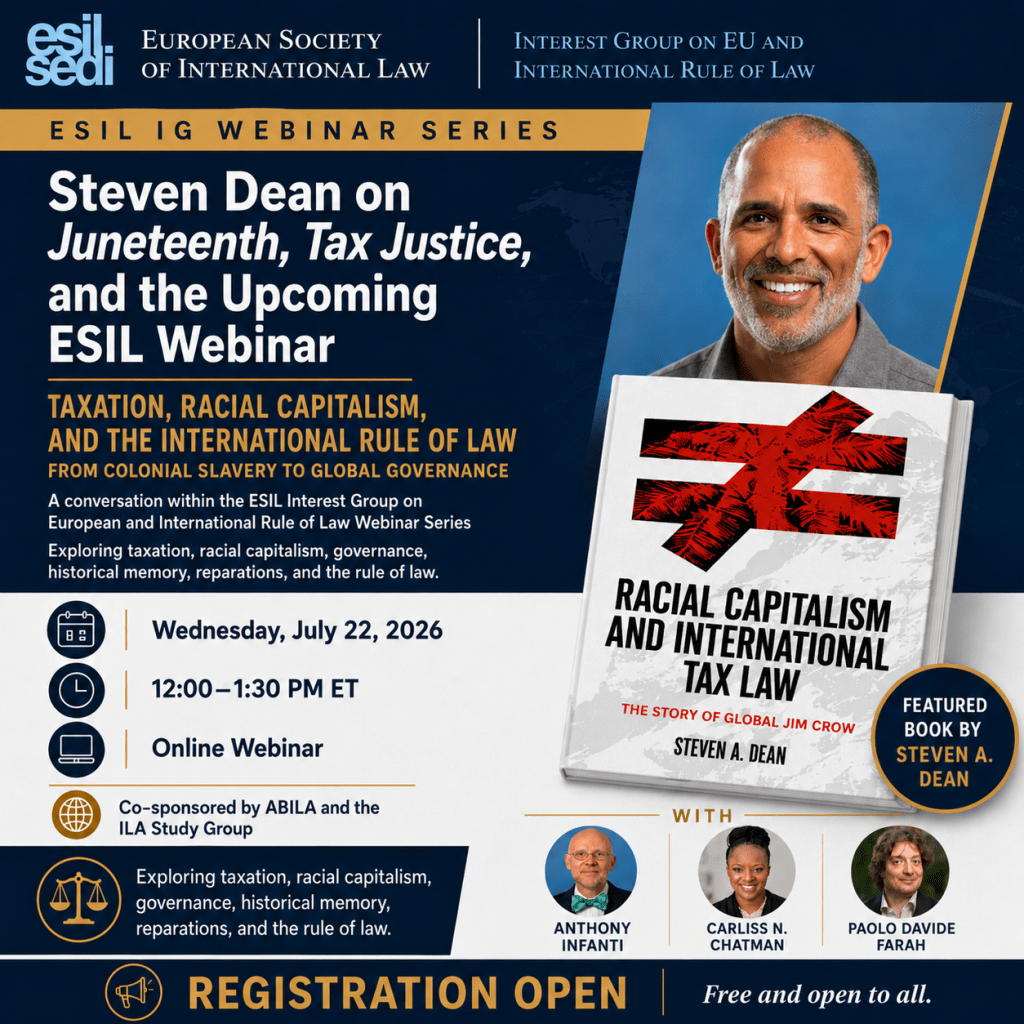
Steven Dean on Juneteenth, Tax Justice, and the Upcoming ESIL Webinar
Juneteenth commemorates June 19, 1865, when enslaved people in Galveston, Texas, were informed of their freedom, more than two years after the Emancipation Proclamation. Steven’s reflections provide an especially meaningful historical frame for a conversation examining how law, taxation, and institutional structures have shaped slavery, racial inequality, and the continuing distribution of economic and political power.
I am greatly looking forward to chairing and moderating the webinar “Taxation, Racial Capitalism, and the International Rule of Law: From Colonial Slavery to Global Governance,” organized as part of the European Society of International Law (ESIL) Interest Group on European and International Rule of Law Webinar Series.
Thank you very much, Steven Dean, for connecting our forthcoming webinar with the history and continuing significance of Juneteenth.
The conversation will bring Steven Dean and Anthony Infanti into dialogue about their books, Racial Capitalism and International Tax Law: The Story of Global Jim Crow and The Human Toll: Taxation and Slavery in Colonial America, with Carliss Chatman participating as discussant.
Together, we will examine how fiscal and legal institutions have contributed to slavery, racial capitalism, exclusion, and global inequality. The discussion will also consider broader questions of emancipation, historical memory, reparations, institutional legitimacy, governance, and the capacity of law to confront the structures it has helped to create.
I am also pleased that the event is co-sponsored by the American Branch of the International Law Association (ABILA) and the ILA Study Group on International Law, Global Challenges, and the Impact of Emerging Powers on Global Governance.
The webinar will take place on Wednesday, July 22, 2026, from 12:00 to 1:30 p.m. Eastern Time. Participation is free and open to all.
Registration
Steven Dean on Juneteenth and the forthcoming conversation
In an earlier post, Steven Dean situated the webinar within the historical significance of Juneteenth:
On Friday, the United States celebrated Juneteenth.
Juneteenth, observed on June 19, marks the day in 1865 when enslaved people in Galveston, Texas, learned that they were free, more than two years after the Emancipation Proclamation.
I hope you will take a moment to celebrate Juneteenth, belatedly, and therefore perhaps appropriately, by registering for this webinar organized by Paolo Davide Farah and the European Society of International Law. It will feature Anthony Infanti, Carliss Chatman, and me.
Steven’s invitation highlights an important dimension of the forthcoming discussion: formal legal declarations do not necessarily produce immediate freedom, equality, or institutional transformation. The gap between legal proclamation and lived reality is central both to the history commemorated by Juneteenth and to the broader examination of taxation, racial capitalism, and the rule of law.
Earlier posts in the series
This post follows a series of announcements and reflections introducing the webinar and its broader intellectual framework.
The first post, “Launching the ESIL Interest Group on European and International Rule of Law Webinar Series,” introduced the objectives of the new series and provided the full description of the inaugural webinar.
A second post, “From Taxation to Epistemic Governance: Knowledge, Power, and the Reconfiguration of Global Order,” situated the webinar within a broader examination of how legal and institutional systems determine whose knowledge is treated as authoritative, how resources and power are allocated, and how competing understandings of justice and global order are legitimized.
In a third post published four days before the webinar entited “Four Days to Go: Taxation, Racial Capitalism, and the International Rule of Law“, I shared an updated announcement highlighting the growing institutional support for the inaugural event of the ESIL Interest Group on European and International Rule of Law Webinar Series. In addition to being organized within the framework of the European Society of International Law, the webinar is co-sponsored by the American Branch of the International Law Association (ABILA) and the ILA Study Group on International Law, Global Challenges, and the Impact of Emerging Powers on Global Governance. Registration remains free and open to all.
This fourth post Anthony Infanti on The Human Toll and the Upcoming ESIL Webinar builds on that announcement by highlighting Anthony Infanti’s own invitation to join the conversation and his reflections on the broader questions of governance, power, legal ordering, institutional design, and knowledge raised by the two books.
This fifth post turns to Steven Dean’s invocation of Juneteenth and the enduring tension between formal legal emancipation and substantive equality.
Proposed Framing of the Conversation
Questions of taxation, racial capitalism, slavery, colonialism, and historical injustice provide an important entry point for examining broader questions of governance, power, legal ordering, institutional design, and the production of knowledge.
Taxation is often presented as a technical field concerned principally with revenue collection, tax bases, administrative efficiency, and the allocation of taxing jurisdiction. The two books in dialogue challenge that limited understanding. They invite us to consider taxation as a form of legal and institutional infrastructure through which societies classify persons and property, structure markets and political authority, distribute resources and vulnerability, and determine whose claims, experiences, and knowledge are recognized.
The conversation will therefore engage directly with the two books while situating them within broader debates concerning international law, global governance, legal history, racial capitalism, fiscal sovereignty, corporate power, historical memory, reparations, institutional legitimacy, and the rule of law.
A central objective will be to consider how formally legal and apparently neutral fiscal arrangements can reproduce durable inequalities, and what forms of historical acknowledgment, redistribution, institutional redesign, and reparative justice may be required in response.
Anthony C. Infanti, The Human Toll: Taxation and Slavery in Colonial America
Professor Infanti’s book challenges the treatment of tax law as a neutral or exceptional field standing apart from the racialized legal ordering of colonial society. It demonstrates how colonial taxation operated alongside property law, slave codes, punishment, migration policy, and public finance to support and perpetuate slavery.
The book examines, among other mechanisms, the classification of enslaved persons as taxable property; the use of import taxes and fiscal incentives to shape racial populations and reinforce White control; and the use of public revenue to compensate slaveholders when enslaved persons were executed or killed under color of law.
The archival method is also central to the book’s intervention. Tax records often preserved the names and claims of slaveholders while erasing or anonymizing the enslaved persons whose lives and deaths generated those claims. By reading fiscal records together with legislative history, petitions, newspapers, pardons, and other sources, the book reconstructs individual lives and forms of resistance while exposing the politics of legal memory.
Steven A. Dean, Racial Capitalism and International Tax Law: The Story of Global Jim Crow
Professor Dean’s book challenges the conventional account of international tax law as the gradual and largely technical development of principles designed to prevent double taxation. It traces the consolidation of the modern international tax order during decolonization and examines the movement of authority away from the United Nations and toward the OECD.
Through the framework of Global Jim Crow, the book considers how rules favoring residence over source taxation, the design of double-tax treaties, institutional exclusion, corporate interests, and the authority of expert communities constrained the fiscal sovereignty of newly independent states and redirected resources away from education, health, development, and other public priorities.
The book also connects representation with distribution. It asks whether formal participation in international institutions can be sufficient when agenda-setting authority, technical expertise, bargaining power, and the substantive rules governing the allocation of taxing rights remain unequal.
Selected Bibliography
Because readers may not have seen those earlier posts, the principal bibliography is reproduced below.
Selected Bibliography
Books in Dialogue
Dean, Steven A. (2025). Racial Capitalism and International Tax Law: The Story of Global Jim Crow. Oxford: Oxford University Press – Examines how international tax law has historically contributed to racialized structures of economic power and inequality on a global scale.
Infanti, Anthony C. (2025). The Human Toll: Taxation and Slavery in Colonial America. New York: New York University Press – Explores the relationship between taxation, slavery, and state-building in colonial America, highlighting the human costs embedded in fiscal and legal institutions.
Related Scholarship by Steven A. Dean
Racialized International Tax Law in Research Handbook on Critical Tax Studies (forthcoming Edinburgh University Press, Yvette Lind and Dominic de Cogan, eds.)
Fear of a Black Planet: Africa’s Decolonisation and the Transformation of the International Tax Regime in Taxing People: The Next 100 Years (Cambridge University Press 2026, Tsilly Dagan and Ruth Mason, eds.)
Filing While Black: The Casual Racism of the Tax Law, 2022 Utah Law Review 801, available at https://papers.ssrn.com/sol3/papers.cfm?abstract_id=4081456
Inclusive International Tax Policymaking: FATCA, the U.S. Congressional Black Caucus, and the OECD Blacklist, Revue Européenne et Internationale de Droit Fiscal(2021) (Reprinted in Tax Notes International)
Ten Truths about Tax Havens: Inclusion and the ‘Liberia’ Problem, 70 Emory Law Journal1657 (2021) (with Attiya Waris), available at https://papers.ssrn.com/sol3/papers.cfm?abstract_id=3822421
Dean’s SSRN Author Page https://papers.ssrn.com/sol3/cf_dev/AbsByAuth.cfm?per_id=440250
Related Scholarship by Anthony Infanti
Our Selfish Tax Laws: Toward Tax Reform That Mirrors Our Better Selves (The MIT Press 2018).
Critical Tax Theory: An Introduction (Cambridge University Press, Anthony C. Infanti & Bridget J. Crawford eds., 2009). The Introduction is available at https://papers.ssrn.com/sol3/papers.cfm?abstract_id=1333799
Internation Equity and Human Development, in Tax, Law and Development (Edward Elgar Publishing, Miranda Stewart & Yariv Brauner eds., 2013).
Tax Equity, 55 Buff. L. Rev. 1191 (2008), available at https://digitalcommons.law.buffalo.edu/buffalolawreview/vol55/iss4/5/
Tax and Time: On the Use and Misuse of Legal Imagination (NYU Press 2022), available at https://papers.ssrn.com/sol3/papers.cfm?abstract_id=4006652
Tax Reform Discourse, 32 Va. Tax Rev. 205 (2012), available at https://papers.ssrn.com/sol3/papers.cfm?abstract_id=2034869
Critical Tax Theory: Insights from the US and Opportunities for All, 51 Austl. Tax Rev. 81 (2022) (with Bridget J. Crawford), available at https://papers.ssrn.com/sol3/papers.cfm?abstract_id=4236410
Infanti’s SSRN Author Page
Related Scholarship by Carliss N. Chatman
(2023). “Teaching Slavery in Commercial Law.” 28 Michigan Journal of Race & Law 1–38. SMU Dedman School of Law Legal Studies Research Paper No. 611. Available at SSRN: https://papers.ssrn.com/sol3/papers.cfm?abstract_id=3926671 – Examines how slavery and its enduring legacies can be more meaningfully integrated into the teaching and understanding of commercial law.
(2026). “The Contract and the Cure: Building a Private Infrastructure for Reparations.” In Slavery’s Long Tentacles: Entanglements in Historical and Modern Forms of Slavery (Cambridge University Press, forthcoming). https://ssrn.com/abstract=6140369 – Explores the role of private law, contracts, and institutional design in advancing reparative justice for the enduring harms of slavery.
(October 24, 2024). “1981”, 82 Wash. & Lee L. Rev. 1655 (2026), SMU Dedman School of Law Legal Studies Research Paper No. 666, Available at SSRN: https://ssrn.com/abstract=4998718 – Analyzes the continuing significance of 42 U.S.C. § 1981 and its role in addressing racial discrimination, equality, and access to economic opportunity.
(2018). “The Corporate Personhood Two-Step.” 18 Nevada Law Journal 811–862. Posted July 17, 2017; revised August 11, 2023. Chatman, Carliss, The Corporate Personhood Two-Step (June 25, 2017). 18 Nev. L. J. 811 (2018), Available at SSRN: https://ssrn.com/abstract=2992275 – Investigates how legal doctrines of corporate personhood shape corporate power, accountability, and the allocation of rights within modern governance systems.
Chatman’s SSRN Author Page https://papers.ssrn.com/sol3/cf_dev/AbsByAuth.cfm?per_id=2419097
Related Scholarship by Paolo D. Farah
(2026). Epistemic Governance. Available at SSRN: https://papers.ssrn.com/sol3/papers.cfm?abstract_id=6487038 – Develops a framework for understanding how knowledge, authority, expertise, and competing narratives shape governance structures, institutional legitimacy, and global ordering.
(2025) China’s Path to Modernization and Legal Pluralism: Transplants and the Belt and Road Initiative, Asian Journal of Law and Society, Cambridge University Press https://papers.ssrn.com/sol3/papers.cfm?abstract_id=5215873 – Examines how competing legal traditions, governance models, and development paradigms contribute to evolving forms of legal pluralism and the reconfiguration of global order.
(2024). “Energy Justice, Just Transition and International Environmental Law.” In ASIL Proceedings (Just Energy Transition: Legal Challenges Associated with Coal Phase Out), Cambridge University Press. Available at SSRN: https://papers.ssrn.com/sol3/papers.cfm?abstract_id=5055884 – Explores how legal and governance frameworks shape the distribution of benefits and burdens during energy transitions, highlighting questions of historical responsibility, distributive justice, institutional legitimacy, and the role of law in addressing structural inequalities associated with climate and energy transformation.
Farah’s SSRN Author Page https://papers.ssrn.com/sol3/cf_dev/AbsByAuth.cfm?per_id=629289
Paolo Davide Farah, Paolo Farah

Professor of Law at Boston University School of Law
On Friday, the US celebrated Juneteenth.
Juneteenth (June 19th) marks the day in 1865 when enslaved people in Galveston, Texas finally learned they were free. That was more than two years after the Emancipation Proclamation had legally freed them.
I hope you will all take a minute to belatedly (and very appropriately so) celebrate Juneteenth by registering for this webinar organized by Paolo Davide Farah (The University of Tulsa College of Law) and the European Society of International Law. It features me, Anthony Infanti (University of Pittsburgh School of Law) and Carliss Chatman (Southern Methodist University Dedman School of Law – Company).
#Juneteenth #TaxJustice #InternationalLaw #RuleOfLaw #HumanRights #LegalScholarship #Webinar #HigherEducation #BULawProf #RacialJustice #CriticalTaxStudies #TaxPolicy

Professor | Founder | Director
Launching the European Society of International Law (ESIL) Interest Group on European and International Rule of Law Webinar Series
The full post is available at https://lnkd.in/dqAu24sr
As Chair of the ESIL Interest Group on European and International Rule of Law, I am delighted to launch the ESIL Interest Group on European and International Rule of Law Webinar Series, a new initiative designed to foster critical and interdisciplinary dialogue on some of the most pressing challenges facing the rule of law today.
This initiative aligns with ESIL’s broader efforts to promote engagement with contemporary developments in international law through innovative online formats. It complements both the ESIL Conversations initiative and the ESIL Teaching Corner Webinar Series, while providing a dedicated forum for sustained discussion of issues relating to governance, justice, accountability, and the rule of law from both European and international perspectives. Giulio Bartolini Patrycja Grzebyk Machiko Kanetake
It is particularly fitting that we begin with a conversation on taxation, racial inequality, and historical injustice, topics that invite reflection on both the promises and limitations of the rule of law.
Inaugural Webinar
1 – Taxation, Racial Capitalism, and the International Rule of Law: From Colonial Slavery to Global Governance
Wednesday July 22, 2026 | 12:00–1:30 PM EST | Online
This inaugural webinar brings into dialogue two important recent books: The Human Toll: Taxation and Slavery in Colonial America by Anthony Infanti (University of Pittsburgh School of Law) New York University Press and Racial Capitalism and International Tax Law: The Story of Global Jim Crow by Steven Dean (Boston University School of Law) – Oxford University Press
The discussion will explore how legal and fiscal systems have historically contributed to structures of domination, exclusion, and racialized inequality, from the fiscal architecture of colonial America to the contemporary global tax order. By placing these works in conversation, the webinar will examine the relationship between taxation, racial capitalism, historical injustice, and the rule of law, while reflecting on the capacity of legal institutions to address past and present inequalities.
The conversation will be chaired by Paolo Davide Farah (The University of Tulsa College of Law) and will feature Carliss Chatman (SMU Dedman School of Law) as discussant.
Participation is free and open to all.
Registration:
https://lnkd.in/dMhpmbda
The full post is available at https://lnkd.in/dqAu24sr
