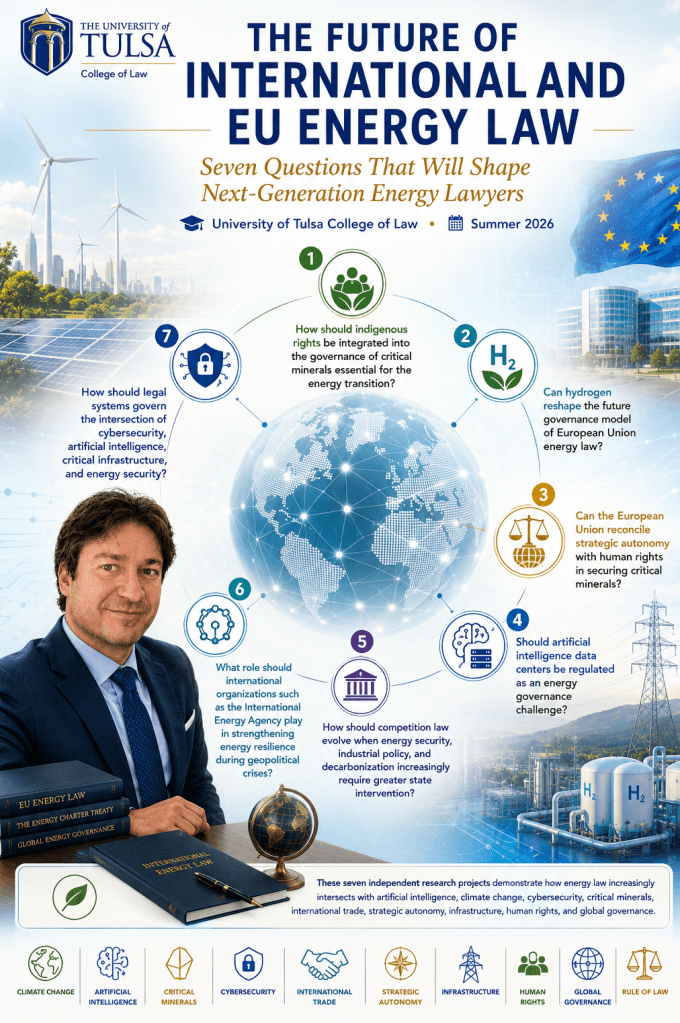
The Future of International and EU Energy Law
Seven Questions That Will Shape Next-Generation Energy Lawyers – University of Tulsa College of Law • Summer 2026
The full post is available at: https://paolofarah.wordpress.com/2026/07/12/the-future-of-international-and-eu-energy-law/
One of the questions I posed to my students during the final session of my International and EU Energy Law course was deceptively simple:
What will the next generation of energy lawyers actually work on?
Thirty years ago, the answer might have centered on oil and gas, pipelines, electricity markets, OPEC, and security of supply.
Today, the picture is very different.
Throughout this summer course at the University of Tulsa College of Law, students developed independent research projects examining some of the most pressing legal and governance challenges shaping the global energy transition.
An important feature of the course was its iterative approach to collaborative research. Rather than preparing presentations independently from the outset, each student first submitted a detailed proposal, received individualized feedback, revised and refined its research question, and, where necessary, adjusted its topic to avoid overlap with other student individual or group presentations and research projects. This iterative process encouraged students to sharpen their analytical frameworks, develop stronger legal arguments, and engage more critically with complex questions of international and EU energy governance before delivering their final presentations.
Collectively, their projects explored seven fundamental questions:
• How should indigenous rights be integrated into the governance of critical mineral extraction essential for the energy transition?
• Can hydrogen reshape the future governance model of European Union energy law?
• Can the European Union reconcile strategic autonomy with its commitments to human rights and sustainable development in securing critical minerals?
• Should artificial intelligence data centers be regulated as an energy governance challenge rather than simply a technology issue?
• How should competition law evolve when energy security, industrial policy, and decarbonization increasingly require greater state intervention?
• What role should international organizations such as the International Energy Agency play in strengthening energy resilience during geopolitical crises?
• How should legal systems govern the intersection of cybersecurity, artificial intelligence, critical infrastructure, and energy security?
Although each student approached a different legal question, together these projects reveal something much larger.
Energy law is no longer confined to regulating oil, gas, or electricity markets.
It increasingly operates at the intersection of:
• artificial intelligence;
• climate change;
• cybersecurity;
• critical minerals;
• international trade;
• strategic autonomy;
• competition law;
• industrial policy;
• human rights;
• infrastructure governance;
• national security;
• and global governance.
Looking across these seven research projects, one conclusion becomes increasingly clear.
The future of energy law will not be defined by a single technology, whether hydrogen, artificial intelligence, advanced nuclear reactors, carbon capture, or critical minerals.
Instead, it will be defined by our ability to design legal institutions capable of governing increasingly interconnected systems in which energy, technology, trade, infrastructure, climate, security, and geopolitics can no longer be treated as separate fields.
Perhaps this is the most important lesson emerging from this course.
The next generation of energy lawyers will not simply advise on regulatory compliance or negotiate energy contracts.
They will help shape the legal architecture governing the energy transition itself.
I would like to thank all of my students for their intellectual curiosity, thoughtful engagement, and commitment throughout this summer semester. Their projects demonstrate not only the remarkable breadth of contemporary energy law but also the importance of preparing future lawyers to navigate an increasingly interconnected world.
The full post is available at: https://paolofarah.wordpress.com/2026/07/12/the-future-of-international-and-eu-energy-law/
Related reflections from this course:
7.20. From Energy Markets to Global Energy Governance: Student Perspectives on the Future of International and EU Energy Law – https://paolofarah.wordpress.com/2026/06/27/from-energy-markets-to-global-energy-governance-student-perspectives-on-the-future-of-international-and-eu-energy-law/
• 7.19. What Is Energy Law Today? Reflections from the Final Class of My International and EU Energy Law Course – https://paolofarah.wordpress.com/2026/06/25/what-is-energy-law-today-reflections-from-the-final-class-of-my-international-and-eu-energy-law-course/
• 7.9. International and EU Energy Law: Global Governance, Strategic Autonomy, and Energy Transformation – https://paolofarah.wordpress.com/2026/05/18/international-and-eu-energy-law-global-governance-strategic-autonomy-and-energy-transformation/
Related Bibliography:
- Artificial Intelligence, Governance and Sustainable Development: Peace, Justice and Strong Institutions, Routledge Publishing (2026).
- Framing AI’s Role in Achieving SDG 16, in Imad Antoine Ibrahim, Jon Truby, Paolo Davide Farah, ARTIFICIAL INTELLIGENCE, GOVERNANCE AND SUSTAINABLE DEVELOPMENT: PEACE, JUSTICE AND STRONG INSTITUTIONS (Routledge Publishing, Transnational Law and Governance Series, 2026).
- Rethinking the Rule of Law for Sustainable Development in the Age of AI, in Imad Antoine Ibrahim, Jon Truby, Paolo Davide Farah, ARTIFICIAL INTELLIGENCE, GOVERNANCE AND SUSTAINABLE DEVELOPMENT, PEACE, JUSTICE AND STRONG INSTITUTIONS (Routledge Publishing, Transnational Law and Governance Series, 2026).
- China’s Belt and Road Initiative and Its Impact on the Energy Independence of the European Union (Asian Journal of Law & Society, 2025): https://papers.ssrn.com/sol3/cf_dev/AbsByAuth.cfm?per_id=629289
- China’s Belt and Road Initiative and Its Impact on the Energy Independence of the European Union, Asian J. Law & Soc’y (Cambridge Univ. Press 2025)
- Science, Technology, Policy and International Law, Routledge Publishing (2024)
- Science, Technology, Society and Law, in Justo Corti Varela & Paolo Davide Farah (eds.), SCIENCE, TECHNOLOGY, POLICY AND INTERNATIONAL LAW (Routledge Publishing, Transnational Law and Governance Series, 2024).
- The Intersections Among Science, Technology, Policy and Law: In Between Truth and Justice, in Justo Corti Varela & Paolo Davide Farah (eds.), SCIENCE, TECHNOLOGY, POLICY AND INTERNATIONAL LAW (Routledge Publishing, Transnational Law and Governance Series, 2024).
- The Interlinkages Science-Technology-Law. Information and Communication Society, Knowledge-Based Economy and the Rule of Law, in Justo Corti Varela & Paolo Davide Farah (eds.), SCIENCE, TECHNOLOGY, POLICY AND INTERNATIONAL LAW (Routledge Publishing, Transnational Law and Governance Series, 2024).
- Energy Justice, Just Transition and International Environmental Law, in ASIL Proc. (Just Energy Transition: Legal Challenges Associated with Coal Phase Out) (Cambridge Univ. Press 2024)
- Urgenda vs. Juliana: Lessons for Future Climate Change Litigation Cases, 84 U. Pitt. L. Rev. 547 (2023).
- Climate Justice in the Anthropocene and Its Relationship with Science and Technology: The Importance of Ethics of Responsibility, 55 Conn. L. Rev. 819 (2023)
- Public Ownership and the WTO in a Post Covid-19 Era: From Trade Disputes To a ‘Social’ Function, 125 W. Va. L. Rev. 644 (2022).
- The Crisis of Multilateral Legal Order: Causes, Dynamics and Implications (Routledge, 2022): https://papers.ssrn.com/sol3/papers.cfm?abstract_id=4235717
- Introduction: Mapping the Crisis of Multilateralism, in Lukasz Gruszczynski, Marcin J. Menkes, Veronika Bilkova & Paolo Davide Farah (eds.), THE CRISIS OF MULTILATERAL LEGAL ORDER: CAUSES, DYNAMICS AND IMPLICATIONS 1–17 (Routledge Publishing 2022).
- Conclusions, in Lukasz Gruszczynski, Marcin J. Menkes, Veronika Bilkova & Paolo Davide Farah (eds.), THE CRISIS OF MULTILATERAL LEGAL ORDER: CAUSES, DYNAMICS AND IMPLICATIONS 303–10 (Routledge Publishing 2022).
- Water-Energy-Food Nexus in International Law: A Legal Analysis, in Floor Brouwer (ed.), HANDBOOK ON THE WATER-ENERGY-FOOD NEXUS 381–97 (Edward Elgar Publishing, Collection: Geography, Planning and Tourism 2022).
- Globalization, Environmental Law and Sustainable Development in the Global South: Challenges for Implementation, Routledge Publishing (2021). This book has been selected by Knowledge Unlatched and awarded a grant for Open Access.
- Introduction, in Kirk W. Junker & Paolo Davide Farah (eds.), GLOBALIZATION, ENVIRONMENTAL LAW AND SUSTAINABLE DEVELOPMENT IN THE GLOBAL SOUTH: CHALLENGES FOR IMPLEMENTATION 1–15 (Routledge Publishing 2021).
- Indicator Species and the Future of Environmental Law, in Kirk W. Junker & Paolo Davide Farah (eds.), GLOBALIZATION, ENVIRONMENTAL LAW AND SUSTAINABLE DEVELOPMENT IN THE GLOBAL SOUTH: CHALLENGES FOR IMPLEMENTATION 305–13 (Routledge Publishing 2021).
- Ethics and Politics of Space for the Anthropocene, Edward Elgar Publishing (2020)
- The Anthropocene and Climate Change in the Post-Paris Agreement Debate, in Anu Valtonen, Outi Rantala & Paolo Davide Farah (eds.), ETHICS AND POLITICS OF SPACE FOR THE ANTHROPOCENE (Edward Elgar Publishing, Collection: Social and Political Science 2020).
- The Role of Imagination, Marginalized Communities, Law and Technology in Building an Ethical Approach to the Anthropocene, in Anu Valtonen, Outi Rantala & Paolo Davide Farah (eds.), ETHICS AND POLITICS OF SPACE FOR THE ANTHROPOCENE (Edward Elgar Publishing, Collection: Social and Political Science 2020).
- Evaluating China’s Environmental Management and Risks Avoidance Policies and Regulations on Offshore Methane Hydrate Extraction, 12 Sustainability 13, 5331 (2020).
- Contextualism in WTO Case Law on Mineral Export Restrictions: Puzzles and Implications, 15 Asian J. WTO & Int’l Health L. & Pol’y 2, 503–38 (Nov. 2020).
- Special Issue, Strategies to Balance Energy Security, Business, Trade and Sustainable Development: Selected Case Studies, 13 J. World Energy L. & Bus. (2020)
- Strategies to Balance Energy Security, Business, Trade and Sustainable Development, 13 J. World Energy L. & Bus. 2, 95–99 (2020).
- China’s Energy Policies and Strategies for Climate Change and Energy Security, 13 J. World Energy L. & Bus. 2, 141–56 (Apr. 2020).
- Trade in Clean Energy Technologies: Sliding from Protection to Protectionism Through Obligations for Technology Transfer in Climate Change Law, or Vice Versa?, 13 J. World Energy L. & Bus. 2, 114–28 (Apr. 2020).
- Governing the Transboundary Risks of Offshore Methane Hydrate Exploration in the Seabed and Ocean Floor: An Analysis on Existing International Provisions and Chinese Law, 13 J. World Energy L. & Bus. 2, 185–203 (Apr. 2020).
- Competition Law and Trade in Energy vs. Sustainable Development: A Clash of Individualism and Cooperative Partnerships? (Arizona State Law Journal, 2018): https://papers.ssrn.com/sol3/papers.cfm?abstract_id=3227777
- Sustainable Development Goals in Europe and Their Intersection with the Business & Human Rights Framework, in Angelica Bonfanti (ed.), BUSINESS AND HUMAN RIGHTS IN EUROPE: INTERNATIONAL LAW CHALLENGES 10–23 (Transnational Law and Governance Series, Routledge Publishing 2018).
- Special Issue, Sustainable Energy and Environmental Protection: The Role of Science in Society, MDPI Sustainability (2017)
- La cooperazione energetica dell’Unione Europea e il Gas Naturale nel Bacino di Levante: Quale Ruolo per l’Associazione delle Autorità dell’Energia del Mediterraneo (MedReg)? (EU Energy Cooperation and Natural Gas in the Levant Basin: Assessing the Role of the Mediterranean Energy Regulators’ Association), Diritto Comunitario e degli Scambi Internazionali, 4/2017, pp. 671 – 700 (in Italian).
- China’s Influence on Non-Trade Concerns in International Economic Law. Climate Change, Sustainable Development and the Protection of Environment, Social, Economic and Cultural Rights, Labour Rights, Public Health, Food and Product Safety, Consumer Protection, Global Law and Sustainable Development Book Series (Routledge Publishing 2016).
- Introduction and Overview, in Paolo Davide Farah & Elena Cima (eds.), CHINA’S INFLUENCE ON NON-TRADE CONCERNS IN INTERNATIONAL ECONOMIC LAW 1–9 (Global Law and Sustainable Development Book Series, Routledge Publishing 2016). ISBN 978-1-4094-4848-8.
- The Development of Global Justice and Sustainable Development Principles in the WTO Multilateral Trading System Through the Lens of Non-Trade Concerns: An Appraisal on China’s Progress, in Paolo Davide Farah & Elena Cima (eds.), CHINA’S INFLUENCE ON NON-TRADE CONCERNS IN INTERNATIONAL ECONOMIC LAW 10–58 (Global Law and Sustainable Development Book Series, Routledge Publishing 2016).
- The Principle of Common But Differentiated Responsibilities in the International Regime of Climate Change, in Paolo Davide Farah & Elena Cima (eds.), CHINA’S INFLUENCE ON NON-TRADE CONCERNS IN INTERNATIONAL ECONOMIC LAW 146–57 (Global Law and Sustainable Development Book Series, Routledge Publishing 2016).
- Product Safety in the Framework of the WTO Agreement on Technical Barriers to Trade, in Paolo Davide Farah & Elena Cima (eds.), CHINA’S INFLUENCE ON NON-TRADE CONCERNS IN INTERNATIONAL ECONOMIC LAW 436–48 (Global Law and Sustainable Development Book Series, Routledge Publishing 2016).
- A Comparison Between Shale Gas in China and Unconventional Fuel Development in the United States: Water, Environment and Sustainable Development, 41 Brook. J. Int’l L. 579 (2016).
- Energy: Policy, Legal and Social-Economic Issues Under the Dimensions of Sustainability and Security (2015): https://papers.ssrn.com/sol3/papers.cfm?abstract_id=2695701
- Introduction, in Paolo Davide Farah & Piercarlo Rossi (eds.), ENERGY: POLICY, LEGAL AND SOCIAL-ECONOMIC ISSUES UNDER THE DIMENSIONS OF SUSTAINABILITY AND SECURITY 1–12 (World Scientific Reference on Globalisation in Eurasia and the Pacific Rim, Imperial College Press 2015).
- Global Energy Governance, International Environmental Law and Regional Dimension, in Paolo Davide Farah & Piercarlo Rossi (eds.), ENERGY: POLICY, LEGAL AND SOCIAL-ECONOMIC ISSUES UNDER THE DIMENSIONS OF SUSTAINABILITY AND SECURITY 143–61 (World Scientific Reference on Globalisation in Eurasia and the Pacific Rim, Imperial College Press 2015).
- Energy Security, Water Resources and Economic Development in Central Asia, in Paolo Davide Farah & Piercarlo Rossi (eds.), ENERGY: POLICY, LEGAL AND SOCIAL-ECONOMIC ISSUES UNDER THE DIMENSIONS OF SUSTAINABILITY AND SECURITY 179–93 (World Scientific Reference on Globalisation in Eurasia and the Pacific Rim, Imperial College Press 2015).
- Energy Investments and Environmental Concerns in South-East Asia, in Paolo Davide Farah & Piercarlo Rossi (eds.), ENERGY: POLICY, LEGAL AND SOCIAL-ECONOMIC ISSUES UNDER THE DIMENSIONS OF SUSTAINABILITY AND SECURITY 195–210 (World Scientific Reference on Globalisation in Eurasia and the Pacific Rim, Imperial College Press 2015).
- Special Issue, Sustainable Energy Investments and National Security: Arbitration and Negotiation Issues, 8 J. World Energy L. & Bus. 495-599 (2015)
- Sustainable Energy Investments and National Security: Arbitration and Negotiation Issues, 8 J. World Energy L. & Bus. 6, 497–500 (Dec. 2015).
- Offshore Natural Gas Resources in the Eastern Mediterranean in the Relations to the European Union: A Legal Perspective through the Lenses of MedReg, 8 J. World Energy L. & Bus. 6, 559–80 (Dec. 2015).
- China’s Role and Contribution in the Global Governance of Climate Change: Institutional Adjustments for Carbon Tax Introduction, Collection and Management in China, 8 J. World Energy L. & Bus. 6, 581–99 (Dec. 2015).
- World Trade Organization, Renewable Energy Subsidies and the Case of Feed-in Tariffs: Time for Reform Toward Sustainable Development?, 27 Geo. Envtl. L. Rev. 515 (2015).
- WTO and Renewable Energy: Lessons from the Case Law, 49 J. World Trade 6, 1103–16 (Dec. 2015). ISSN: 1011-6702.
- Lo shale gas in Cina alla luce della sicurezza energetica e dei principi dello sviluppo sostenibile (Shale Gas in China in the Light of Energy Security and Sustainable Development Principles), ItalianiEuropei, 2/2015, March 2015, pp. 132-141 (in Italian).
- Regolazione e prospettive del mercato dello shale gas in Cina tra diritto del commercio internazionale, diritto dell’energia, accordi di produzione, protezione ambientale e sviluppo sostenibile: un confronto con l’esperienza statunitense (Regulation and Prospects of the Shale Gas Market in China in Light of International Trade Law, Energy Law, Production-Sharing Agreements, Environmental Protection, and Sustainable Development: A Comparison with the US Experience), Diritto Comunitario e degli Scambi Internazionali, 1-2/2015, pp. 29-83 (in Italian).
- L’energia nel contesto degli accordi dell’OMC: sovvenzioni per le energie rinnovabili e pratiche OPEC di controllo dei prezzi (Energy in the Context of WTO Agreements: Subsidies for Renewable Energy and OPEC Price Control Practices), Rivista di Diritto del Commercio Internazionale, 2/2013, ISSN: 1593-2605, pp. 343-381 (in Italian).
- Energy Trade and the WTO: Implications for Renewable Energy and the OPEC Cartel (Journal of International Economic Law, 2013): https://papers.ssrn.com/sol3/papers.cfm?abstract_id=2330416
- National Energy Policies and Energy Security in the Context of Climate Change and Global Environmental Risks: A Theoretical Framework for Reconciling Domestic and International Law through a Multiscalar and Multilevel Approach, 20 Eur. Energy & Envtl. L. Rev. 6, 232–44 (2011).
Paolo Davide Farah, Paolo Farah