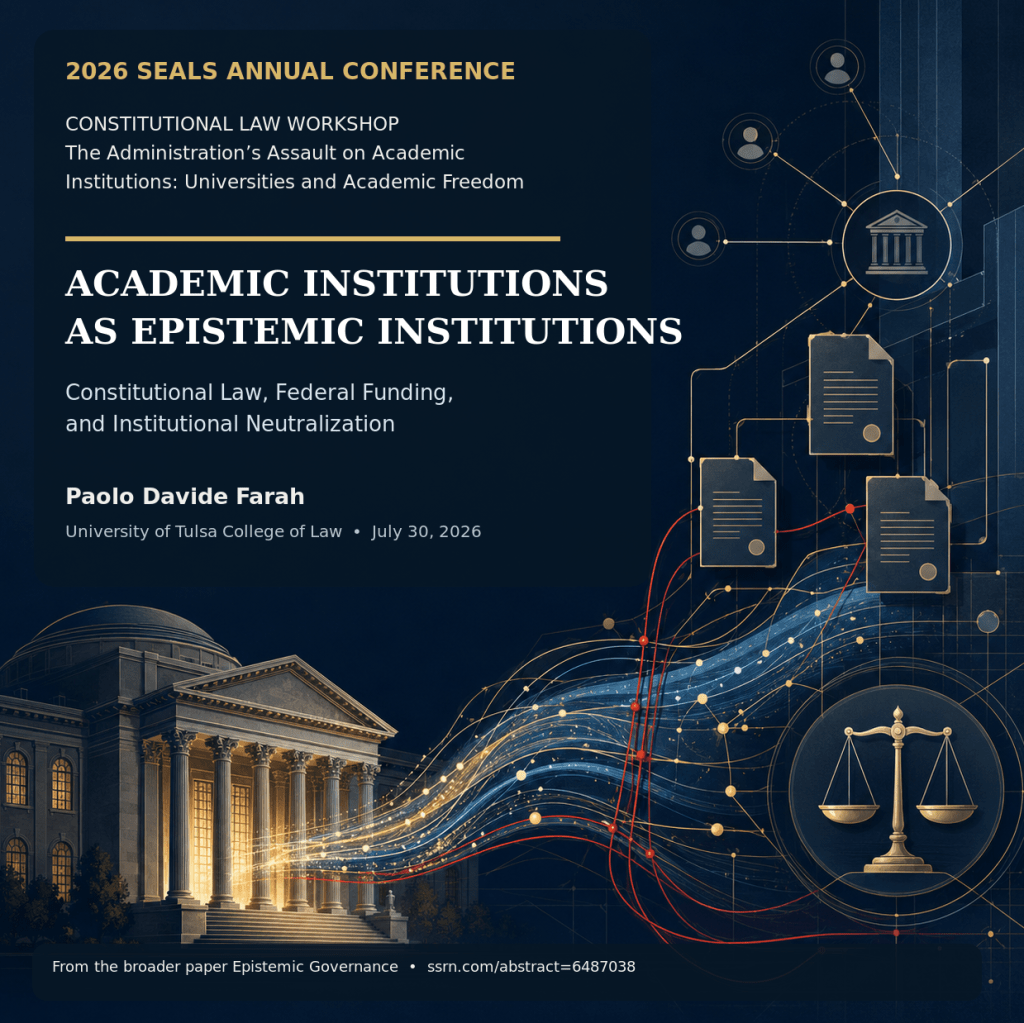
Academic Institutions as Epistemic Institutions: Constitutional Law, Federal Funding, and Institutional Neutralization
It was a pleasure to present “Academic Institutions as Epistemic Institutions: Constitutional Law, Federal Funding, and Institutional Neutralization” at the Constitutional Law Workshop, “The Administration’s Assault on Academic Institutions: Universities and Academic Freedom,” during the 2026 Southeastern Association of Law Schools (SEALS) Annual Conference.
The full long post is available at https://paolofarah.wordpress.com/2026/07/31/academic-institutions-as-epistemic-institutions-constitutional-law-federal-funding-and-institutional-neutralization-2026-southeastern-association-of-law-schools-seals-annual-conference/
My presentation developed one component of my broader paper, “Epistemic Governance,” applying its analytical framework to contemporary pressures on universities, academic freedom, federal research funding, and institutional autonomy. It examined how formally neutral legal, financial, and administrative mechanisms can reshape the conditions under which knowledge is produced, evaluated, and institutionally authorized.
The full working paper is available on SSRN:
https://ssrn.com/abstract=6487038
My contribution examines contemporary pressures on universities and academic freedom through the framework of epistemic governance—the legal and institutional processes through which authority determines what counts as valid knowledge, who may produce it, and under what material conditions it may be produced and disseminated.
Rather than concentrating exclusively on direct censorship or explicit ideological intervention, I examine how ostensibly neutral legal and administrative mechanisms—including conditional federal funding, budgetary restructuring, compliance mandates, accreditation pressures, changes in research priorities, and the centralization of university governance—can reshape the conditions under which knowledge is produced, evaluated, disseminated, and institutionally authorized. I describe this process as institutional neutralization: the weakening of institutions capable of generating independent expertise, criticism, or oversight through defunding, restructuring, procedural marginalization, governance redesign, and the reallocation of decision-making authority.
This perspective also complicates the conventional distinction between public and private universities. Although their constitutional positions remain different, both are embedded in dense networks of federal funding, accreditation, regulation, contractual obligations, tax benefits, and administrative dependence. Government may therefore influence academic institutions not only through direct legal commands, but also by altering the financial, regulatory, and organizational infrastructure upon which research and teaching depend.
The constitutional and administrative-law dimension of my analysis traces the judiciary’s evolving role in allocating epistemic authority among scientific communities, courts, administrative agencies, universities, Congress, and the Executive. The doctrinal account begins with evidence law. Under the general-acceptance standard articulated in Frye v. United States, courts largely relied on the relevant scientific community to determine whether specialized knowledge had achieved sufficient legitimacy to enter legal proceedings. Daubert v. Merrell Dow Pharmaceuticals did not reject scientific expertise, but it reallocated ultimate authority over the legal admissibility of scientific knowledge to judges, transforming courts into epistemic gatekeepers.
The analysis then turns to administrative law. Motor Vehicle Manufacturers Association v. State Farm, Chevron U.S.A. Inc. v. NRDC, and Massachusetts v. EPA offer different models for mediating among judicial review, statutory obligation, administrative expertise, political accountability, and decision-making under conditions of scientific uncertainty. That accommodation has increasingly given way to more intensive judicial control, particularly through the major-questions doctrine in West Virginia v. EPA and the abandonment of Chevron deference in Loper Bright Enterprises v. Raimondo.
The separation-of-powers analysis culminates in Trump v. Slaughter, in which the Supreme Court overruled Humphrey’s Executor and substantially expanded presidential control over independent regulatory agencies. The decision is especially important to my argument because the constitutional status of agency independence is also a question about the institutional conditions under which professional expertise can resist immediate political direction. The Supreme Court’s June 29, 2026 opinion confirms this characterization.
Finally, I connect this doctrinal trajectory to recent litigation concerning federal research funding and the continued viability of particular fields of inquiry, including Association of American Universities v. National Science Foundation, Commonwealth of Massachusetts v. National Institutes of Health, National Institutes of Health v. American Public Health Association, and American Association of Physicians for Human Rights v. National Institutes of Health. These cases bring together Administrative Procedure Act review, congressional control of appropriations, presidential administration, separation of powers, jurisdiction, remedial authority, and Fifth Amendment equal-protection principles. They also expose a deeper constitutional question: whether government funding decisions merely allocate scarce resources or may effectively determine which forms of knowledge, research communities, and academic disciplines are institutionally capable of surviving. See, for example, the decisions involving NSF funding, NIH indirect-cost reimbursement, and NIH grant terminations.
Taken together, these developments reveal an important transformation in the judicial function. Courts have moved from deciding which knowledge may enter legal proceedings, to reviewing how administrative agencies use scientific knowledge, and ultimately to determining the institutional, constitutional, and financial conditions under which scientific and academic knowledge may be produced at all.
Without equating contemporary American developments with McCarthyism or with historical authoritarian experiences abroad, I draw on comparative and historical examples to identify structural continuities in the ways political power can recalibrate epistemic institutions while preserving the outward appearance of legality, administrative neutrality, and institutional autonomy. My central claim is that academic freedom cannot be protected solely as an individual expressive right. It must also be understood as an institutional and infrastructural constitutional value, dependent upon the continued existence of institutions with sufficient professional autonomy, financial stability, and decisional independence to produce knowledge that may challenge governmental power.
The full long post is available at https://paolofarah.wordpress.com/2026/07/31/academic-institutions-as-epistemic-institutions-constitutional-law-federal-funding-and-institutional-neutralization-2026-southeastern-association-of-law-schools-seals-annual-conference/
Paolo Davide Farah, Paolo Farah