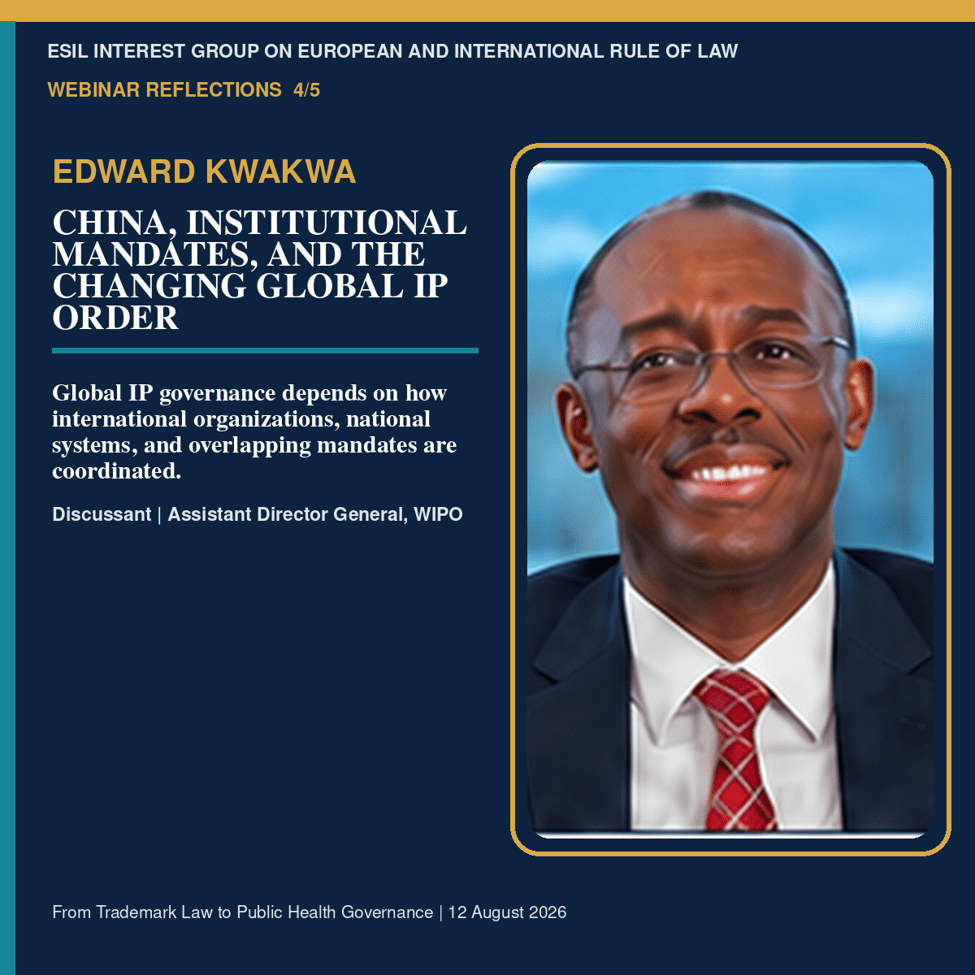

Edward Kwakwa: China, Institutional Mandates, and the Changing Global IP Order – Reflections on the 2nd Webinar – ESIL Interest Group on European and International Rule of Law Webinar Series · Webinar 2 · Reflection 4/5
What happens when international intellectual-property governance is viewed not from the perspective of a single treaty or doctrine, but from inside the institutions that must make different legal mandates coexist?
That was the distinctive contribution of Edward Kwakwa, Assistant Director General of the World Intellectual Property Organization (WIPO), to our second Webinar, From Trademark Law to Public Health Governance: Intellectual Property, International Treaties, and the Rule of Law in a Changing Global Order.
His role in the Webinar was deliberately different from those of Professors Shujie Feng and Srividhya Ragavan.
Professor Feng introduced his work on Chinese trademark law and international treaties. Professor Ragavan presented the arguments developed with Swaraj Paul Barooah in Fractures in IP, Trade, and Health: Centering a Public Health Framework. I had invited Edward Kwakwa not to provide a third book presentation, but to act as an institutional bridge: to bring the two scholarly projects into conversation with the practical architecture of international intellectual-property governance itself.
In the discussion framework circulated to the speakers before the Webinar, I therefore asked a different set of questions of him.
Where should international harmonization end and legitimate domestic implementation discretion begin?
How should WIPO, the WTO, and the WHO cooperate when their mandates overlap but are not identical?
How can international organizations provide technical assistance and capacity building without transmitting a one-size-fits-all conception of “best practice”?
What role should international organizations play in producing and validating the evidence on which national IP policy is based?
And, from the perspective of the international rule of law, which institutional safeguards—transparency, participation, reason-giving, technical capacity, review, distributional assessment—matter most for legitimate global norm-setting?
Kwakwa’s own opening reflections began with China and with how dramatically the international IP landscape has changed.
He recalled that approximately two decades ago, international discussion frequently approached China through the language of non-compliance: whether China adequately respected intellectual property, whether it participated in particular international agreements, and whether its legal system conformed sufficiently to international standards.
The institutional picture he described in 2026 was profoundly different.
Drawing on WIPO statistics available at the time of the Webinar, he noted China’s leading role in international patent activity under the Patent Cooperation Treaty, the presence of Chinese companies among major international applicants, the position of Tsinghua University among significant university users of the system, and China’s extraordinary presence in international trademarks and industrial designs.
The significance of these figures for our conversation was not simply quantitative.
Statistics do not themselves establish the quality of innovation, its social value, or its distributional consequences. Professor Ragavan would later make precisely that point.
But the figures demonstrated something institutionally important: China can no longer plausibly be understood only as an object of international IP compliance. It has become one of the principal users, participants, and increasingly shapers of the international system itself.
That distinction connected directly with one of the broader questions I had introduced into the Webinar: how should international law understand China, India, and other emerging powers not merely as recipients of rules produced elsewhere, but as sources of legal practice, policy innovation, negotiating power, and institutional alternatives?
Kwakwa’s example of the Beijing Treaty on Audiovisual Performances made that transformation concrete.
An earlier diplomatic conference had failed because states could not agree on the allocation of rights between performers and producers. The eventual Beijing Treaty succeeded through an institutional compromise that left space for national law to determine aspects of that allocation.
This example mattered for more than the history of one WIPO treaty.
It illustrated a theme running through the entire Webinar: harmonization does not have to mean uniformity.
International cooperation sometimes succeeds precisely because an international instrument establishes a common framework while preserving legitimate domestic legal choice.
That insight created a direct bridge to Professor Feng’s account of Chinese trademark law. Feng had shown international norms being received, implemented, supplemented, and eventually adapted through Chinese institutions. Kwakwa’s treaty example showed the same problem from the other direction: international norm-making itself may depend upon recognizing that domestic legal systems need space to operate differently.
The question I wanted the conversation to confront was therefore not simply whether harmonization is desirable.
It was where harmonization should stop.
Common rules can create predictability, facilitate international transactions, and protect legitimate expectations. But excessive standardization can obscure differences in legal culture, administrative capacity, technological development, economic structure, developmental priorities, and public-health needs.
Kwakwa resisted a one-size-fits-all model and emphasized that domestic regulatory autonomy must remain capable of responding to these different national circumstances.
This was particularly important because the Webinar was also examining the transformation of emerging powers within global governance.
Professor Feng’s trademark-squatting example showed Chinese domestic law extending an international baseline in response to forms of abuse encountered in practice.
Kwakwa’s statistics and treaty experience showed China exercising increasing influence within international institutional processes.
Professor Ragavan then added a necessary caution: impressive numbers of applications or registered rights should not automatically be equated with greater creativity, better innovation, or increased welfare.
Together, these interventions moved the discussion beyond the old binary of rule-maker versus rule-taker.
States may receive international norms, adapt them, generate domestic solutions, participate more intensively in international institutions, and eventually influence the norms and institutional practices through which other states operate.
The direction of legal influence is therefore increasingly multidirectional.
Kwakwa then brought the conversation to COVID-19, where the relationship among intellectual property, innovation, public health, and institutional responsibility became much more contested.
He emphasized the extraordinary speed with which several vaccines moved from research to regulatory approval and defended the contribution made by the intellectual-property system to the innovation ecosystem that made such development possible.
At the same time, he resisted attributing unequal vaccine access to intellectual property alone.
Regulatory approvals, manufacturing capacity, production bottlenecks, supply limitations, distribution infrastructure, and vaccine nationalism also shaped the outcome.
His skepticism concerning the TRIPS waiver produced one of the most valuable exchanges of the Webinar.
Professor Ragavan did not deny the extraordinary achievement represented by rapid vaccine development. Instead, she redirected the discussion toward a structural question:
Why should such extraordinary scientific, governmental, regulatory, financial, and industrial coordination become possible only when the world is already confronting catastrophe?
That exchange helped move the conversation beyond a binary debate over whether “IP caused” or “IP solved” the COVID crisis.
Innovation, regulatory approval, production, procurement, distribution, affordability, and public trust are different institutional tasks.
A system can perform remarkably well at one and fail dramatically at another.
The more important governance question is therefore how institutions can preserve the conditions for innovation while building the mechanisms of coordination required for access before the next emergency occurs.
This brought us directly to one of the principal issues I had placed in the circulated discussion framework: the relationship among WIPO, the WTO, and the WHO.
Professor Ragavan and Professor Barooah call for stronger institutional cooperation and a public-health framework capable of operating across existing legal regimes.
Kwakwa brought the perspective of an international organization whose mandate is centered on intellectual property but which operates in an environment where IP decisions intersect constantly with trade, development, innovation, public health, competition, technology, and national regulation.
The difficulty is that institutional cooperation cannot simply mean asking three organizations to work together.
They possess different legal mandates, different expertise, different decision-making structures, and different forms of institutional authority.
The example of Australia’s tobacco plain-packaging measures made those tensions visible.
Trademark law ordinarily protects signs that distinguish goods and services. Public-health regulation sought instead to reduce the communicative and promotional force of cigarette packaging.
The WTO litigation ultimately left room for Australia’s health measures, and the result could understandably be regarded as an important victory for public-health regulation.
But the issue looked different when viewed from organizations possessing different institutional mandates.
The WHO approaches tobacco through health.
The WTO approaches measures through disciplines governing international trade.
WIPO operates through an institutional mandate centered on intellectual property and the international systems through which those rights are recognized and administered.
The same factual controversy can therefore enter different institutions through different legal categories.
That was precisely why I had framed the Webinar through institutional and epistemic governance.
Institutions do not merely apply neutral rules to objectively established facts. They help define the problem itself.
They determine which evidence matters, which expertise is authoritative, which risks are made visible, how competing interests are characterized, and what counts as a legally relevant consequence.
A tobacco measure can therefore appear simultaneously as a trademark issue, a trade issue, a public-health measure, a regulatory intervention, and a question about state policy space.
The rule-of-law challenge is not solved simply by declaring one institutional mandate superior in every case.
During the discussion, I therefore emphasized that coordination must not become a disguised institutional hierarchy.
If every conflict is resolved automatically in favor of IP protection, public-health institutions lose meaningful authority.
If every IP entitlement can be displaced whenever another policy interest is invoked, predictability and legal protection become unstable.
But allowing specialized institutions simply to operate in isolation produces fragmentation, duplication, and potentially contradictory assumptions.
The harder task is to determine what should be coordinated, what should remain institutionally plural, what evidence should be shared, where authority should lie, and how decisions should be explained and reviewed.
This is also why the distinction between fragmentation and legitimate pluralism mattered so much to the conversation.
Institutional plurality is not necessarily a defect.
Different organizations may possess valuable specialized knowledge. Multiple institutions can create experimentation, alternative pathways, and checks against excessive concentration of authority.
The question is whether those institutions possess mechanisms for joint reasoning, exchange of evidence, transparency, and accountability when their decisions affect the same people and policies.
Kwakwa’s contribution also sharpened another epistemic question.
International organizations do not only negotiate treaties.
They produce statistics, classifications, technical standards, comparative information, capacity-building programs, and models of best practice.
Those activities influence how governments understand their own legal systems.
China’s transformation, for example, can be made institutionally visible through PCT applications, trademark filings, industrial-design statistics, treaty participation, and other indicators generated through international systems.
Those indicators are extremely valuable.
But the conversation with Professor Ragavan demonstrated why they must also be interpreted carefully.
Application numbers can show participation in an IP system. They cannot, by themselves, tell us whether the resulting innovation improves health, increases welfare, advances domestic productive capacity, benefits particular communities, or produces socially valuable creativity.
International organizations therefore exercise an important form of epistemic authority: the categories they measure help determine what governments and scholars perceive as institutional success.
That makes evidence itself part of the rule-of-law inquiry.
The final round of the Webinar allowed Kwakwa to return from these large conceptual questions to a very concrete institutional example: geographical indications.
Because no public audience questions appeared in the queue, I moved directly to the concluding question that had been circulated to the speakers:
What single institutional change—or change in legal imagination—would most improve the ability of international intellectual-property law to reconcile innovation, public welfare, national regulatory autonomy, and legitimate global cooperation?
Kwakwa answered through the development of an operational international mechanism.
TRIPS had placed geographical indications firmly within international intellectual-property law, but WTO negotiations concerning enhanced protection and a multilateral register proved exceptionally difficult.
WIPO’s Lisbon system, particularly following its evolution to encompass geographical indications, offered another institutional pathway.
The significance of his example was practical.
International governance advances not only through declarations of principle, but through legal and administrative infrastructures that states, producers, and communities can actually use.
Kwakwa referred to products from Ghana, including kente cloth, shea butter, and pineapples, as illustrations of the potential value that geographical-indication systems may hold for developing economies and local producers.
This example brought the discussion full circle.
International IP law is often described through major treaty negotiations and abstract debates about harmonization.
But much of its practical significance lies in the institutional machinery constructed beneath those norms: filing systems, registration procedures, classifications, administrative expertise, databases, technical assistance, dispute-settlement mechanisms, judicial review, and pathways through which local producers can convert distinctive knowledge, reputation, or production into legally recognizable interests.
The GI example also connected Kwakwa’s intervention back to the themes raised by Professor Ragavan concerning India, traditional knowledge, traditional cultural expressions, local productive capacity, and development.
It suggested that the future of international IP governance may not depend upon discovering a single institution capable of resolving every conflict.
It may depend instead upon designing relationships among institutions that remain specialized but become more capable of learning from one another, accommodating national difference, and building operational mechanisms around interests that the international system has historically recognized unevenly.
Edward Kwakwa’s contribution therefore showed why the international IP order cannot be understood solely through treaty texts.
Its evolution depends upon institutional mandates, statistical knowledge, diplomatic negotiation, domestic implementation, regulatory autonomy, technical capacity, organizational cooperation, and the creation of mechanisms that states and communities can actually use.
His intervention also illustrated the transformation of the global order itself.
China’s trajectory from a country frequently discussed through the language of IP compliance to one of the major participants in international IP systems is not simply a story about China.
It is evidence of a changing geography of international legal authority.
And the disagreements over vaccines, public health, trademarks, geographical indications, and institutional competence demonstrate that the central rule-of-law problem is increasingly not whether international institutions exist, but how authority should be distributed among them when legitimate mandates, forms of expertise, and public purposes overlap.
The task is therefore neither complete harmonization nor institutional isolation.
It is to make international cooperation capable of preserving common commitments while remaining responsive to legal diversity, development, public health, innovation, evidence, domestic policy space, and the changing distribution of power within global governance.
Edward Kwakwa: China, Institutional Mandates, and the Changing Global IP Order – Reflections on the 2nd Webinar – ESIL Interest Group on European and International Rule of Law Webinar Series · Webinar 2 · Reflection 4/5
What happens when international intellectual-property governance is viewed not from the perspective of a single treaty or doctrine, but from inside the institutions that must make different legal mandates coexist?
That was the distinctive contribution of Edward Kwakwa, Assistant Director General of the World Intellectual Property Organization (WIPO), to our second Webinar, From Trademark Law to Public Health Governance: Intellectual Property, International Treaties, and the Rule of Law in a Changing Global Order.
His role in the Webinar was deliberately different from those of Professors Shujie Feng and Srividhya Ragavan.
Professor Feng introduced his work on Chinese trademark law and international treaties. Professor Ragavan presented the arguments developed with Swaraj Paul Barooah in Fractures in IP, Trade, and Health: Centering a Public Health Framework. I had invited Edward Kwakwa not to provide a third book presentation, but to act as an institutional bridge: to bring the two scholarly projects into conversation with the practical architecture of international intellectual-property governance itself.
In the discussion framework circulated to the speakers before the Webinar, I therefore asked a different set of questions of him.
Where should international harmonization end and legitimate domestic implementation discretion begin?
How should WIPO, the WTO, and the WHO cooperate when their mandates overlap but are not identical?
How can international organizations provide technical assistance and capacity building without transmitting a one-size-fits-all conception of “best practice”?
What role should international organizations play in producing and validating the evidence on which national IP policy is based?
And, from the perspective of the international rule of law, which institutional safeguards—transparency, participation, reason-giving, technical capacity, review, distributional assessment—matter most for legitimate global norm-setting?
Kwakwa’s own opening reflections began with China and with how dramatically the international IP landscape has changed.
He recalled that approximately two decades ago, international discussion frequently approached China through the language of non-compliance: whether China adequately respected intellectual property, whether it participated in particular international agreements, and whether its legal system conformed sufficiently to international standards.
The institutional picture he described in 2026 was profoundly different.
Drawing on WIPO statistics available at the time of the Webinar, he noted China’s leading role in international patent activity under the Patent Cooperation Treaty, the presence of Chinese companies among major international applicants, the position of Tsinghua University among significant university users of the system, and China’s extraordinary presence in international trademarks and industrial designs.
The significance of these figures for our conversation was not simply quantitative.
Statistics do not themselves establish the quality of innovation, its social value, or its distributional consequences. Professor Ragavan would later make precisely that point.
But the figures demonstrated something institutionally important: China can no longer plausibly be understood only as an object of international IP compliance. It has become one of the principal users, participants, and increasingly shapers of the international system itself.
That distinction connected directly with one of the broader questions I had introduced into the Webinar: how should international law understand China, India, and other emerging powers not merely as recipients of rules produced elsewhere, but as sources of legal practice, policy innovation, negotiating power, and institutional alternatives?
Kwakwa’s example of the Beijing Treaty on Audiovisual Performances made that transformation concrete.
An earlier diplomatic conference had failed because states could not agree on the allocation of rights between performers and producers. The eventual Beijing Treaty succeeded through an institutional compromise that left space for national law to determine aspects of that allocation.
This example mattered for more than the history of one WIPO treaty.
It illustrated a theme running through the entire Webinar: harmonization does not have to mean uniformity.
International cooperation sometimes succeeds precisely because an international instrument establishes a common framework while preserving legitimate domestic legal choice.
That insight created a direct bridge to Professor Feng’s account of Chinese trademark law. Feng had shown international norms being received, implemented, supplemented, and eventually adapted through Chinese institutions. Kwakwa’s treaty example showed the same problem from the other direction: international norm-making itself may depend upon recognizing that domestic legal systems need space to operate differently.
The question I wanted the conversation to confront was therefore not simply whether harmonization is desirable.
It was where harmonization should stop.
Common rules can create predictability, facilitate international transactions, and protect legitimate expectations. But excessive standardization can obscure differences in legal culture, administrative capacity, technological development, economic structure, developmental priorities, and public-health needs.
Kwakwa resisted a one-size-fits-all model and emphasized that domestic regulatory autonomy must remain capable of responding to these different national circumstances.
This was particularly important because the Webinar was also examining the transformation of emerging powers within global governance.
Professor Feng’s trademark-squatting example showed Chinese domestic law extending an international baseline in response to forms of abuse encountered in practice.
Kwakwa’s statistics and treaty experience showed China exercising increasing influence within international institutional processes.
Professor Ragavan then added a necessary caution: impressive numbers of applications or registered rights should not automatically be equated with greater creativity, better innovation, or increased welfare.
Together, these interventions moved the discussion beyond the old binary of rule-maker versus rule-taker.
States may receive international norms, adapt them, generate domestic solutions, participate more intensively in international institutions, and eventually influence the norms and institutional practices through which other states operate.
The direction of legal influence is therefore increasingly multidirectional.
Kwakwa then brought the conversation to COVID-19, where the relationship among intellectual property, innovation, public health, and institutional responsibility became much more contested.
He emphasized the extraordinary speed with which several vaccines moved from research to regulatory approval and defended the contribution made by the intellectual-property system to the innovation ecosystem that made such development possible.
At the same time, he resisted attributing unequal vaccine access to intellectual property alone.
Regulatory approvals, manufacturing capacity, production bottlenecks, supply limitations, distribution infrastructure, and vaccine nationalism also shaped the outcome.
His skepticism concerning the TRIPS waiver produced one of the most valuable exchanges of the Webinar.
Professor Ragavan did not deny the extraordinary achievement represented by rapid vaccine development. Instead, she redirected the discussion toward a structural question:
Why should such extraordinary scientific, governmental, regulatory, financial, and industrial coordination become possible only when the world is already confronting catastrophe?
That exchange helped move the conversation beyond a binary debate over whether “IP caused” or “IP solved” the COVID crisis.
Innovation, regulatory approval, production, procurement, distribution, affordability, and public trust are different institutional tasks.
A system can perform remarkably well at one and fail dramatically at another.
The more important governance question is therefore how institutions can preserve the conditions for innovation while building the mechanisms of coordination required for access before the next emergency occurs.
This brought us directly to one of the principal issues I had placed in the circulated discussion framework: the relationship among WIPO, the WTO, and the WHO.
Professor Ragavan and Professor Barooah call for stronger institutional cooperation and a public-health framework capable of operating across existing legal regimes.
Kwakwa brought the perspective of an international organization whose mandate is centered on intellectual property but which operates in an environment where IP decisions intersect constantly with trade, development, innovation, public health, competition, technology, and national regulation.
The difficulty is that institutional cooperation cannot simply mean asking three organizations to work together.
They possess different legal mandates, different expertise, different decision-making structures, and different forms of institutional authority.
The example of Australia’s tobacco plain-packaging measures made those tensions visible.
Trademark law ordinarily protects signs that distinguish goods and services. Public-health regulation sought instead to reduce the communicative and promotional force of cigarette packaging.
The WTO litigation ultimately left room for Australia’s health measures, and the result could understandably be regarded as an important victory for public-health regulation.
But the issue looked different when viewed from organizations possessing different institutional mandates.
The WHO approaches tobacco through health.
The WTO approaches measures through disciplines governing international trade.
WIPO operates through an institutional mandate centered on intellectual property and the international systems through which those rights are recognized and administered.
The same factual controversy can therefore enter different institutions through different legal categories.
That was precisely why I had framed the Webinar through institutional and epistemic governance.
Institutions do not merely apply neutral rules to objectively established facts. They help define the problem itself.
They determine which evidence matters, which expertise is authoritative, which risks are made visible, how competing interests are characterized, and what counts as a legally relevant consequence.
A tobacco measure can therefore appear simultaneously as a trademark issue, a trade issue, a public-health measure, a regulatory intervention, and a question about state policy space.
The rule-of-law challenge is not solved simply by declaring one institutional mandate superior in every case.
During the discussion, I therefore emphasized that coordination must not become a disguised institutional hierarchy.
If every conflict is resolved automatically in favor of IP protection, public-health institutions lose meaningful authority.
If every IP entitlement can be displaced whenever another policy interest is invoked, predictability and legal protection become unstable.
But allowing specialized institutions simply to operate in isolation produces fragmentation, duplication, and potentially contradictory assumptions.
The harder task is to determine what should be coordinated, what should remain institutionally plural, what evidence should be shared, where authority should lie, and how decisions should be explained and reviewed.
This is also why the distinction between fragmentation and legitimate pluralism mattered so much to the conversation.
Institutional plurality is not necessarily a defect.
Different organizations may possess valuable specialized knowledge. Multiple institutions can create experimentation, alternative pathways, and checks against excessive concentration of authority.
The question is whether those institutions possess mechanisms for joint reasoning, exchange of evidence, transparency, and accountability when their decisions affect the same people and policies.
Kwakwa’s contribution also sharpened another epistemic question.
International organizations do not only negotiate treaties.
They produce statistics, classifications, technical standards, comparative information, capacity-building programs, and models of best practice.
Those activities influence how governments understand their own legal systems.
China’s transformation, for example, can be made institutionally visible through PCT applications, trademark filings, industrial-design statistics, treaty participation, and other indicators generated through international systems.
Those indicators are extremely valuable.
But the conversation with Professor Ragavan demonstrated why they must also be interpreted carefully.
Application numbers can show participation in an IP system. They cannot, by themselves, tell us whether the resulting innovation improves health, increases welfare, advances domestic productive capacity, benefits particular communities, or produces socially valuable creativity.
International organizations therefore exercise an important form of epistemic authority: the categories they measure help determine what governments and scholars perceive as institutional success.
That makes evidence itself part of the rule-of-law inquiry.
The final round of the Webinar allowed Kwakwa to return from these large conceptual questions to a very concrete institutional example: geographical indications.
Because no public audience questions appeared in the queue, I moved directly to the concluding question that had been circulated to the speakers:
What single institutional change—or change in legal imagination—would most improve the ability of international intellectual-property law to reconcile innovation, public welfare, national regulatory autonomy, and legitimate global cooperation?
Kwakwa answered through the development of an operational international mechanism.
TRIPS had placed geographical indications firmly within international intellectual-property law, but WTO negotiations concerning enhanced protection and a multilateral register proved exceptionally difficult.
WIPO’s Lisbon system, particularly following its evolution to encompass geographical indications, offered another institutional pathway.
The significance of his example was practical.
International governance advances not only through declarations of principle, but through legal and administrative infrastructures that states, producers, and communities can actually use.
Kwakwa referred to products from Ghana, including kente cloth, shea butter, and pineapples, as illustrations of the potential value that geographical-indication systems may hold for developing economies and local producers.
This example brought the discussion full circle.
International IP law is often described through major treaty negotiations and abstract debates about harmonization.
But much of its practical significance lies in the institutional machinery constructed beneath those norms: filing systems, registration procedures, classifications, administrative expertise, databases, technical assistance, dispute-settlement mechanisms, judicial review, and pathways through which local producers can convert distinctive knowledge, reputation, or production into legally recognizable interests.
The GI example also connected Kwakwa’s intervention back to the themes raised by Professor Ragavan concerning India, traditional knowledge, traditional cultural expressions, local productive capacity, and development.
It suggested that the future of international IP governance may not depend upon discovering a single institution capable of resolving every conflict.
It may depend instead upon designing relationships among institutions that remain specialized but become more capable of learning from one another, accommodating national difference, and building operational mechanisms around interests that the international system has historically recognized unevenly.
Edward Kwakwa’s contribution therefore showed why the international IP order cannot be understood solely through treaty texts.
Its evolution depends upon institutional mandates, statistical knowledge, diplomatic negotiation, domestic implementation, regulatory autonomy, technical capacity, organizational cooperation, and the creation of mechanisms that states and communities can actually use.
His intervention also illustrated the transformation of the global order itself.
China’s trajectory from a country frequently discussed through the language of IP compliance to one of the major participants in international IP systems is not simply a story about China.
It is evidence of a changing geography of international legal authority.
And the disagreements over vaccines, public health, trademarks, geographical indications, and institutional competence demonstrate that the central rule-of-law problem is increasingly not whether international institutions exist, but how authority should be distributed among them when legitimate mandates, forms of expertise, and public purposes overlap.
The task is therefore neither complete harmonization nor institutional isolation.
It is to make international cooperation capable of preserving common commitments while remaining responsive to legal diversity, development, public health, innovation, evidence, domestic policy space, and the changing distribution of power within global governance.
Because readers may not have seen those earlier posts, the principal bibliography is reproduced below.
Selected Bibliography – 2nd Webinar
Books in Dialogue
Shujie Feng, Chinese Trademark Law from the Perspective of International Treaties (Springer Nature, 2026);
Shujie Feng, Le Droit Chinois des Marques au Regard des Traités Internationaux (Éditions Pedone, 2024); and
Srividhya Ragavan and Swaraj Paul Barooah, Fractures in IP, Trade, and Health: Centering a Public Health Framework (Oxford University Press, 2025).
Related Scholarship by Shujie Feng
- Shujie FENG, The Copyrightability of AI- Generated Content: A Doctrinal Exploration of the Pioneering Chinese Judicial Practice , Computer Law & Security Review , Vol. 59 , 2025.
- Shujie FENG, Geographical Indications: Can China Reconcile the Irreconcilable Intellectual Property Issue Between E.U. and U.S.? World Trade Review , May 2019. 13.
- Shujie FENG, La mise en œuvre du droit de l’OMC en matière de propriété intellectuelle en Chine —- Etude sur le droit chinois des brevets avec une perspective française- européenne (en Français ) , Edition s A. Pédone, 2019.
- ILA 2023 Paris Conference White Paper on Intellectual Property
Related Scholarship by Srividhya Ragavan
Selected Bibliography
Books
- Intellectual Property Law and Access to Medicine: TRIPS Agreement, Health, and Pharmaceuticals, Amaka Vanni ed., Routledge Press, 2021.Chapter of particular relevance:
“World Trade Organization: A Barrier to Global Public Health?”https://www.taylorfrancis.com/chapters/edit/10.4324/9781003176602-3/world-trade-organization-srividhya-ragavanBook DOI:
https://doi.org/10.4324/9781003176602 - Book Chapter
- “To Sow or Not to Sow: Dilemmas from Creating New Food Rights,” in Agricultural Biotechnology and Intellectual Property: Seeds of Change, Jay P. Kesan ed., CABI Publishers, 2007.https://www.cabidigitallibrary.org/doi/10.1079/9781845932015.0320
Law Review Articles
- “New Paradigms for Protection of Biodiversity.”https://papers.ssrn.com/sol3/Delivery.cfm?abstractid=1742721
- “The Dispute Settlement Process of the WTO: A Normative Structure to Achieve Utilitarian Objectives.”https://scholarship.law.tamu.edu/cgi/viewcontent.cgi?article=1540&context=facscholar
- “Make America Healthy: Reducing High Pharmaceutical Prices Without Reducing Innovation,” 77 SMU Law Review 787 (2024).https://doi.org/10.25172/smulr.77.4.5
- “The Dispute Settlement Process of the WTO: A Normative Structure to Achieve Utilitarian Objectives,” with Brian Manning, 79 UMKC Law Review 1 (2010).
- “Correlative Obligation in Patent Law: The Role of Public Good in Defining the Limits of Patent Exclusivity,” 6 NYU Journal of Intellectual Property and Entertainment Law 6 (2016).
Related Scholarship by Paolo Davide Farah
Selected Bibliography
Books
- Artificial Intelligence, Governance and Sustainable Development: Peace, Justice and Strong Institutions, co-edited with Imad Antoine Ibrahim and Jon Truby, Routledge, 2026.https://www.routledge.com/Artificial-Intelligence-Governance-and-Sustainable-Development-Peace-Justice-and-Strong-Institutions/Ibrahim-Truby-Farah/p/book/9781032524047
- Science, Technology, Policy and International Law, co-edited with Justo Corti Varela, Routledge, 2024.https://www.routledge.com/Science-Technology-Policy-and-International-Law/Varela-Farah/p/book/9781032751139
- China’s Influence on Non-Trade Concerns in International Economic Law: Trade, Investment and Beyond, co-edited with Elena Cima, Routledge, 2016.https://www.routledge.com/Chinas-Influence-on-Non-Trade-Concerns-in-International-Economic-Law/Farah-Cima/p/book/9780367439897
- Globalization, Environmental Law, and Sustainable Development in the Global South: Challenges for Implementation, co-edited with Kirk W. Junker, Routledge, 2021.https://www.routledge.com/Globalization-Environmental-Law-and-Sustainable-Development-in-the-Global-South-Challenges-for-Implementation/Junker-Farah/p/book/9780367749262
Book Chapters and Related Contributions
- “Framing AI’s Role in Achieving SDG 16,” with Imad Antoine Ibrahim and Jon Truby, in Artificial Intelligence, Governance and Sustainable Development: Peace, Justice and Strong Institutions, Routledge, 2026.https://ssrn.com/abstract=5399415
- “The Intersections Among Science, Technology, Policy and Law: In Between Truth and Justice,” with Justo Corti Varela, in Science, Technology, Policy and International Law, Routledge, 2024.https://ssrn.com/abstract=4590214
- “Water-Energy-Food Nexus in International Law: A Legal Analysis,” with Imad Antoine Ibrahim, in Handbook on the Water-Energy-Food Nexus, Edward Elgar Publishing, 2022, pp. 381–397.https://ssrn.com/abstract=4243774
Articles
- Five Years of China’s WTO Membership: EU and US Perspectives about China’s Compliance with Transparency Commitments and the Transitional Review Mechanism, 33 Legal Issues Econ. Integration 3, 263–304 (2006).
- When John Locke Meets Lao Tzu: The Relationship between Intellectual Property, Biodiversity and Indigenous Knowledge and the Implications for Food Security, 33 Duke Envtl. L. & Pol’y F. 297 (2024).
- Conflict between Intellectual Property Rights and Human Rights: A Case Study on Intangible Cultural Heritage, 94 Or. L. Rev. 125 (2015).
- The Implementation of the WTO Agreement on Trade-Related Aspects of Intellectual Property Rights (TRIPs) in China, 2 Tsinghua China L. Rev. 2, 317–51 (Spring 2010).
- China’s Water Environmental Management Towards Institutional Integration: A Review of Current Progress and Constraints vis-a-vis the European Experience, 113 J. Cleaner Prod. 285–98 (2016).
- Desirability of Commodification of Intangible Cultural Heritage: The Unsatisfying Role of IPRs, 11 Transnat’l Dispute Mgmt. 2, 2014.
- Global Governance and Intangible Cultural Heritage in the Information Society: At the Crossroads of IPRs and Innovation, in Daniele Archibugi & Andrea Filippetti (eds.), HANDBOOK OF GLOBAL SCIENCE, TECHNOLOGY, AND INNOVATION 462–79 (Oxford: Wiley Publisher 2015).
- Public Ownership and the WTO in a Post Covid-19 Era: From Trade Disputes To a ‘Social’ Function, 125 W. Va. L. Rev. 644 (2022).
- “Energy Trade and the WTO: Implications for Renewable Energy and the OPEC Cartel,” with Elena Cima, 16 Journal of International Economic Law 707–740 (2013).https://doi.org/10.1093/jiel/jgt024
- World Trade Organization, Renewable Energy Subsidies and the Case of Feed-in Tariffs: Time for Reform Toward Sustainable Development?, 27 Geo. Envtl. L. Rev. 515 (2015).
- Trade and Progress: The Case of China, 30 Colum. J. Asian L. 51 (2016).
- “Trade in Clean Energy Technologies: Sliding from Protection to Protectionism Through Obligations for Technology Transfer in Climate Change Law, or Vice Versa?,” with Anthi Koskina-Saridaki and Imad Antoine Ibrahim, 13 Journal of World Energy Law & Business 114–128 (2020).https://ssrn.com/abstract=3646993
- China’s Role and Contribution in the Global Governance of Climate Change: Institutional Adjustments for Carbon Tax Introduction, Collection and Management in China, 8 J. World Energy L. & Bus. 6, 581–99 (Dec. 2015).
- “China’s Energy Policies and Strategies for Climate Change and Energy Security,” with Haifeng Deng, 13 Journal of World Energy Law & Business 141–156 (2020).https://doi.org/10.1093/jwelb/jwaa018
- Evaluating China’s Environmental Management and Risks Avoidance Policies and Regulations on Offshore Methane Hydrate Extraction, 12 Sustainability 13, 5331 (2020).
- “A Comparison Between Shale Gas in China and Unconventional Fuel Development in the United States: Water, Environment and Sustainable Development,” with Riccardo Tremolada, 41 Brooklyn Journal of International Law 579–654 (2016).https://ssrn.com/abstract=2802157
- “Balancing Technological Innovation and Regulation: Safeguarding Societal Interests in the Age of AI,” JURIST, February 25, 2025.https://ssrn.com/abstract=5156010
- China’s Belt and Road Initiative and Its Impact on the Energy Independence of the European Union, Asian J. Law & Soc’y, 1 -30 (Cambridge Univ. Press 2025)
- China’s Path to Modernization and Legal Pluralism: Transplants and the Belt and Road Initiative, Asian J. Law & Soc’y, pp. 1 – 36 (Cambridge Univ. Press 2025).
Paolo Davide Farah, Paolo Farah
Webinar Reflections 4/5: Edward Kwakwa: China, Institutional Mandates, and the Changing Global IP Order