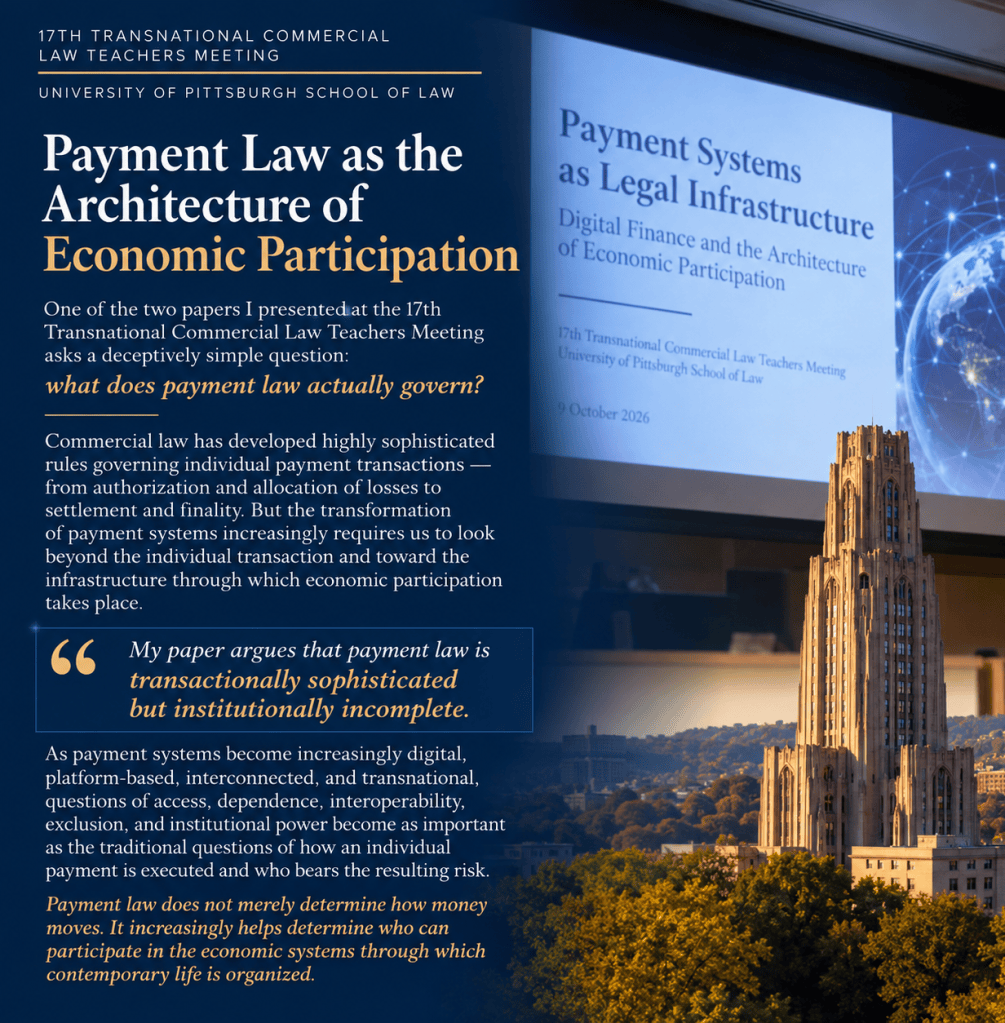
Payment Law as the Architecture of Economic Participation
One of the two papers I presented at the 17th Transnational Commercial Law Teachers Meeting at the University of Pittsburgh School of Law asks the following question: what does payment law actually govern?
The full post is available at https://paolofarah.wordpress.com/2026/10/12/payment-law-as-the-architecture-of-economic-participation/
Commercial law has developed highly sophisticated rules governing individual payment transactions—from authorization and allocation of losses to settlement and finality. But the transformation of payment systems increasingly requires us to look beyond the individual transaction and toward the infrastructure through which economic participation itself takes place.
My paper, “Payment Systems as Legal Infrastructure: Digital Finance and the Architecture of Economic Participation,” argues that payment law is transactionally sophisticated but institutionally incomplete.
As payment systems become increasingly digital, platform-based, interconnected, and transnational, questions of access, dependence, interoperability, exclusion, and institutional power become as important as the traditional questions of how an individual payment is executed and who bears the resulting risk.
The discussion following the presentation further deepened one aspect of the argument: who has access to essential payment infrastructure—and who ultimately has the power to determine that access?
The broader project therefore examines payment systems not simply as mechanisms through which money moves, but as part of the legal architecture through which contemporary economic participation is organized.
My other paper “Collateralizing the Future: Secured Credit, Artificial Intelligence Infrastructure, and Systemic Risk in the Digital Economy,” will be discussed in another post.
I am grateful for the thoughtful questions and exchanges at Pitt Law, which gave me several new directions to explore as the paper develops.
It was wonderful to reconnect with longstanding colleagues and to meet many new colleagues during two days of stimulating discussions at Pitt Law. Ron Brand Ron Brand John Linarelli Miriam Goldby Andrea Guaccero Don Scott De Amicis Katarzyna Kryla-Cudna Ulrich G. Schroeter Ilias Ioannou Djakhongir Saidov Teresa Rodríguez de las Heras Ballell Tolulope Falokun Jenny Jingbo Zhang Lev Breydo Marcelo Marzouka
Paolo Davide Farah, Paolo Farah