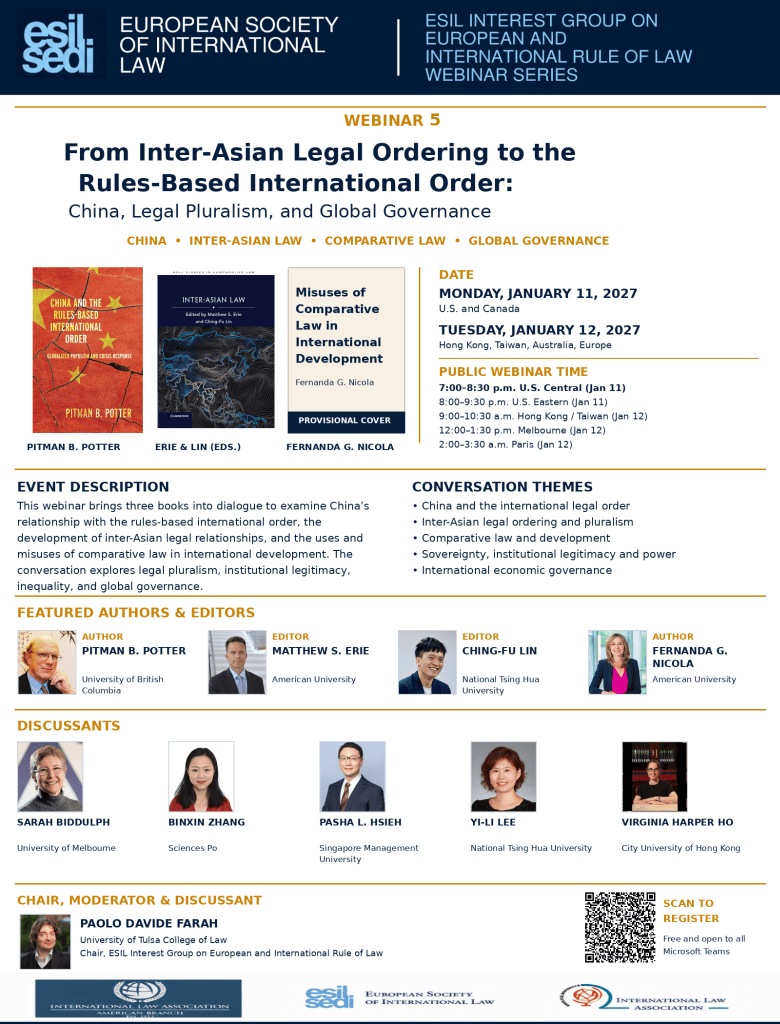
European Society of International Law (ESIL) Interest Group on European and International Rule of Law Webinar Series – Webinar 5 – From Inter-Asian Legal Ordering to the Rules-Based International Order: China, Legal Pluralism, and Global Governance
Monday, January 11, 2027 (North America) | Tuesday, January 12, 2027 (Asia, Australia, and Europe)
Online via Microsoft Teams | Free and open to all | Registration required
REGISTER HERE:
The European Society of International Law (ESIL) Interest Group on European and International Rule of Law is pleased to announce the fifth webinar in its international series, conceived, organized, chaired, and moderated by Professor Paolo Davide Farah, University of Tulsa College of Law, Chair of the ESIL Interest Group on European and International Rule of Law.
The webinar brings together scholars from North America, Europe, and the Asia-Pacific region to examine the evolving relationship between China, Asian legal systems, comparative law, international development, and the transformation of the international legal order.
Rather than focusing on a single publication, the event places three recent and forthcoming books into dialogue, inviting their authors and distinguished discussants to explore competing understandings of legal authority, regional and international legal ordering, institutional legitimacy, and the future of global governance.
Date and International Schedule
The public webinar will take place at the following local times:
| Location | Date | Time |
|---|---|---|
| Vancouver, Canada (PST) | Monday, January 11 | 5:00–6:30 p.m. |
| U.S. Central (CST) | Monday, January 11 | 7:00–8:30 p.m. |
| U.S. Eastern (EST) | Monday, January 11 | 8:00–9:30 p.m. |
| Hong Kong and Taiwan (UTC+8) | Tuesday, January 12 | 9:00–10:30 a.m. |
| Melbourne, Australia (AEDT) | Tuesday, January 12 | 12:00–1:30 p.m. |
| Paris, France (CET) | Tuesday, January 12 | 2:00–3:30 a.m. |
Format: Online via Microsoft Teams.
Participation is free and open to all. Registration is required.
Registration link:
Registered participants will receive the Microsoft Teams joining information before the event.
The webinar will be recorded for subsequent public dissemination.
Three Books in Dialogue
1. China and the Rules-Based International Order: Globalized Populism and Crisis Response
Pitman B. Potter
Peter A. Allard School of Law, University of British Columbia, Canada
University of British Columbia Press, 2026.
Pitman Potter’s book examines China’s engagement with the rules-based international order and the tensions between international legal commitments, domestic political priorities, sovereignty, and global governance.
It provides a framework for examining how China responds to international crises, engages with international institutions, and articulates its own understandings of legal and political authority.
The book also raises broader questions about the legitimacy and resilience of the rules-based international order and the implications of China’s growing international influence.
2. Inter-Asian Law
Edited by Matthew S. Erie and Ching-Fu Lin
Cambridge University Press, 2026.
Matthew S. Erie – American University Washington College of Law, United States.
Ching-Fu Lin – National Tsing Hua University, Taiwan.
Inter-Asian Law examines legal relationships, institutions, and practices emerging across Asian jurisdictions and offers an alternative to approaches that understand Asian legal systems primarily through their relationship with European or American legal models.
The volume brings attention to the circulation of legal ideas, the development of regional and transregional legal relationships, and the ways Asian legal actors influence one another.
It raises fundamental questions about legal pluralism, comparative legal methodology, regional integration, and the emergence of overlapping legal orders.
3. Misuses of Comparative Law in International Development
Fernanda G. Nicola
American University Washington College of Law, United States.
Cambridge University Press, ASCL Studies in Comparative Law, forthcoming January 2027.
Fernanda Nicola’s forthcoming book critically examines how comparative law has been deployed by international organizations, governments, and nongovernmental organizations to legitimize legal reforms that may reproduce inequalities and reinforce existing hierarchies of power.
The book challenges assumptions about legal convergence, efficiency, and institutional reform underlying international development initiatives, including projects associated with the World Bank, the European Union, and the OECD.
Through its examination of comparative legal knowledge, legal transplantation, and development governance, the book offers a critical perspective on the political and institutional uses of comparative law.
It also explores how comparative legal analysis might be reimagined as a more equitable, context-sensitive, and emancipatory practice.
Featured Authors and Speakers
Pitman B. Potter
Peter A. Allard School of Law, University of British Columbia, Canada.
Matthew S. Erie
American University Washington College of Law, United States.
Ching-Fu Lin
National Tsing Hua University, Taiwan.
Fernanda G. Nicola
American University Washington College of Law, United States; Director, Program on International Organizations, Law and Development.
Discussants
Sarah Biddulph
Melbourne Law School, University of Melbourne, Australia; Director, Asian Law Centre.
Binxin Zhang
Sciences Po, Paris, France.
Pasha L. Hsieh
Singapore Management University, Singapore.
Yi-Li Lee
Institute of Law for Science and Technology, National Tsing Hua University, Taiwan.
Virginia E. Harper Ho
School of Law, City University of Hong Kong, Hong Kong SAR.
Chair, Moderator, and Discussant
Professor Paolo Davide Farah, University of Tulsa College of Law
Chair, ESIL Interest Group on European and International Rule of Law.
Intellectual Framing: China, Inter-Asian Legal Ordering, and the Future of the International Rule of Law
The contemporary international legal order is undergoing profound transformations as established institutions and normative frameworks confront geopolitical competition, shifting economic relationships, and increasingly diverse understandings of sovereignty, development, and legal authority.
China occupies a central position in these developments. Its growing influence within international institutions, expanding relationships across Asia and the Global South, and evolving approaches to international economic governance raise fundamental questions about the resilience, legitimacy, and future direction of the rules-based international order.
At the same time, legal developments across Asia cannot be understood exclusively through the relationship between China and Western-led international institutions.
Regional and transregional legal relationships, the circulation of legal knowledge among Asian jurisdictions, and the development of new forms of institutional cooperation increasingly complicate conventional distinctions between domestic law, regional legal ordering, and international law.
The role of comparative law is equally important. Legal models and institutional reforms are frequently presented as neutral technical solutions, yet their selection, circulation, and implementation may reflect particular political priorities, economic interests, and unequal relationships of power.
Bringing together the three featured books offers an opportunity to examine these transformations from complementary perspectives.
Pitman Potter’s analysis of China and the rules-based international order provides an entry point into questions concerning international legal legitimacy, sovereignty, institutional authority, and China’s changing global role.
Matthew Erie and Ching-Fu Lin’s Inter-Asian Law broadens the geographical and conceptual framework by examining legal relationships and practices across Asian jurisdictions and challenging conventional assumptions about the sources and direction of legal influence.
Fernanda Nicola’s Misuses of Comparative Law in International Development adds a critical methodological dimension, questioning how comparative legal knowledge is constructed and deployed in development governance and how legal reform may reproduce or challenge inequalities.
The discussion will explore how these approaches intersect, where they diverge, and what their differences reveal about the changing international legal order.
Principal Themes
The webinar will address several interconnected questions:
China and the Rules-Based International Order: How does China’s engagement with international law challenge, reproduce, or transform existing international institutions and legal norms? What competing understandings of sovereignty, legitimacy, and international legal authority are emerging?
Inter-Asian Legal Ordering and Legal Pluralism: How do legal relationships among Asian jurisdictions reshape conventional understandings of international and comparative law? What can inter-Asian legal exchanges reveal about regional governance, institutional diversity, and legal pluralism?
Comparative Law and International Development: How are comparative legal models used to justify institutional reforms? What assumptions about efficiency, convergence, and legal modernization shape international development initiatives, and whose interests do these assumptions serve?
China, the Global South, and Transregional Governance: How do China’s expanding relationships with Africa and other regions of the Global South influence the circulation of legal ideas, institutional practices, and development models?
International Economic Governance and Corporate Regulation: How do domestic legal institutions, regional economic integration, corporate governance, and transnational regulation interact with competing frameworks of international economic law?
The Future of the International Rule of Law: What do these transformations mean for institutional legitimacy, legal accountability, equality, development, and the possibility of a more pluralistic international legal order?
The objective is to develop an integrated scholarly conversation among the authors, discussants, and audience, identifying both convergences and substantive disagreements among the three books and connecting them to broader debates about international law and global governance.
Organization and Academic Collaboration
The webinar is organized as part of the European Society of International Law Interest Group on European and International Rule of Law Webinar Series, conceived, organized, chaired, and moderated by Professor Paolo Davide Farah.
The event is also developed in connection with the activities of the American Branch of the International Law Association Committee on International Law, China, and the Reconfiguration of the Global Order, and the International Law Association Study Group on International Law, Global Challenges, and the Impact of Emerging Powers on Global Governance.
The series aims to bring recent scholarly publications into dialogue across disciplines, legal traditions, and geographical regions, fostering sustained conversations on international law, comparative legal governance, institutional legitimacy, and the rule of law.
Registration
Participation is free and open to all. Registration is required.
Please register using the following link:
The Microsoft Teams joining information will be shared with registered participants before the event.
The webinar will be recorded for subsequent public dissemination.
We warmly invite scholars, students, practitioners, policymakers, and all those interested in Chinese law, international law, Asian legal systems, comparative law, international economic governance, international development, and the future of the rule of law to participate.
Professor Paolo Davide Farah
University of Tulsa College of Law
Chair, ESIL Interest Group on European and International Rule of Law
Chair, International Law Association Study Group on International Law, Global Challenges, and the Impact of Emerging Powers on Global Governance.
Chair, American Branch of the International Law Association Committee on International Law, China, and the Reconfiguration of the Global Order.
https://papers.ssrn.com/sol3/cf_dev/AbsByAuth.cfm?per_id=629289