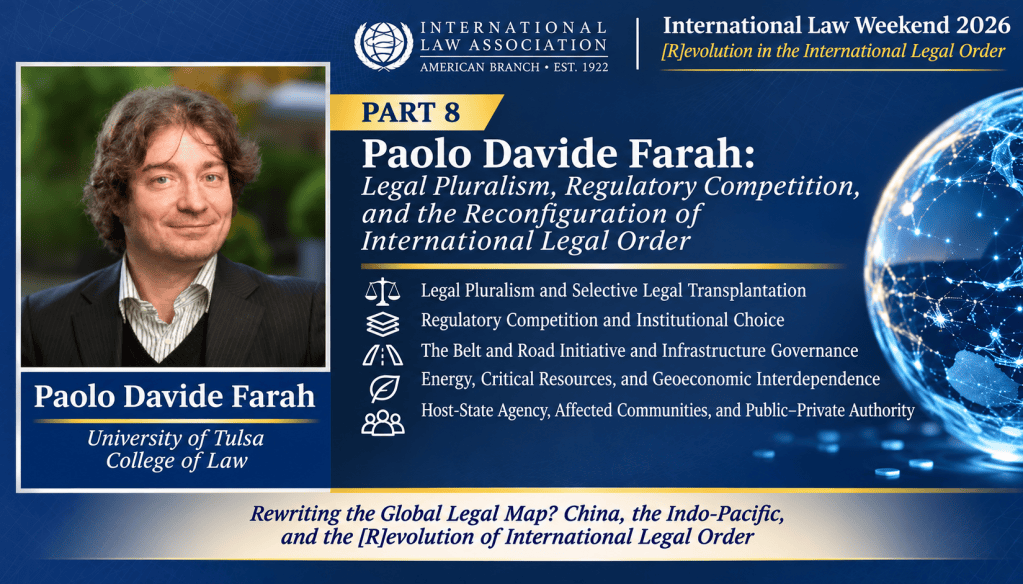


Rewriting the Global Legal Map? China, the Indo-Pacific, and the [R]evolution of International Legal Order — ABILA International Law Weekend 2026 — PART 8 – Paolo Davide Farah: Legal Pluralism, Regulatory Competition, and the Reconfiguration of International Legal Order — Legal Transplants, the Belt and Road Initiative, Energy Governance, and Geoeconomics
Are we witnessing the emergence of a new international legal order, or a more complex reconfiguration of existing legal systems through regulatory competition, selective legal transplantation, and institutional adaptation?
This question was central to my substantive contributions during the panel “Rewriting the Global Legal Map? China, the Indo-Pacific, and the [R]evolution of International Legal Order,” which I organized, chaired, moderated, and participated in as a discussant at International Law Weekend 2026, held on October 24 at Fordham University School of Law in New York City.
The panel was sponsored by the American Branch of the International Law Association (ABILA) Committee on International Law, China, and the Reconfiguration of the Global Order, which I chair.
Together with Gregory Shaffer (Georgetown University Law Center), Keith J. Hand (University of California College of the Law, San Francisco), and Carrie Shu Shang (California State Polytechnic University, Pomona), we examined how geopolitical transformations are influencing international legal institutions, regulatory practices, and the distribution of legal authority.
In the preceding installments of this series, I examined the contributions of my three colleagues and the connections emerging from our discussion.
This eighth installment focuses on my own substantive interventions, particularly those concerning legal pluralism, selective legal transplantation, regulatory competition, infrastructure governance, energy security, public and private authority, unequal bargaining power, and geoeconomics.
These arguments build upon my longstanding research on China’s relationship with international economic law, international environmental and energy governance, and the institutional consequences of legal and economic globalization.
They also connect with the broader research agenda of the International Law Association Study Group on International Law, Global Challenges, and the Impact of Emerging Powers on Global Governance, which I chair.
1. Is Law Neutral? The Political Dimensions of Commercial and Technological Infrastructure
One of my principal interventions followed Professor Carrie Shu Shang’s discussion of technology licensing and the increasingly strategic significance of private commercial relationships.
Carrie raised the question of whether licensing agreements, traditionally understood as private contractual instruments, can still be considered politically neutral when they involve sensitive technological capabilities.
Building upon her observations, I suggested that the same question extends to numerous other areas of economic and technological regulation.
Are payment systems neutral? Are secured transactions neutral? Are cloud infrastructure, digital platforms, and data-governance arrangements neutral? And, more fundamentally, were these mechanisms ever entirely neutral?
These questions are increasingly important because infrastructures traditionally understood as technical mechanisms supporting private economic activity may also determine the distribution of political and economic power.
International payment systems, for example, are not simply instruments facilitating commercial transactions.
They can also become mechanisms through which sanctions are implemented, access to financial networks is restricted, and international institutional relationships are influenced.
Similarly, secured transactions and financial arrangements may determine access to capital, ownership interests, and the allocation of risks associated with strategically significant technological infrastructure.
Cloud services, digital platforms, and data governance raise comparable questions concerning control over information, technological dependencies, and regulatory authority.
During the panel, I referred to the increasing importance of private companies in activities historically associated with national strategic priorities, including the development of outer-space capabilities.
The expansion of private commercial capacity does not necessarily diminish the political significance of these activities.
Instead, the relationship between governmental authority and private economic power may become more complex.
Companies operating in strategically significant sectors can pursue commercial objectives while remaining subject to national regulation, technological dependencies, and geopolitical considerations.
This challenges rigid distinctions between public and private authority.
The separation between public regulation and private commercial ordering is often less clear in practice than conventional legal categories suggest.
The question is therefore not simply whether particular commercial activities are becoming politicized.
It is also whether their political and distributive consequences were previously obscured by assumptions concerning the neutrality of markets, contracts, and technological infrastructure.
2. Legal Pluralism as a Framework for Understanding International Legal Transformation
I connected these observations with my research on legal pluralism and the circulation of legal models across jurisdictions.
During the panel, Gregory Shaffer emphasized the importance of examining different actors operating within transnational legal orders.
Keith Hand demonstrated how China has developed legal instruments resembling American sanctions and countermeasure frameworks.
Carrie Shu Shang described the rapid circulation of regulatory models through governmental institutions, businesses, legal professionals, and technological relationships.
These contributions suggest that the transformation of international legal order cannot be understood exclusively through formal treaties or the creation of new international institutions.
Legal change also occurs through the interaction of domestic laws, commercial practices, professional communities, and regulatory arrangements operating across multiple jurisdictions.
I proposed legal pluralism as an analytical framework capable of capturing these relationships.
Legal pluralism recognizes that different legal systems, regulatory regimes, and institutional practices may coexist within overlapping economic and political relationships.
Their interaction does not necessarily produce a single uniform legal order.
Instead, legal models may be selectively incorporated into domestic systems, adapted to local institutional circumstances, or combined with existing legal traditions.
The resulting arrangements may generate convergence in some areas and divergence in others.
They may facilitate cooperation while simultaneously creating new forms of competition.
This perspective challenges approaches that assume the circulation of legal rules necessarily produces harmonization.
The existence of similar legal instruments does not imply identical implementation, institutional objectives, or legal consequences.
Legal pluralism therefore helps explain how transnational legal learning and geopolitical competition can coexist.
3. Regulatory Competition: Beyond the Opposition Between Convergence and Conflict
Building upon the presentations by my colleagues, I introduced regulatory competition as another conceptual category for understanding contemporary international legal transformations.
Gregory, Keith, and Carrie had employed different analytical perspectives, including transnational legal ordering, legal struggle, regulatory learning, and institutional adaptation.
I suggested that regulatory competition offers a way to connect these processes.
China and the United States may adopt comparable legal instruments while pursuing competing strategic objectives.
States may selectively borrow regulatory approaches developed elsewhere, modify them to reflect domestic interests, and deploy them within different institutional environments.
At the same time, third countries may respond to these competing frameworks through their own regulatory choices.
The resulting landscape cannot be adequately described as either complete convergence or complete fragmentation.
Instead, legal arrangements may simultaneously compete, coexist, and influence one another.
This is particularly important for understanding contemporary international economic law.
Trade regulation, investment screening, export controls, financial restrictions, technology governance, and infrastructure development increasingly involve overlapping domestic and transnational legal mechanisms.
The boundaries between cooperation and confrontation are therefore not always clearly defined.
Regulatory competition may generate convergence in legal form while reinforcing divergence in political purpose.
This observation also raises broader questions concerning the legitimacy of legal transplantation.
Who selects the legal models that circulate internationally?
Which institutions determine how they are adapted?
And to what extent do the actors affected by their implementation participate in these choices?
4. China’s Legal Modernization and Selective Legal Transplantation
These questions connect directly with research I developed with Davide Giacomo Zoppolato, published in the Asian Journal of Law and Society by Cambridge University Press:
“China’s Path to Modernization and Legal Pluralism: Transplants and the Belt and Road Initiative.”
Our research examines China’s evolving relationship with foreign legal models and its increasingly significant role in the international circulation of legal and regulatory approaches.
Historically, China’s legal modernization involved substantial engagement with foreign institutional experiences and legal concepts.
However, legal transplantation should not be understood as a mechanical process through which rules originating in one jurisdiction are reproduced without modification in another.
Receiving jurisdictions may select particular elements, reinterpret legal concepts, combine foreign rules with domestic institutions, or reject aspects that conflict with their political and economic priorities.
This process can be described as selective legal transplantation.
It recognizes that the circulation of legal models involves institutional choices rather than automatic convergence.
China’s contemporary engagement with international legal ordering illustrates this dynamic.
Having historically incorporated and adapted foreign legal approaches, China has increasingly become an important participant in the development and circulation of legal models through international economic relationships.
Yet this development does not necessarily involve the exportation of a uniform Chinese legal system.
Instead, the institutional arrangements associated with China’s overseas economic activities frequently depend upon the legal and political circumstances of individual participating countries.
This makes comparative law particularly relevant to understanding contemporary international legal transformations.
Legal transplantation must be examined through the processes of selection, adaptation, implementation, and institutional interaction.
5. The Belt and Road Initiative: A Uniform Legal Model or Multiple Institutional Arrangements?
During my substantive contribution, I examined the Belt and Road Initiative (BRI) as an important example of legal pluralism and selective institutional adaptation.
BRI-related infrastructure and investment projects frequently operate through combinations of bilateral governmental arrangements, domestic legislation, commercial contracts, investment protections, and project-specific institutional mechanisms.
The resulting legal frameworks may differ significantly among countries and sectors.
Consequently, the Belt and Road Initiative should not automatically be understood as a process through which China imposes one uniform legal system across participating jurisdictions.
Rather, its implementation involves multiple forms of negotiation and institutional adaptation.
In my intervention, I suggested that China may adapt elements of its own approaches to the specific circumstances of participating countries rather than simply introducing a legal model and leaving recipient states to modify it independently.
This observation does not eliminate the possibility of asymmetrical influence.
Instead, it directs attention toward the processes through which legal arrangements are negotiated, selected, and implemented.
BRI relationships can involve cooperation and conflict simultaneously.
Commercial opportunities may coexist with regulatory disagreements.
Infrastructure development may strengthen economic interdependence while generating disputes concerning environmental protection, financial obligations, or the allocation of risks.
Different national and local actors may also pursue objectives that do not coincide with those of the central governments negotiating the arrangements.
The resulting governance structures therefore provide an important setting for examining how legal pluralism operates in practice.
6. The Limits of Voluntariness: Bargaining Power and Legal Choice
A particularly important part of my intervention concerned the meaning of voluntary legal transplantation.
The formal acceptance of a legal or institutional arrangement does not necessarily establish that the parties possessed comparable bargaining power.
A host state may consent to an infrastructure agreement while facing substantial economic constraints, limited financing alternatives, or unequal access to technical and legal expertise.
These circumstances can narrow the practical choices available during negotiations.
The distinction between formal consent and effective bargaining capacity is therefore essential.
I emphasized that we should distinguish among formal assent, meaningful institutional choice, and the participation of affected communities.
A negotiated arrangement may be legally valid while still raising questions concerning the distribution of benefits, obligations, and decision-making authority.
Similarly, agreement between national governments does not necessarily demonstrate that local communities or other affected actors participated meaningfully in shaping the project.
These issues are not unique to China or the Belt and Road Initiative.
They have long characterized international investment and development relationships involving unequal economic and political power.
Nevertheless, the expansion of Chinese infrastructure and investment relationships provides new contexts in which these longstanding questions must be examined.
The critical issue is not simply whether a state formally agreed to a particular legal model.
It is also whether meaningful alternatives existed and whether affected actors retain the practical capacity to influence implementation.
7. Energy Governance, Infrastructure, and Competing Models of Regional Integration
I connected these observations with another recent article, developed with Davide Giacomo Zoppolato and Tivadar Ötvös:
“China’s Belt and Road Initiative and Its Impact on the Energy Independence of the European Union,” published in the Asian Journal of Law and Society.
Our research examines the interactions among China’s infrastructure initiatives, energy security, international economic relationships, and competing approaches to regional governance.
During the panel, I referred specifically to the Central Asia–China gas pipeline arrangements and compared their institutional structure with European regional energy governance frameworks, including the Energy Community.
The comparison illustrates the importance of distinguishing cross-border infrastructure cooperation from regional legal integration.
Energy infrastructure can connect several jurisdictions through pipelines, commercial arrangements, intergovernmental agreements, and joint ventures.
However, these relationships do not necessarily establish a common regulatory framework equivalent to those operating within European regional energy institutions.
The Central Asia–China pipeline arrangements involve bilateral governmental cooperation, host-state measures, commercial participation, and coordination among institutions and companies.
Their legal architecture differs substantially from regional systems designed to promote broader regulatory integration.
This distinction matters because the existence of interconnected infrastructure does not necessarily establish uniform governance.
Nor does extensive economic cooperation necessarily eliminate competition over strategic resources.
Energy relationships may involve cooperation and confrontation within the same institutional setting.
This is particularly important when considering China’s energy security, European energy dependence, the consequences of Russia’s invasion of Ukraine, and the evolving significance of natural gas and other strategic resources.
Infrastructure interdependence does not automatically produce regulatory integration or political alignment.
Instead, it may create complex relationships involving cooperation, dependence, competition, and institutional adaptation.
8. Host States and Affected Communities: Who Controls the Rules After Investment?
One of the central questions I introduced during the moderated discussion concerned the role of host states and affected communities.
I asked:
What would demonstrate that host states and affected communities are genuinely participating in rulemaking rather than merely receiving arrangements developed elsewhere?
The question emerged from our discussion of transnational legal ordering, regulatory competition, and infrastructure development.
In responding to the exchanges, I suggested that the central issue for host states and affected communities may not always be which foreign power provides the investment capital.
It may instead be who retains the authority to modify the rules, require safeguards, or obtain remedies after the investment has taken place.
This distinction is particularly important for energy and infrastructure projects.
A host government may retain substantial regulatory authority in one project while possessing significantly less bargaining power in another.
Similarly, the opportunities available to local communities may depend on domestic institutional structures, access to judicial remedies, environmental procedures, and the practical distribution of political power.
Professor Gregory Shaffer’s subsequent intervention reinforced the importance of these distinctions.
He emphasized that the implementation of legal arrangements operates not only at the national level but also through regional and local institutions.
National agreements may encounter different political, economic, and social circumstances during implementation.
These observations connect with my broader research on development, environmental governance, and legal pluralism.
International legal arrangements should not be evaluated exclusively through the formal relationship between the governments negotiating them.
Their implementation and legitimacy also depend upon the participation of actors affected by their consequences.
9. Geoeconomics, Political Geography, and Legal Geography
During the audience discussion, Professor Gregory Shaffer raised a broader question concerning the changing paradigms through which international economic relations are understood.
He contrasted the prominence of neoliberal approaches in earlier discussions of international economic governance with the growing importance of geoeconomics and national-security considerations.
His intervention also addressed how analytical frameworks, including those reproduced through artificial intelligence, can influence perceptions of international economic relationships.
Building upon his observations, I suggested that geoeconomics should be connected with political geography and legal geography.
International legal order has never been entirely uniform.
Different regions, institutions, economic corridors, and political relationships have historically developed distinct arrangements governing international cooperation and competition.
Contemporary geopolitical transformations may make these differences more visible, but they do not necessarily create them from nothing.
Legal geography provides a perspective through which to examine how legal authority and institutional arrangements are distributed across particular territories, economic relationships, and regulatory spaces.
Political geography helps situate those arrangements within broader relationships of power.
Together, these approaches can enrich the analysis of international legal change.
Rather than assuming the existence of a single international legal order undergoing uniform transformation, we can examine the development of different legal and institutional configurations.
This is particularly relevant to the Indo-Pacific, Eurasian infrastructure corridors, regional trade relationships, and energy governance.
It also reinforces the importance of legal pluralism as an analytical framework.
The changing global legal map is not necessarily being redrawn through the replacement of one uniform order by another. It may instead be reconfigured through overlapping legal systems, competing institutions, and geographically differentiated arrangements.
10. Beyond a Binary Interpretation of International Legal Change
My interventions throughout the panel sought to connect the different perspectives presented by Gregory Shaffer, Keith Hand, and Carrie Shu Shang.
Gregory’s analysis demonstrated the importance of identifying the multiple actors operating within transnational legal orders.
Keith’s contribution illustrated how domestic legislation can become an instrument of geopolitical competition while borrowing from foreign regulatory models.
Carrie’s presentation emphasized how international legal learning may continue—and even accelerate—during periods of political confrontation.
My own contribution focused on the implications of these developments for legal pluralism, regulatory competition, selective legal transplantation, infrastructure governance, and the distribution of authority.
Taken together, these approaches challenge binary interpretations of international legal transformation.
The relationship between China and existing international institutions cannot be understood exclusively as either integration or disruption.
Similarly, U.S.–China regulatory competition cannot be described simply as convergence or fragmentation.
Legal models may circulate across borders while acquiring different meanings and functions.
Institutional cooperation may coexist with geopolitical confrontation.
Infrastructure development may strengthen economic relationships without producing common regulatory institutions.
And formal agreement may coexist with unequal bargaining power and limited opportunities for meaningful participation.
These developments suggest that contemporary international legal change involves multiple overlapping processes rather than one uniform transformation.
11. Who Is Rewriting the Global Legal Map?
I concluded my intervention by returning to the broader question guiding the panel.
What would constitute evidence of a genuine rupture in international legal order?
Would it involve incompatible substantive obligations?
Conflicting remedies?
Refusals to recognize decisions rendered by institutions operating under different legal frameworks?
Or a more fundamental redistribution of the authority determining legal outcomes?
These distinctions matter because transformations occurring in different fields may have different legal implications.
A development that represents gradual institutional evolution in commercial arbitration may simultaneously contribute to substantial disruption in security relations.
Regulatory borrowing may preserve familiar legal forms while changing the political purposes for which those forms are employed.
New economic relationships may expand participation without necessarily increasing institutional accountability.
The transformation of international legal order must therefore be examined through both institutional analysis and normative evaluation.
Understanding why legal systems change does not establish whether those changes produce more inclusive, accountable, or legitimate arrangements.
For this reason, I returned throughout our discussion to four questions:
Who makes the operative decision?
Through what legal mechanism?
Who can contest it?
Who bears the costs?
These questions help connect international economic dispute settlement, regulatory competition, technological governance, energy infrastructure, and geopolitical relationships without treating them as interchangeable legal regimes.
They also direct attention toward the institutional and distributive consequences of legal transformation.
Ultimately, the question is not simply whether China, the United States, or other powers are rewriting the global legal map.
It is also who participates in rewriting it, which legal mechanisms structure that process, whose interests receive protection, and whether affected actors possess meaningful opportunities to influence and contest the resulting arrangements.
12. Concluding the Series and Continuing the Research
This article concludes the eight-part series documenting my participation in International Law Weekend 2026 and the scholarly exchanges developed through our October 24 panel at Fordham University School of Law.
I remain grateful to Gregory Shaffer, Keith J. Hand, and Carrie Shu Shang for accepting my invitation and contributing their research, professional experience, and insights to the discussion.
Their contributions provided complementary perspectives on the transformation of international legal order and created opportunities to connect theoretical, doctrinal, and institutional approaches that are frequently examined separately.
I am also grateful to the American Branch of the International Law Association, the organizers of International Law Weekend 2026, and the colleagues and participants who contributed to the audience discussion.
The questions explored during our panel remain central to the activities of the ABILA Committee on International Law, China, and the Reconfiguration of the Global Order and the International Law Association Study Group on International Law, Global Challenges, and the Impact of Emerging Powers on Global Governance, both of which I chair.
Through these complementary initiatives, I hope to continue encouraging international dialogue and scholarly cooperation concerning the changing role of emerging powers, the circulation of legal models, international economic governance, and the institutional consequences of geopolitical transformation.
The broader research agenda extends beyond China and the United States.
It concerns the interaction among states, international institutions, private actors, regional organizations, and affected communities in an increasingly complex global legal environment.
The challenge is not merely to determine whether international law is undergoing a revolution or an evolution, but to understand how legal authority is being redistributed, through which institutions, and with what consequences for participation, accountability, and global governance.
Selected Bibliographical References
Publications directly connected to my intervention
Zoppolato, Davide Giacomo, and Paolo Davide Farah. “China’s Path to Modernization and Legal Pluralism: Transplants and the Belt and Road Initiative.” Asian Journal of Law and Society 12, no. 2 (2025): 109–144. Cambridge University Press.
https://papers.ssrn.com/sol3/papers.cfm?abstract_id=5215873
Farah, Paolo Davide, Davide Giacomo Zoppolato, and Tivadar Ötvös. “China’s Belt and Road Initiative and Its Impact on the Energy Independence of the European Union.” Asian Journal of Law and Society 12, no. 2 (2025): 274–303. Cambridge University Press.
https://papers.ssrn.com/sol3/papers.cfm?abstract_id=5215879
Additional selected scholarship
Farah, Paolo Davide. China’s Influence on Non-Trade Concerns in International Economic Law. Routledge, 2016.
Farah, Paolo Davide. “Energy Trade and the WTO: Implications for Renewable Energy and the OPEC Cartel.” Journal of International Economic Law 16 (2013): 707–740.
https://doi.org/10.1093/jiel/jgt024
Farah, Paolo Davide. “A Comparison Between Shale Gas in China and Unconventional Fuel Development in the United States: Water, Environment and Sustainable Development.” Brooklyn Journal of International Law 41 (2016): 579–654.
https://ssrn.com/abstract=2802157
Farah, Paolo Davide. “The Crisis of Multilateral Legal Order: Causes, Dynamics and Implications.” Routledge, 2022.
https://papers.ssrn.com/sol3/papers.cfm?abstract_id=4236758
Shaffer, Gregory, Ji Li, and Henry Gao. “China and International Economic Dispute Settlement: Disaggregating the State.” Journal of International Economic Law (2026).
https://papers.ssrn.com/sol3/papers.cfm?abstract_id=6576238
Hand, Keith J. “Waging External Struggle through Law: China’s Evolving Legal Strategies and Pelosi’s Taiwan Visit.” UC San Diego 21st Century China Center Special Report (2022).
https://papers.ssrn.com/sol3/papers.cfm?abstract_id=4208433
Shang, Carrie Shu. “US-China Transnational Law in a Time of Trade Crisis.” Indiana Journal of Global Legal Studies 28, no. 2 (2021): 139–204.
https://www.repository.law.indiana.edu/ijgls/vol28/iss2/4
International Law Weekend 2026
October 22–24, 2026
Fordham University School of Law, New York City
Panel: Rewriting the Global Legal Map? China, the Indo-Pacific, and the [R]evolution of International Legal Order
Sponsored by: ABILA Committee on International Law, China, and the Reconfiguration of the Global Order
Chair, Moderator, and Discussant: Paolo Davide Farah
Participating Speakers: Gregory Shaffer, Keith J. Hand, and Carrie Shu Shang
International Law Weekend 2026 — Complete Eight-Part Publication Series
This article concludes an eight-part series documenting my participation in International Law Weekend 2026, organized by the American Branch of the International Law Association (ABILA), and the scholarly discussion developed through the panel “Rewriting the Global Legal Map? China, the Indo-Pacific, and the [R]evolution of International Legal Order.”
The panel was sponsored by the ABILA Committee on International Law, China, and the Reconfiguration of the Global Order, which I chair.
The Complete Series
PART 1 — Rewriting the Global Legal Map? China, the Indo-Pacific, and the [R]evolution of International Legal Order — Panel Announcement and Intellectual Framework
PART 2 — International Law Weekend 2026 at Fordham Law School: Reflections on ABILA, International Scholarly Cooperation, and Emerging Initiatives
PART 3 — Rewriting the Global Legal Map? The Full Panel Discussion: China, Transnational Legal Orders, Geopolitical Competition, and Global Governance
PART 4 — Opening Remarks: Who Is Rewriting the Global Legal Map? Power, Institutions, Legal Pluralism, and International Legal Change
PART 5 — Gregory Shaffer: China’s Multi-Actor Engagement with Transnational Legal Orders — Disaggregating the State, Institutional Adaptation, and Geoeconomics
PART 6 — Keith J. Hand: Legal Struggle, Sanctions, and China’s Countermeasure Legislation
[Insert Part 6 WordPress link]
PART 7 — Carrie Shu Shang: Transnational Legal Learning, Technology Competition, and Regulatory Adaptation
[Insert Part 7 WordPress link]
PART 8 — Paolo Davide Farah: Legal Pluralism, Regulatory Competition, and the Reconfiguration of International Legal Order
[Insert Part 8 WordPress link]
Continuing the Conversation
Together, these eight installments examine the transformation of international legal order through the perspectives of international economic law, transnational legal ordering, regulatory competition, legal pluralism, technological governance, infrastructure development, and geoeconomics.
They also contribute to the continuing scholarly activities of the ABILA Committee on International Law, China, and the Reconfiguration of the Global Order and the International Law Association Study Group on International Law, Global Challenges, and the Impact of Emerging Powers on Global Governance, both of which I chair.
The conclusion of this publication series does not mark the end of the conversation. Rather, it provides a foundation for further research, dialogue, and scholarly cooperation concerning the changing role of emerging powers and the reconfiguration of international legal authority.
#InternationalLaw #ILW2026 #ABILA #China #IndoPacific #LegalPluralism #RegulatoryCompetition #InternationalEconomicLaw #BeltAndRoadInitiative #EnergyGovernance #Geoeconomics #GlobalGovernance