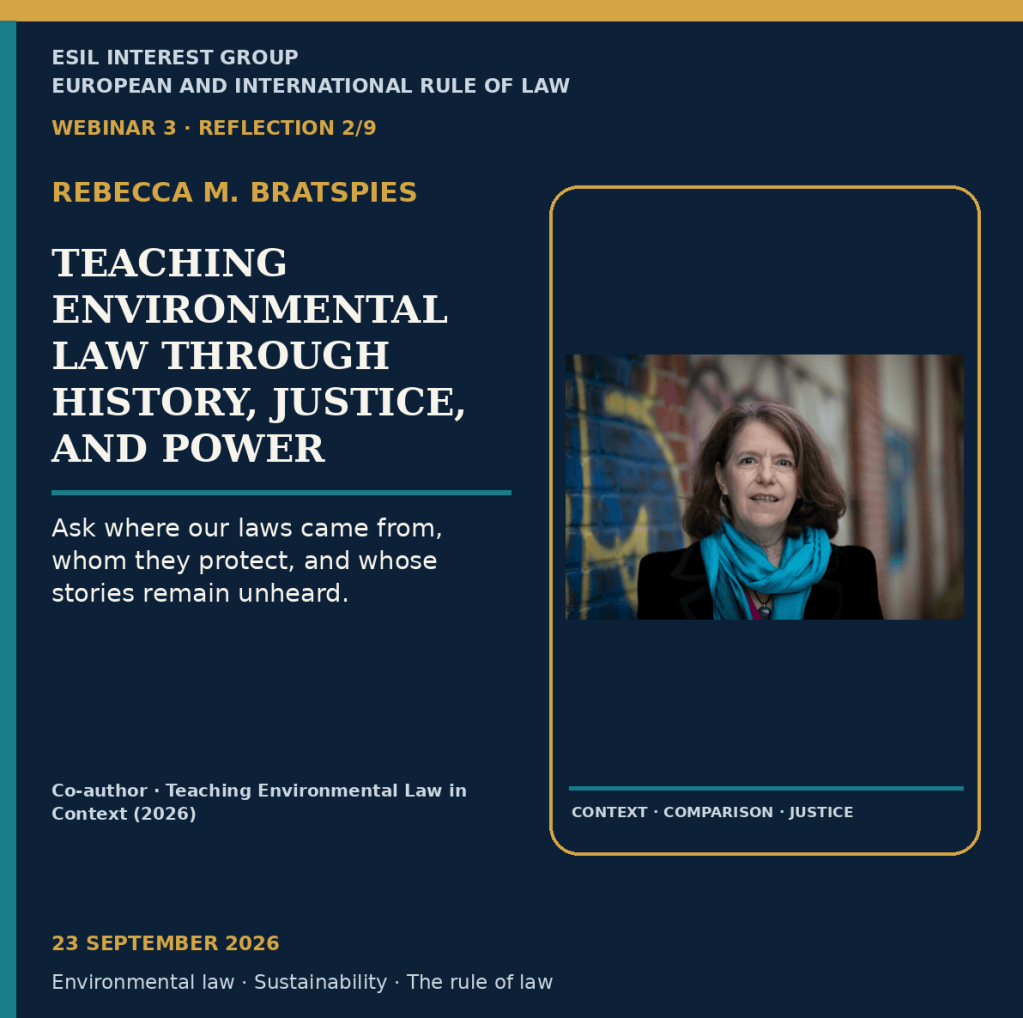

Rebecca Bratspies: Teaching Environmental Law Through History, Justice, and Power – Reflections on ESIL Webinar 3 – Webinar 3 · Reflection 2/9
Rebecca Bratspies began her contribution to the September 23, 2026 – European Society of International Law (ESIL) Interest Group on European and International Rule of Law Webinar, entitled From Environmental Law in Context to Comparative Environmental Governance: Justice, Sustainability, and the Rule of Law, with the purposes of environmental law: the people who breathe the air, drink the water, and live on the land. In a period of uncertainty for environmental protection, she and Carmen G. Gonzalez had written Teaching Environmental Law in Context as a constructive contribution to the future of the field.
Her presentation organized that contribution around three inquiries. The first looks backward: why do we have the laws we have, what problems were they designed to solve, and what institutional constraints shaped them? The second looks forward: what challenges require a response today? The third asks what belongs at the center of environmental law and how that choice changes the interpretation and enforcement of legal rules.
History as a tool for legal understanding
Rebecca used the 1948 Donora smog disaster in Pennsylvania to illustrate the value of historical inquiry. Examining the origins of air-pollution regulation can help students understand both the urgency that produced legal change and the questions of unequal exposure that remain relevant. Her account linked the history of environmental protection to the position of Black and low-income communities.
This method also makes regulatory achievements visible. Students who have not experienced the severe smog of earlier decades may struggle to appreciate what environmental statutes have achieved. A historical approach can recognize those accomplishments while asking whether existing tools can address cumulative harms, continuing environmental injustice, and climate change.
That combination matters. Understanding a statute’s origins gives students a basis for evaluating its current operation. It also makes clear that legal arrangements emerged from choices, conflicts, and constraints that can be examined rather than treated as inevitable.
Following one problem across several legal fields
Rebecca described the book’s teaching exercises as a practical way to connect these questions to doctrinal learning. Concentrated animal feeding operations in North Carolina recur across the chapters on torts, air pollution, water pollution, and waste handling. Each return allows students to examine a different legal mechanism while continuing to consider the same communities and environmental burdens.
The repeated case study can make fragmentation visible. A problem that appears manageable within one regulatory category may look different when students consider the combined
effects of several activities and legal regimes. The exercise asks why law fails particular communities and which responses might improve their protection.
This is a way to deepen doctrinal competence through context. Students still learn statutes, legal tools, and the skills needed to use them. They also learn to ask how those tools fit together and what the boundaries between them leave unresolved.
Questioning the starting point
Rebecca’s response to the discussants developed a further theme: who defines the problem that environmental law is supposed to solve? Different starting points produce different legal priorities. An inquiry centered on an economically efficient level of pollution raises different questions from one centered on a baseline of protection for people and other living things.
She also identified an asymmetry in the treatment of the status quo. Existing illness, contamination, and inequality may require little explanation, while efforts to change those conditions must satisfy extensive demands for economic and legal justification. The inherited distribution of environmental burdens can become embedded in the baseline against which reform is assessed.
Contextual and comparative inquiry can each expose that baseline. Historical examination asks how it was created and whose interests shaped it. Comparison reveals that other institutions and legal systems organize protection differently.
Power, voice, and legal education
In the closing round, Rebecca called for greater recognition that law is rooted in power. She emphasized the importance of examining whose voices are absent and whose accounts of the world receive institutional attention. Drawing on her work with schoolchildren, she described questions about untold stories, the beneficiaries of dominant stories, and the location of power.
Her intervention underscored the importance of teaching environmental law not simply as a collection of doctrines and regulatory instruments, but as a field shaped by historical choices, unequal distributions of power, and competing understandings of environmental harm.
This approach also invites students to question why certain environmental conditions are treated as normal, why particular communities bear disproportionate burdens, and how existing legal arrangements may reproduce inequalities even when they appear formally neutral.
From problem definition to epistemic governance: The Chair’s perspective
As Chair, Moderator, and Discussant, I approached Rebecca’s contribution through a broader set of questions that I had developed in preparing the webinar’s Speaker and Discussant Guide, drawing on my ongoing research on epistemic governance, institutional authority, and the legal construction of knowledge. These questions provided part of the conceptual framework through which I sought to connect the speakers’ contributions to wider debates about environmental governance, legal legitimacy, and the authority to define and assess regulatory problems.
These questions concern not only how environmental law responds to established problems, but also how those problems become defined, recognized, and translated into legal and regulatory priorities in the first place.
Who has the authority to define an environmental problem? Whose knowledge and experiences count in identifying harm? Who determines which risks warrant legal intervention? And why are certain existing inequalities accepted as neutral baselines while efforts to change them require extensive justification?
These questions reflect a central concern of my research on epistemic governance: the ways legal and regulatory institutions determine what counts as authoritative knowledge, which forms of expertise receive recognition, and how particular understandings of risk, harm, and public interest acquire institutional legitimacy.
Rebecca’s analysis of historical injustice, problem definition, and the normalization of environmental burdens provided an especially valuable perspective through which to explore these questions.
Her contribution approached these issues primarily through environmental legal history, pedagogy, and the relationship between law and power. My framing sought to connect those insights with the broader institutional and epistemic processes through which environmental problems are identified, evidence is evaluated, regulatory priorities are established, and particular forms of knowledge become authoritative.
The relationship between these perspectives was therefore not simply one of agreement, but of complementary approaches to a shared problem: how law both reflects and structures the distribution of power, knowledge, and authority.
Our exchange illustrated how contextual environmental legal education and comparative environmental governance can illuminate not only what legal rules require, but also how institutions determine which problems deserve attention, whose experiences inform legal responses, and which alternative arrangements remain possible.
In this sense, the discussion also connected Rebecca’s work to a wider question running through the ESIL webinar series: who decides what counts as knowledge, and with what consequences for justice, institutional accountability, and the rule of law?
Rebecca’s contribution offers a practical agenda for environmental legal education: teach history alongside doctrine, use recurring problems to reveal fragmentation, assess the purposes of regulatory tools, and ask how power shapes both law and the stories told about it.
Event information and selected bibliography. Teaching Environmental Law in Context.
Keywords/tags: ESIL, environmental law, environmental justice, comparative environmental governance, rule of law, legal education, institutional accountability, legal pluralism, epistemic governance
This post forms part of the ESIL Interest Group on European and International Rule of Law Webinar Reflections series, which offers accounts of individual contributions and the wider intellectual exchanges generated by each event.
Paolo Davide Farah, Paolo Farah
Explore the Complete Webinar 3 Reflections Series
ESIL Interest Group on European and International Rule of Law Webinar Series
Webinar 3 — From Environmental Law in Context to Comparative Environmental Governance: Justice, Sustainability, and the Rule of Law
September 23, 2026
This nine-part series documents the contributions and intellectual exchanges developed during Webinar 3, examining environmental justice, comparative environmental governance, legal education, sustainability, institutional accountability, and the rule of law.
Reflection 1/9 — Environmental Law, Justice, and Comparative Governance: Reflections on ESIL Webinar 3
[Link forthcoming]
Reflection 2/9 — Rebecca Bratspies: Teaching Environmental Law Through History, Justice, and Power
[Link forthcoming]
Reflection 3/9 — Carmen G. Gonzalez: Environmental Justice in Every Topic, Every Tool, and Every Statute
[Link forthcoming]
Reflection 4/9 — Tseming Yang: Comparative Environmental Law, Legal Cultures, and Learning Across Systems
[Link forthcoming]
Reflection 5/9 — Sara K. Phillips: From Legal Mechanisms to Practical Influence in Environmental Governance
[Link forthcoming]
Reflection 6/9 — Mekonnen Ayano: How Much Distance for Comparison, How Much Proximity for Justice?
[Link forthcoming]
Reflection 7/9 — Chinonso Tansi Anozie: Humanizing Environmental Law and Connecting Sustainability to Energy Justice
[Link forthcoming]
Reflection 8/9 — Paolo Davide Farah: From Comparative Environmental Law to Comparative Environmental Governance—Beyond Rules, Across Institutions and Contexts
[Link forthcoming]
Reflection 9/9 — Paolo Davide Farah: Who Decides What Counts as Knowledge? Environmental Justice and Epistemic Accountability
[Link forthcoming]
Webinar information, speakers, books, and selected bibliography:
https://paolofarah.wordpress.com/2026/09/05/european-society-of-international-law-esil-interest-group-on-european-and-international-rule-of-law-webinar-series-webinar-3-from-environmental-law-in-context-to-comparative-environme/
The ESIL Interest Group on European and International Rule of Law Webinar Reflections Series is conceived, coordinated, and edited by Professor Paolo Davide Farah, Chair of the Interest Group and Chair and Moderator of the Webinar Series. The reflections document and critically engage with the contributions of Rebecca Bratspies, Carmen G. Gonzalez, Tseming Yang, Sara K. Phillips, Mekonnen Ayano, Chinonso Tansi Anozie, and Paolo Davide Farah, recognizing their respective scholarly perspectives and the wider intellectual exchanges generated during the webinar. The series seeks to preserve, develop, and disseminate these contributions as part of an ongoing international scholarly dialogue. The reflections are editorial accounts of the discussions and do not necessarily represent the official positions of the Interest Group or the individual participants.
The recording is now available here:
Related Scholarship by Rebecca M. Bratspies
SSRN author page | Official Tulane profile
- With Carmen G. Gonzalez, Teaching Environmental Law in Context (Edward Elgar Publishing, 2026).
- With Carmen G. Gonzalez, “The Unbearable Whiteness of Environmental Law” (Center for Progressive Reform Symposium, 2023).
- “Access to Environmental Information under International Law,” in Tseming Yang, Anastasia Telesetsky and Sara K. Phillips, eds., Comparative Environmental Law (Edward Elgar Publishing, 2025).
- “‘Underburdened’ Communities,” 110 California Law Review 1933–1989 (2022).
- “Do I Really Have the Right to Breathe Clean Air?” (2025).
- “Climate Justice Begins at Home,” 37 New York International Law Review 13 (2024).
- “The Human Rights Fulcrum: Using Environmental Rights as Leverage for Change,” 38 Pace International Law Review 229 (2026).
Related Scholarship by Tseming Yang
SSRN author page | Official Santa Clara profile | Complete scholarship list
- With Anastasia Telesetsky and Sara K. Phillips, eds., Comparative Environmental Law (Edward Elgar Publishing, 2025).
- With Anastasia Telesetsky and Sara K. Phillips, “Introduction to Comparative Environmental Law,” in Comparative Environmental Law (2025).
- “A Comparative Environmental Law Primer,” in Comparative Environmental Law (2025).
- “Old and New Environmental Racism,” 2024 Utah Law Review No. 1 (2024).
- “The Emergence of the Environmental Impact Assessment Duty as a Global Legal Norm and General Principle of Law,” 70 Hastings Law Journal 525–572 (2019).
- “The Emergence of Global Environmental Law,” 36 Ecology Law Quarterly 615–664 (2009).
- “Melding Civil Rights and Environmentalism: Finding Environmental Justice’s Place in Environmental Regulation,” 26 Harvard Environmental Law Review 1–107 (2002).
- “International Treaty Enforcement as a Public Good: Institutional Deterrent Sanctions in International Environmental Agreements,” 27 Michigan Journal of International Law 1131–1184 (2006).
Related Scholarship by Anastasia Telesetsky
SSRN author page | Official Cal Poly profile and publications
- With Tseming Yang and Sara K. Phillips, eds., Comparative Environmental Law (Edward Elgar Publishing, 2025).
- With Tseming Yang and Sara K. Phillips, “Introduction to Comparative Environmental Law,” in Comparative Environmental Law (2025).
- “Rights of Nature: Time for a Next Generation Normative Paradigm Shift?,” in Comparative Environmental Law (2025).
- With Tseming Yang, Lin Harmon-Walker and Robert V. Percival, Comparative and Global Environmental Law and Policy (Wolters Kluwer, 2019).
- Ecological Restoration in International Environmental Law (Routledge, 2017).
- “Legal Pluralism—Linking Law and Culture in Natural Resource Co-Management and Environmental Compliance,” in James A.R. Nafziger, ed., Comparative Law and Anthropology (Edward Elgar Publishing, 2017).
- “Fulfilling the Human Right to Food and a Healthy Environment: Is It Time for an Agroecological and Aquaecological Revolution?,” 40 Vermont Law Review 791–812 (2016).
- “Ecoscapes: The Future of Ecological Restoration Law,” 14 Vermont Journal of Environmental Law 493–548 (2013).
- “Beyond Voluntary Corporate Social Responsibility: Corporate Human Rights Obligations to Prevent Disasters and to Provide Temporary Emergency Relief,” 48 Vanderbilt Journal of Transnational Law 1003 (2015).
Related Scholarship by Sara K. Phillips
SSRN author page | SEI publication profile | Google Scholar
- With Tseming Yang and Anastasia Telesetsky, eds., Comparative Environmental Law (Edward Elgar Publishing, 2025).
- With Tseming Yang and Anastasia Telesetsky, “Introduction to Comparative Environmental Law,” in Comparative Environmental Law (2025).
- “Mining Law and Governance: Structures and Challenges,” in Comparative Environmental Law, pp. 389–415 (2025).
- “The Legal Construct of Mining Conflicts,” 109 Resources Policy, article 105706 (2025).
- “Strategic Engagement and Legal Pluralism: Navigating Knowledge and Expertise in Mining Disputes,” 56(1) Chulalongkorn University Journal of Social Sciences 177–196 (2026).
- Rights-Based Claims and Extractive Industries in Asia: An Assessment and Ways Forward (Stockholm Environment Institute Working Paper, 2020).
- “Building Business, Human Rights and Climate Change Synergies in Southeast Asia: What the Philippines’ National Inquiry on Climate Change Could Mean for ASEAN,” 13(1) Journal of Human Rights and the Environment 238–264 (2022).
Discussants
Related Scholarship by Mekonnen Firew Ayano
SSRN author page | Official University at Buffalo profile | Google Scholar
- “Understanding the Local Complexities in Land Law Reforms: The Case of Land Inalienability in Ethiopia, 1991–2018,” 49 Law & Social Inquiry 2398–2438 (2024).
- “Law and Land Conflict in Emerging Market Economies: Ethiopia, 2014–2018,” 18 International Journal of Constitutional Law 988–1012 (2020).
- “Rural Land Registration in Ethiopia: Myths and Realities,” 52 Law & Society Review 1060–1097 (2018).
- “Decolonizing Legal Influence: China’s Role in the Changing Landscape of the Ethiopian Legal Profession, 2000–2018,” 13 Notre Dame Journal of International & Comparative Law 1 (2023).
- “Tenants Without Rights: Immigrants’ Experiences in the U.S. Low-Income Housing Market,” 28 Georgetown Journal on Poverty Law & Policy 159–200 (2021).
Related Scholarship by Chinonso Tansi Anozie
SSRN author page | Official University of Houston profile | Google Scholar
- “Left Behind: Funding Climate Action in the Global South,” 11 Texas A&M Law Review 333–363 (2024).
- “Equalizing Remediation,” 2023 Wisconsin Law Review 919 (2023).
- “Energy Sanctions Hegemony” (SSRN working paper, 2026).
- “United States,” in Oil Wealth and Federal Conflict in American Petrofederations (Elsevier, 2022).
- “Ownership of Natural Resources Beneath the Surface: An Appraisal of the American and Nigerian System” (2017).
- “Parallel Application of Monopoly and Competition in Nigeria’s Energy Sector: A Malediction to Energy and Economic Development” (2017).
Chair, moderator, and discussant
Related Scholarship by Paolo Davide Farah
SSRN author page | Official University of Tulsa profile | Google Scholar | Publication profile
- “Epistemic Governance” (SSRN working paper 2025, posted and revised in 2026).
- Globalization, Environmental Law and Sustainable Development in the Global South: Challenges for Implementation (Routledge, 2021; open access).
- “Indicator Species and the Future of Environmental Law,” in Globalization, Environmental Law and Sustainable Development in the Global South: Challenges for Implementation, pp. 305–313 (Routledge, 2021).
- “Urgenda vs. Juliana: Lessons for Future Climate Change Litigation Cases,” 84(3) University of Pittsburgh Law Review 547–584 (2023). Also available on SSRN.
- “Climate Justice in the Anthropocene and Its Relationship with Science and Technology: The Importance of Ethics of Responsibility,” 55 Connecticut Law Review 819–860 (2023).
- “Energy Justice, Just Transition and International Environmental Law,” in “Just Energy Transition: Legal Challenges Associated with Coal Phase Out,” 117 Proceedings of the American Society of International Law Annual Meeting 255–267 (2023; Cambridge University Press, 2024).
- “Water-Energy-Food Nexus in International Law: A Legal Analysis,” in Floor Brouwer, ed., Handbook on the Water-Energy-Food Nexus, pp. 381–397 (Edward Elgar Publishing, 2022).
- “When John Locke Meets Lao Tzu: The Relationship Between Intellectual Property, Biodiversity, and Indigenous Knowledge and the Implications for Food Security,” 33 Duke Environmental Law & Policy Forum 77–112 (2024).
- “The Anthropocene and Climate Change in the Post-Paris Agreement Debate,” in Anu Valtonen, Outi Rantala, and Paolo Davide Farah, eds., Ethics and Politics of Space for the Anthropocene, pp. 197–210 (Edward Elgar Publishing, 2020).
- “China’s Water Environmental Management Towards Institutional Integration: A Review of Current Progress and Constraints vis-à-vis the European Experience,” 113 Journal of Cleaner Production 285–298 (2016).
- “China’s Energy Policies and Strategies for Climate Change and Energy Security,” 13 Journal of World Energy Law & Business 141–156 (2020).
- “A Comparison Between Shale Gas in China and Unconventional Fuel Development in the United States: Water, Environmental Protection, and Sustainable Development,” 41 Brooklyn Journal of International Law 579–654 (2016).
- “The Principle of Common But Differentiated Responsibilities in the International Regime of Climate Change,” in Paolo Davide Farah and Elena Cima, eds., China’s Influence on Non-Trade Concerns in International Economic Law, pp. 146–157 (Routledge, 2016).
Paolo Davide Farah, Paolo Farah