
Environmental Law, Justice, and Comparative Governance: Reflections on ESIL Webinar 3 – Webinar 3 · Reflection 1/9
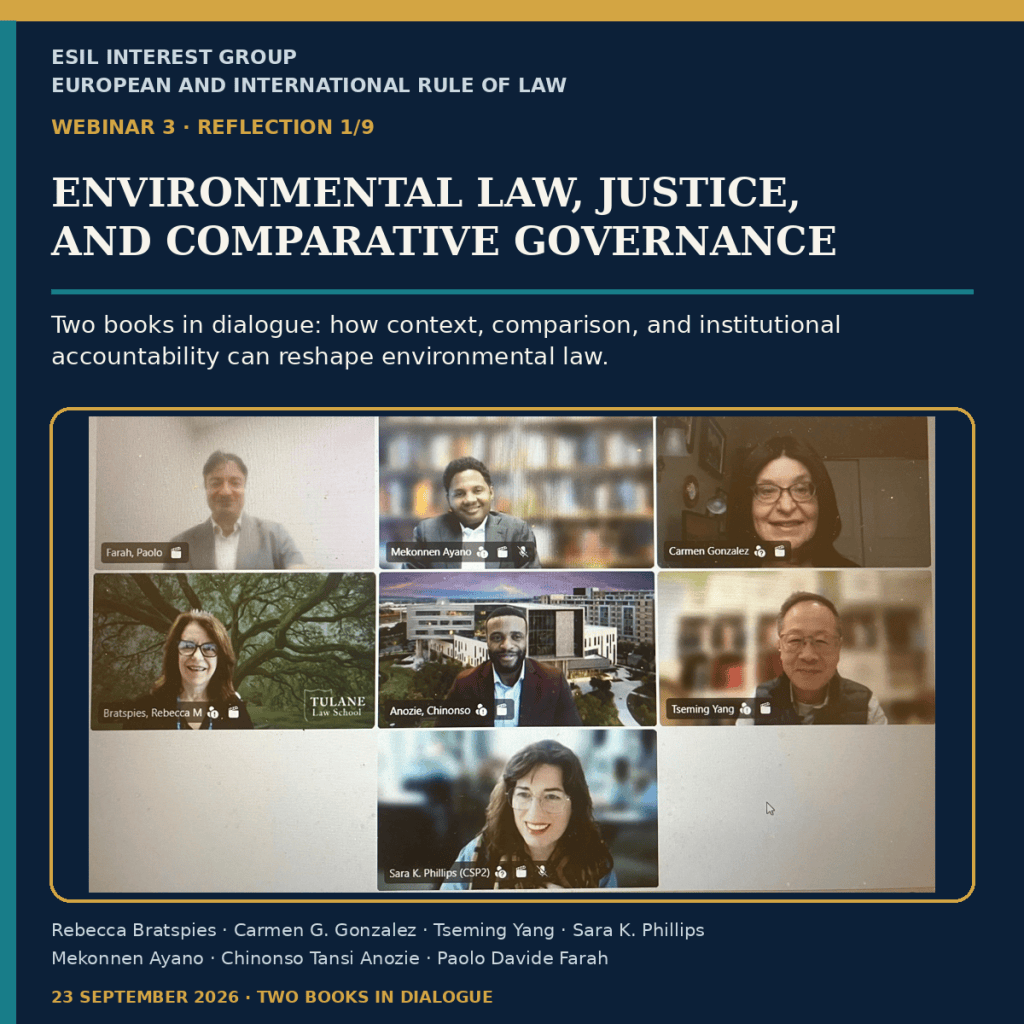
The third event in the ESIL Interest Group on European and International Rule of Law Webinar Series brought two books into a conversation about how environmental law understands its subject, whose interests it protects, and how legal education prepares lawyers to work with environmental problems. Held on September 23, 2026, the webinar was entitled From Environmental Law in Context to Comparative Environmental Governance: Justice, Sustainability, and the Rule of Law. I organized, chaired, and moderated the discussion and also contributed as a discussant.
The books approached environmental law from different directions. Rebecca Bratspies and Carmen G. Gonzalez presented Teaching Environmental Law in Context (Edward Elgar, 2026). Tseming Yang and Sara K. Phillips presented Comparative Environmental Law (Edward Elgar, 2025), co-edited with Anastasia Telesetsky, who was unable to participate live. Mekonnen Ayano and Chinonso Tansi Anozie served as discussants.
Environmental justice throughout the field
Rebecca and Carmen challenged the treatment of environmental justice as a supplementary topic that can be reached only after the main statutes have been covered. Their approach integrates justice into the analysis of each statute, regulatory tool, and teaching exercise.
Environmental law becomes easier to understand when students can connect its technical requirements to the people breathing polluted air, drinking contaminated water, or living with the accumulated burdens of industrial development.
Rebecca’s historical approach invited teachers to ask why particular laws emerged, what they accomplished, and what they leave unresolved. Carmen’s account of Flint illustrated how cumulative exposure, technical assumptions, institutional responses, and community credibility can interact. Both contributions linked doctrinal competence to the ability to question how a problem has been framed.
What comparison can reveal
Tseming explained why comparative environmental law can help lawyers understand their own systems as well as those of other jurisdictions. Functional equivalence, legal history, legal cultures, and legal transplants provide different ways of examining similar environmental challenges. His call to widen the field beyond its traditional transatlantic focus brought legal education directly into the comparative conversation.
Sara asked what legal mechanisms actually enable people to do. Environmental impact assessment may spread widely while producing different legal effects. Environmental rights may rest on different foundations. Mining projects may be governed through legislation, contracts, assessment, corporate standards, and investment protections at the same time.
The practical question is how those arrangements affect the ability of communities and Indigenous nations to influence decisions.
Distance, proximity, and human consequences
Mekonnen identified a productive methodological tension. Comparison needs some analytical distance to reveal patterns, but justice requires attention to local histories and lived experience. He asked whether justice should inform the method of comparison itself and emphasized the need for categories flexible enough to recognize different meanings of justice in different places.
Chinonso connected environmental standards to human health and life. His contribution also linked comparative learning to the challenges of energy access, sustainability, and transition in poorer economies. Common environmental objectives must be considered alongside the resources and conditions under which countries pursue them.
Institutions, knowledge, and the rule of law
My interventions connected these arguments through comparative environmental governance. Legal rules acquire their practical meaning through history, political economy, institutional capacity, scientific judgment, and distributive choices. Comparison can therefore examine how authority is organized among legislatures, agencies, courts, scientists, markets, and affected communities.
I also developed an epistemic dimension of environmental justice. Institutions decide which harms are recognized, which evidence is relevant, which experts are credible, and how uncertainty is treated. In the closing round, I proposed epistemic accountability: making those decisions about knowledge transparent and open to scrutiny.
The discussion left room for differences. Tseming acknowledged the historical contribution of technical regulation while arguing that its exclusive dominance is insufficient. Mekonnen cautioned against overly rigid comparative categories. Sara emphasized empirical investigation of participation and institutional practice. Together, these interventions offered a richer agenda than any single formula for environmental reform.
Continuing the conversation
This reflection opens a nine-part retrospective series. The following posts focus separately on Rebecca Bratspies, Carmen G. Gonzalez, Tseming Yang, Sara K. Phillips, Mekonnen Ayano, and Chinonso Tansi Anozie. Two concluding reflections develop distinct aspects of my contributions: comparative environmental governance and epistemic accountability. The accompanying detailed report provides a fuller account of the exchange.
The ESIL webinar series is conceived, organized, chaired, and moderated by Professor Paolo Davide Farah, Chair of the Interest Group on European and International Rule of Law.
Webinar 3 was co-sponsored by the ABILA Committee on International Law, China, and the Reconfiguration of the Global Order and the ILA Study Group on International Law, Global Challenges, and the Impact of Emerging Powers on Global Governance.
Event information and selected bibliography.
Keywords/tags: ESIL, environmental law, environmental justice, comparative environmental governance, rule of law, legal education, institutional accountability, legal pluralism, epistemic governance
This post forms part of the ESIL Interest Group on European and International Rule of Law Webinar Reflections series, which offers accounts of individual contributions and the wider intellectual exchanges generated by each event.
Explore the Complete Webinar 3 Reflections Series
ESIL Interest Group on European and International Rule of Law Webinar Series
Webinar 3 — From Environmental Law in Context to Comparative Environmental Governance: Justice, Sustainability, and the Rule of Law
September 23, 2026
This nine-part series documents the contributions and intellectual exchanges developed during Webinar 3, examining environmental justice, comparative environmental governance, legal education, sustainability, institutional accountability, and the rule of law.
Reflection 1/9 — Environmental Law, Justice, and Comparative Governance: Reflections on ESIL Webinar 3
[Link forthcoming]
Reflection 2/9 — Rebecca Bratspies: Teaching Environmental Law Through History, Justice, and Power
[Link forthcoming]
Reflection 3/9 — Carmen G. Gonzalez: Environmental Justice in Every Topic, Every Tool, and Every Statute
[Link forthcoming]
Reflection 4/9 — Tseming Yang: Comparative Environmental Law, Legal Cultures, and Learning Across Systems
[Link forthcoming]
Reflection 5/9 — Sara K. Phillips: From Legal Mechanisms to Practical Influence in Environmental Governance
[Link forthcoming]
Reflection 6/9 — Mekonnen Ayano: How Much Distance for Comparison, How Much Proximity for Justice?
[Link forthcoming]
Reflection 7/9 — Chinonso Tansi Anozie: Humanizing Environmental Law and Connecting Sustainability to Energy Justice
[Link forthcoming]
Reflection 8/9 — Paolo Davide Farah: From Comparative Environmental Law to Comparative Environmental Governance—Beyond Rules, Across Institutions and Contexts
[Link forthcoming]
Reflection 9/9 — Paolo Davide Farah: Who Decides What Counts as Knowledge? Environmental Justice and Epistemic Accountability
[Link forthcoming]
Webinar information, speakers, books, and selected bibliography:
https://paolofarah.wordpress.com/2026/09/05/european-society-of-international-law-esil-interest-group-on-european-and-international-rule-of-law-webinar-series-webinar-3-from-environmental-law-in-context-to-comparative-environme/
The ESIL Interest Group on European and International Rule of Law Webinar Reflections Series is conceived, coordinated, and edited by Professor Paolo Davide Farah, Chair of the Interest Group and Chair and Moderator of the Webinar Series. The reflections document and critically engage with the contributions of Rebecca Bratspies, Carmen G. Gonzalez, Tseming Yang, Sara K. Phillips, Mekonnen Ayano, Chinonso Tansi Anozie, and Paolo Davide Farah, recognizing their respective scholarly perspectives and the wider intellectual exchanges generated during the webinar. The series seeks to preserve, develop, and disseminate these contributions as part of an ongoing international scholarly dialogue. The reflections are editorial accounts of the discussions and do not necessarily represent the official positions of the Interest Group or the individual participants.
The recording is now available here:
Paolo Davide Farah, Paolo Farah