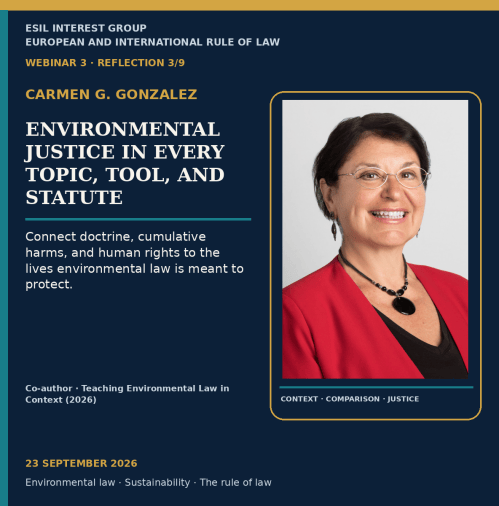


Carmen G. Gonzalez: Environmental Justice in Every Topic, Every Tool, and Every Statute – Reflections on ESIL Webinar 3 – Webinar 3 · Reflection 3/9
Carmen G. Gonzalez’s contribution to the September 23, 2026 – European Society of International Law (ESIL) Interest Group on European and International Rule of Law Webinar entitled From Environmental Law in Context to Comparative Environmental Governance: Justice, Sustainability, and the Rule of Law, began from a curricular and conceptual concern: environmental justice is often treated as an additional topic, even though it is intertwined with the tools and statutes that organize environmental protection. Presenting Teaching Environmental Law in Context, co-authored with Rebecca Bratspies, she explained why justice should run through the field’s foundational teaching.
The book combines legal doctrine with social and historical context and practical lawyering skills. Its case studies, videos, exercises, and classroom activities are designed to support instructors using different principal textbooks. The objective is to help students understand regulatory law through the people and places whose well-being depends on it.
Flint and the interaction of regulatory failures
Carmen’s account of Flint, Michigan illustrated this approach. She described the community’s exposure to industrial pollution before the water crisis and explained why assessments organized around individual chemicals or facilities can overlook cumulative burdens. Technical assumptions can determine which risks appear significant and which experiences receive attention.
The teaching exercise also serves a practical purpose. Students learn how to read and question a risk assessment. They can examine its assumptions, consider the information it uses, and ask what its categories leave out. Those skills connect doctrinal study to the work environmental lawyers must perform.
Flint recurs across different parts of the book. Carmen discussed the response to earlier civil rights complaints, the regulation of drinking water, the treatment of residents’ reports, and the search for legal accountability. Her point was that the crisis cannot be understood adequately through a single statute or moment. The history of institutional decisions and the credibility assigned to community knowledge matter to the legal analysis.
Examining the methods that guide regulation
Responding to the discussion about knowledge and power, Carmen focused on quantitative risk assessment and cost-benefit analysis. She argued that foundational teaching should interrogate these methods rather than assume that students will understand or question them elsewhere.
Her comments on cost-benefit analysis connected methodology to institutional history. She described the political origins of its expanded regulatory role and then examined the consequences of the choices made within it. Benefits can remain unquantified because relevant information is missing. Compliance costs can depend on estimates supplied by regulated industries. An aggregate calculation can obscure who bears the burdens and who receives the benefits. Discounting can reduce the apparent significance of harms that occur later.
These were substantive criticisms of a particular approach to regulation. They also raised a broader question: who decides which method will be used to define a regulatory problem and evaluate a response? Improving an analysis may be valuable, but students should also understand the alternatives and the different purposes they serve, including health protection and human rights.
Connecting local struggles and global rights
Carmen placed the book in conversation with the global movement toward rights-based environmental protection. She referred to constitutional developments, international human rights instruments, the UN General Assembly’s recognition of the right to a clean, healthy, and sustainable environment, and the ICJ’s climate advisory opinion.
The point for the webinar was the opportunity for learning across legal systems. International developments can help illuminate assumptions within U.S. environmental law, while local struggles show what rights and regulatory mechanisms must address in practice.
Her closing priority was to connect these scales more thoughtfully in foundational courses. Federal statutes remain important, but state constitutional law, state legislation, and litigation also deserve attention. She proposed using a legal pluralism lens to examine this activity while relating it to global movements in environmental governance.
Justice as a way of understanding doctrine
Carmen’s response to Mekonnen Ayano made the methodological point explicit. Environmental justice was integrated into every topic deliberately because it provides insight into every topic. Its place in the book is therefore connected to how the subject is analyzed and taught.
As Chair, Moderator, and Discussant, I saw her intervention as a powerful bridge between contextual legal education and epistemic accountability. Choices about evidence, assessment, and valuation influence what institutions see and whose claims they recognize. Teaching those choices alongside doctrine prepares students to question them in practice.
Carmen’s contribution asks environmental lawyers to connect technical competence with historical understanding, distributional inquiry, and the ability to engage seriously with community experience. That is a substantial contribution to how the field is conceptualized as well as how it is taught.
Event information and selected bibliography. Teaching Environmental Law in Context.
Keywords/tags: Carmen G. Gonzalez, environmental justice, Flint, cumulative impacts, risk assessment, cost-benefit analysis, environmental human rights, state constitutional law, legal pluralism
This post forms part of the ESIL Interest Group on European and International Rule of Law Webinar Reflections series, which offers accounts of individual contributions and the wider intellectual exchanges generated by each event.
Explore the Complete Webinar 3 Reflections Series
ESIL Interest Group on European and International Rule of Law Webinar Series
Webinar 3 — From Environmental Law in Context to Comparative Environmental Governance: Justice, Sustainability, and the Rule of Law
September 23, 2026
This nine-part series documents the contributions and intellectual exchanges developed during Webinar 3, examining environmental justice, comparative environmental governance, legal education, sustainability, institutional accountability, and the rule of law.
Reflection 1/9 — Environmental Law, Justice, and Comparative Governance: Reflections on ESIL Webinar 3
[Link forthcoming]
Reflection 2/9 — Rebecca Bratspies: Teaching Environmental Law Through History, Justice, and Power
[Link forthcoming]
Reflection 3/9 — Carmen G. Gonzalez: Environmental Justice in Every Topic, Every Tool, and Every Statute
[Link forthcoming]
Reflection 4/9 — Tseming Yang: Comparative Environmental Law, Legal Cultures, and Learning Across Systems
[Link forthcoming]
Reflection 5/9 — Sara K. Phillips: From Legal Mechanisms to Practical Influence in Environmental Governance
[Link forthcoming]
Reflection 6/9 — Mekonnen Ayano: How Much Distance for Comparison, How Much Proximity for Justice?
[Link forthcoming]
Reflection 7/9 — Chinonso Tansi Anozie: Humanizing Environmental Law and Connecting Sustainability to Energy Justice
[Link forthcoming]
Reflection 8/9 — Paolo Davide Farah: From Comparative Environmental Law to Comparative Environmental Governance—Beyond Rules, Across Institutions and Contexts
[Link forthcoming]
Reflection 9/9 — Paolo Davide Farah: Who Decides What Counts as Knowledge? Environmental Justice and Epistemic Accountability
[Link forthcoming]
Webinar information, speakers, books, and selected bibliography:
https://paolofarah.wordpress.com/2026/09/05/european-society-of-international-law-esil-interest-group-on-european-and-international-rule-of-law-webinar-series-webinar-3-from-environmental-law-in-context-to-comparative-environme/
The ESIL Interest Group on European and International Rule of Law Webinar Reflections Series is conceived, coordinated, and edited by Professor Paolo Davide Farah, Chair of the Interest Group and Chair and Moderator of the Webinar Series. The reflections document and critically engage with the contributions of Rebecca Bratspies, Carmen G. Gonzalez, Tseming Yang, Sara K. Phillips, Mekonnen Ayano, Chinonso Tansi Anozie, and Paolo Davide Farah, recognizing their respective scholarly perspectives and the wider intellectual exchanges generated during the webinar. The series seeks to preserve, develop, and disseminate these contributions as part of an ongoing international scholarly dialogue. The reflections are editorial accounts of the discussions and do not necessarily represent the official positions of the Interest Group or the individual participants.
The recording is now available here:
Paolo Davide Farah, Paolo Farah