Blog

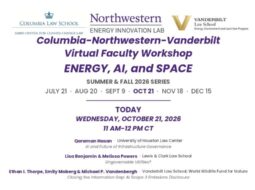
Discussing AI and the Future of Infrastructure Governance | Columbia–Northwestern–Vanderbilt Faculty Workshop

Discussing AI and the Future of Infrastructure Governance | Columbia–Northwestern–Vanderbilt Faculty Workshop Today, I was pleased to serve as a discussant for Qaraman M. Hasan’s paper, “AI and the Future of Infrastructure Governance,” during the Columbia–Northwestern–Vanderbilt Energy, AI, and Space Faculty Workshop, within the track on AI, Data Centers, and Energy Systems. The full post, together […]

Read More
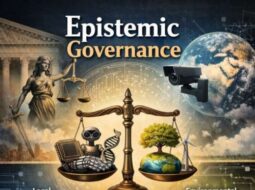
Epistemic Governance: Early Scholarly Recognition Across Disciplines

I am particularly pleased to see that Epistemic Governance, although still a working paper, is already beginning to attract citations in published scholarship, including research appearing in an Oxford University Press journal and work addressing epistemic integrity, institutional credibility, and regulatory enforcement in financial reporting. It is encouraging to see the questions at the heart […]

Read More

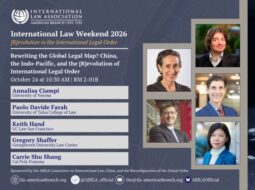
Rewriting the Global Legal Map? China, the Indo-Pacific, and the [R]evolution of International Legal Order — American Branch of the International Law Association (ABILA) International Law Weekend – ILW 2026

Rewriting the Global Legal Map? China, the Indo-Pacific, and the [R]evolution of International Legal Order — ABILA International Law Weekend 2026 I am pleased to announce that I will chair and moderate a panel entitled “Rewriting the Global Legal Map? China, the Indo-Pacific, and the [R]evolution of International Legal Order” at International Law Weekend 2026, […]

Read More

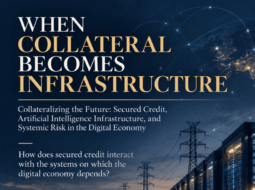
When Collateral Becomes Infrastructure

When Collateral Becomes Infrastructure The second paper I presented at the 17th Transnational Commercial Law Teachers Meeting at the University of Pittsburgh School of Law examines a question that is becoming increasingly important as the digital economy becomes more dependent on large-scale physical infrastructure: What happens when assets financed through secured credit are also part […]

Read More

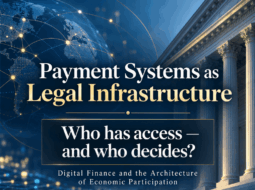
Payment Law, Sanctions, and the Architecture of Economic Participation

Payment Law, Sanctions, and the Architecture of Economic Participation One of the most thought-provoking questions following my presentation of “Payment Systems as Legal Infrastructure: Digital Finance and the Architecture of Economic Participation” at the 17th Transnational Commercial Law Teachers Meeting at the University of Pittsburgh School of Law concerned the power to exclude actors from […]

Read More

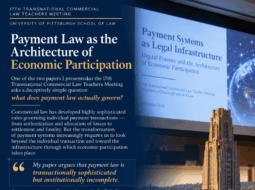
Payment Law as the Architecture of Economic Participation

Payment Law as the Architecture of Economic Participation One of the two papers I presented at the 17th Transnational Commercial Law Teachers Meeting at the University of Pittsburgh School of Law asks the following question: what does payment law actually govern? The full post is available at https://paolofarah.wordpress.com/2026/10/12/payment-law-as-the-architecture-of-economic-participation/ Commercial law has developed highly sophisticated rules […]

Read More

A Thoughtful Initiative by Pitt Law’s Barco Law Library

A Thoughtful Initiative by Pitt Law’s Barco Law Library During the 17th Transnational Commercial Law Teachers Meeting at the University of Pittsburgh School of Law, where I have presented two new papers on “Collateralizing the Future: Secured Credit, Artificial Intelligence Infrastructure, and Systemic Risk in the Digital Economy,” and on “Payment Systems as Legal Infrastructure: […]

Read More

Building Connections Across International Law: Reflections from the ILA Vienna Conference in the ABILA Summer/Fall Newsletter

Building Connections Across International Law: Reflections from the ILA Vienna Conference in the ABILA Summer/Fall Newsletter I am pleased to share that the Summer/Fall 2026 Newsletter of the American Branch of the International Law Association (ABILA) includes my reflections on the 82nd Biennial Conference of the International Law Association, held in Vienna from August 17–21, […]

Read More

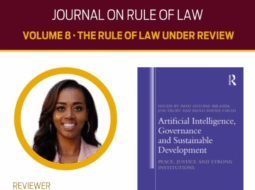
What Happens When Governments Increasingly Rely on AI Systems that They May Not Have The Capacity to Fully Understand, Audit, or Contest?

What Happens When Governments Increasingly Rely on AI Systems that They May Not Have The Capacity to Fully Understand, Audit, or Contest? A thoughtful new review of our Routledge and gLAWcal – Global Law Initiatives for Sustainable Development volume, Artificial Intelligence, Governance and Sustainable Development: Peace, Justice and Strong Institutions, by Monita Varence LLM, LLB, […]

Read More