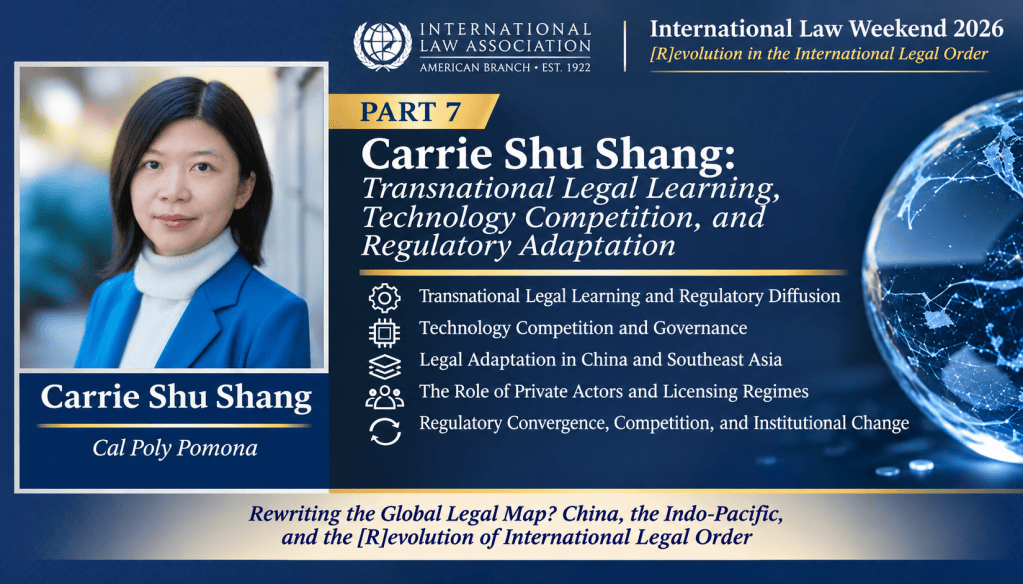


Rewriting the Global Legal Map? China, the Indo-Pacific, and the [R]evolution of International Legal Order — ABILA International Law Weekend 2026 — PART 7 – Carrie Shu Shang: Transnational Legal Learning, Technology Competition, and Regulatory Adaptation — China, Southeast Asia, Private Actors, and the Circulation of Legal Models
Can geopolitical competition accelerate transnational legal learning, even when governments are increasingly reluctant to cooperate?
This question was central to the contribution of Professor Carrie Shu Shang, California State Polytechnic University, Pomona, during the panel I organized, chaired, and moderated at International Law Weekend 2026, held on October 24 at Fordham University School of Law in New York City.
The panel, “Rewriting the Global Legal Map? China, the Indo-Pacific, and the [R]evolution of International Legal Order,” was sponsored by the American Branch of the International Law Association (ABILA) Committee on International Law, China, and the Reconfiguration of the Global Order, which I chair.
This seventh installment of my series examines Professor Shang’s opening presentation and subsequent interventions, including her exchanges with Gregory Shaffer, Keith J. Hand, and me, as well as her responses to questions from the audience.
Her contribution provided an important perspective on the changing relationship between geopolitical competition, transnational legal processes, technology regulation, private economic actors, and the circulation of legal and institutional models.
Drawing upon her scholarship and professional experience in international arbitration in Hong Kong and Shanghai, Professor Shang explored how legal systems continue to influence one another even during periods of political confrontation.
Her analysis also moved beyond bilateral U.S.–China relations to consider the agency of third countries, particularly in Southeast Asia, where governments and businesses increasingly navigate competing regulatory and technological frameworks.
1. Understanding Transnational Law as a Process of Legal Learning
Professor Shang organized her presentation around three interconnected questions:
What is happening in contemporary transnational legal processes?
Where are these processes taking place?
How do legal rules and regulatory practices circulate across borders?
She began by describing transnational law as a process of learning through which legal institutions, governments, businesses, and professionals observe, adapt, and reproduce practices developed in other jurisdictions.
This approach builds upon longstanding debates concerning the interaction between domestic and international legal systems.
However, it also directs attention toward the practical mechanisms through which legal knowledge circulates.
Legal learning does not necessarily require formal international agreements.
It may occur through professional networks, commercial transactions, regulatory compliance, technology licensing, cross-border investment, and the responses of private actors to foreign legislation.
Professor Shang emphasized that this process has become particularly visible in the relationship between China and the United States.
As geopolitical competition intensifies, Chinese institutions and businesses have become increasingly attentive to developments in American legislation and regulation.
Rather than interrupting the circulation of legal models, political rivalry can sometimes accelerate it.
This observation introduced one of the central propositions of her contribution:
The diffusion of legal forms can continue—and even intensify—during periods of geopolitical confrontation.
2. U.S.–China Competition and the Rapid Circulation of Regulatory Models
Professor Shang examined the development of China’s regulatory responses to American economic and technological measures.
She explained that Chinese authorities have closely monitored U.S. legislation and administrative practices involving export controls, investment screening, sanctions, extraterritorial restrictions, data governance, and national security.
These developments have encouraged the creation of Chinese regulatory instruments that resemble, respond to, or adapt approaches previously developed in the United States.
Professor Shang emphasized the speed with which this legal learning can occur.
Regulatory developments in one jurisdiction may quickly become subjects of analysis for legislators, legal professionals, and businesses in another.
This process challenges assumptions that geopolitical rivalry necessarily produces completely separate legal systems.
Instead, competition may create incentives for states to develop comparable instruments in order to strengthen their capacity to respond to foreign measures.
This observation connected closely with Professor Keith Hand’s presentation on China’s foreign-related legislation and countermeasure framework.
While Professor Hand examined the strategic and institutional purposes of these measures, Professor Shang emphasized the processes of legal learning and regulatory diffusion through which they develop.
The resulting relationship can be understood as a form of competitive legal convergence.
The regulatory instruments may become increasingly similar, even when the political purposes underlying their adoption remain opposed.
This distinction is important because it demonstrates that convergence in legal form does not necessarily imply convergence in political values, strategic objectives, or institutional outcomes.
3. Chinese Businesses as Participants in Transnational Legal Learning
A particularly interesting aspect of Professor Shang’s presentation concerned the role of Chinese businesses in monitoring foreign regulatory developments.
She described how companies operating far from China’s principal international commercial centers nevertheless follow detailed developments in American technology regulation.
Her example concerned a Chinese company seeking specialized expertise on a recent U.S. regulatory authorization mechanism affecting connected vehicles.
The company was attempting to identify individuals with the necessary regulatory experience to help it understand and respond to American requirements.
The example illustrated how transnational legal learning extends beyond governments, major multinational corporations, and internationally connected law firms.
Even businesses with relatively limited direct international exposure may become highly attentive to foreign regulatory requirements when those requirements affect their commercial opportunities.
Companies may seek specialized legal counsel, recruit professionals familiar with foreign administrative systems, or adapt their operations to changing compliance requirements.
This process also shows how private actors can become important carriers of public regulatory norms.
Foreign legislation influences commercial decisions across borders, while business responses help disseminate knowledge of those legal frameworks.
Consequently, transnational legal ordering operates not only through formal state-to-state relationships but also through the decentralized activities of companies and legal professionals.
4. Technology Competition and the Transformation of Transnational Regulation
Professor Shang identified technology-intensive sectors as particularly important sites of contemporary transnational legal development.
She referred to developments concerning:
- Artificial intelligence and semiconductors;
- Connected vehicles and advanced manufacturing;
- Biotechnology and pharmaceutical supply chains;
- Batteries, electric vehicles, and clean-energy technologies;
- Export controls, investment screening, and sensitive data.
These sectors increasingly combine commercial innovation with national-security considerations.
Regulatory measures adopted by one jurisdiction can therefore have consequences for companies, technologies, and supply chains operating in multiple countries.
Professor Shang emphasized that technology competition has accelerated the circulation of regulatory approaches.
States observe foreign measures, evaluate their implications, and adopt instruments intended either to protect domestic interests or respond to external restrictions.
However, the consequences of this process vary across sectors.
The institutional arrangements governing artificial intelligence, semiconductor manufacturing, biotechnology, and clean-energy technologies are not identical.
Different technological dependencies, production structures, and commercial relationships influence how regulatory competition develops.
This observation reinforces the importance of avoiding overly general characterizations of technological decoupling.
The practical possibilities for separating economic and technological relationships depend upon the structure of particular industries and the legal mechanisms available to governments and companies.
5. Technology Licensing: Can Private Contracts Remain Neutral?
One of the most significant elements of Professor Shang’s presentation concerned the changing legal and political significance of technology licensing.
Licensing agreements have traditionally been analyzed primarily through contract law, intellectual property rights, and commercial relationships.
However, in strategically sensitive sectors, licensing may also involve the transfer of technological capabilities, specialized knowledge, or production capacity.
Professor Shang suggested that licensing can no longer always be treated as a politically neutral commercial arrangement.
Her analysis focused particularly on biotechnology.
In this sector, cross-border licensing relationships may involve complex dependencies concerning research, manufacturing, pharmaceutical ingredients, technological expertise, and market access.
These dependencies complicate efforts to reproduce regulatory restrictions developed in other technology sectors.
Governments may seek to limit the transfer of sensitive capabilities while businesses continue to depend upon international production networks and commercial partnerships.
Licensing arrangements may consequently become sites of interaction between private contractual autonomy and public regulatory authority.
This observation was particularly relevant to my own intervention during the panel.
Building upon Professor Shang’s discussion, I raised a broader question:
Were legal and commercial infrastructures ever truly neutral, or has geopolitical competition made their political significance increasingly visible?
I suggested that similar questions arise in relation to payment systems, secured transactions, cloud infrastructure, digital platforms, data governance, and other technological arrangements.
These systems are often presented as technical mechanisms supporting commercial activity.
Yet their design, ownership, accessibility, and regulation can influence the distribution of economic and political power.
The distinction between public authority and private contractual relationships therefore becomes increasingly difficult to maintain in sectors characterized by strategic technological dependencies.
Professor Shang’s analysis of licensing provided an important entry point into this broader discussion.
6. Beyond China and the United States: Legal Adaptation in Southeast Asia
Professor Shang emphasized that the consequences of U.S.–China regulatory competition extend beyond the two countries.
Third states increasingly face situations in which they must navigate overlapping or potentially conflicting regulatory requirements.
Their responses may involve selective adaptation, regulatory experimentation, or the combination of elements originating in different legal systems.
She referred to developments in Malaysia and Southeast Asia, particularly concerning technology governance and export restrictions.
For example, regulatory measures affecting advanced computing technologies and semiconductor-related trade can influence how regional governments position themselves within international supply chains.
These developments demonstrate that countries outside the United States and China are not merely passive recipients of geopolitical pressure.
They also make institutional choices concerning how foreign regulatory models are incorporated into domestic systems.
Professor Shang suggested that the emerging regulatory responses of Southeast Asian jurisdictions deserve greater scholarly attention.
Their experiences may reveal new forms of legal adaptation that cannot be fully understood through a simple binary opposition between American and Chinese regulatory influence.
This observation connected directly with my research on legal pluralism, selective legal transplantation, and regulatory competition.
Legal models do not necessarily move unchanged from one jurisdiction to another.
Receiving states may modify their content, combine them with domestic legal traditions, or adapt their implementation to particular economic and political circumstances.
The resulting arrangements may preserve elements of different regulatory systems without reproducing any one model in its entirety.
7. Singapore: Commercial Relationships and the Adaptation of Legal Institutions
During our subsequent discussion, Professor Shang returned to Southeast Asia by discussing developments in Singapore.
She emphasized how the increasing importance of Chinese businesses and commercial relationships has influenced the demand for professional expertise concerning Chinese law.
Singaporean legal professionals and institutions have incentives to understand Chinese legal rules and commercial practices because of the needs of businesses operating across jurisdictions.
Professor Shang also discussed the relationship between company formation procedures, commercial services, and the evolving requirements of Chinese entrepreneurs and investors.
Her observations illustrated how legal adaptation can occur in response to private commercial demand.
Rather than being driven exclusively by governmental efforts to export legal models, transnational legal learning may emerge from the practical requirements of businesses and legal professionals.
These developments also demonstrate that the consequences of legal diffusion are not inherently positive or negative.
They depend upon the content of the legal norms being adopted, the purposes for which they are used, and the institutional circumstances of their implementation.
This perspective complemented Professor Gregory Shaffer’s observation that transnational legal ordering does not necessarily produce cooperation or normatively desirable results.
The significance of legal circulation must therefore be assessed through its practical consequences rather than through assumptions about convergence itself.
8. Private Actors as Carriers of Public Regulation
Another recurring theme in Professor Shang’s contribution concerned the relationship between governments and private economic actors.
She emphasized that businesses continue to transmit legal practices and regulatory knowledge across borders even when formal governmental cooperation becomes more difficult.
Companies operating internationally must respond to foreign requirements concerning exports, investment, technology transfers, data governance, and commercial transactions.
Their compliance practices can contribute to the dissemination of regulatory standards beyond the jurisdiction in which those standards originated.
Private actors may therefore function as intermediaries between domestic regulation and transnational legal ordering.
This process is especially significant in technology-intensive sectors.
Companies may adjust contractual arrangements, establish new compliance procedures, seek specialized legal expertise, or reorganize production relationships in response to regulatory changes.
These commercial responses can influence the practical reach of national legislation.
Professor Shang’s analysis therefore illustrates how international legal transformations may develop through decentralized processes involving businesses, legal professionals, and commercial institutions.
This perspective also reinforces the importance of examining the relationship between public and private authority.
The formal distinction between governmental regulation and commercial decision-making does not necessarily reflect their practical interdependence.
9. Chinese Arbitration Institutions: Institutional Ambition and Commercial Reality
During the audience discussion, Professor Shang addressed questions concerning the development of Chinese arbitration institutions and their capacity to attract international commercial disputes.
The question concerned efforts to encourage the selection of Chinese law and Chinese dispute settlement venues in cross-border commercial relationships.
Drawing upon her professional experience in arbitration, Professor Shang cautioned against assuming that the development of arbitration institutions necessarily translates into international commercial influence.
She emphasized the significant competition among Chinese arbitration centers.
Different institutions compete for commercial disputes, professional recognition, and market opportunities.
At the same time, many arbitration practices remain strongly oriented toward domestic commercial relationships, including in cases containing international elements.
Consequently, institutional expansion does not automatically establish the international competitiveness of particular arbitration venues.
The effectiveness of efforts to promote Chinese arbitration depends upon the preferences of commercial parties, the perceived quality of institutions, the availability of professional expertise, and the practical functioning of dispute settlement mechanisms.
This observation connected closely with Professor Shaffer’s analysis of institutional differentiation within China.
While international arbitration practices have developed extensively in major Chinese commercial centers, institutional capacity and international orientation remain unevenly distributed.
Professor Shang’s intervention therefore reinforced the importance of distinguishing between formal institutional development and the actual commercial use of legal institutions.
10. Regulatory Convergence, Competition, and the Reconfiguration of International Legal Order
Professor Shang’s contribution provides an important perspective on the changing relationship between geopolitical competition and transnational law.
Her analysis demonstrates that legal learning does not necessarily depend upon political cooperation.
Indeed, competing states may become increasingly attentive to one another’s regulatory practices precisely because of their strategic disagreements.
This process can accelerate the circulation of legal models across borders.
However, such diffusion does not necessarily produce uniform implementation or similar political consequences.
The role of private actors further complicates these developments.
Businesses, lawyers, and other professionals can carry regulatory knowledge across jurisdictions, adapting their activities to legal requirements that originate elsewhere.
Third countries, particularly in Southeast Asia, may develop their own responses through selective adaptation and institutional experimentation.
Technology licensing illustrates how arrangements traditionally understood as private commercial contracts can acquire broader strategic significance.
Finally, the development of Chinese arbitration institutions demonstrates that formal legal innovation must be distinguished from practical institutional effectiveness.
Taken together, these observations suggest that contemporary international legal change involves overlapping processes of learning, adaptation, regulatory competition, commercial interdependence, and geopolitical confrontation.
They also reinforce the broader analytical framework I proposed at the beginning of our panel:
Who makes the operative decision? Through what legal mechanism? Who can contest it? And who bears the costs?
These questions are particularly relevant when legal norms circulate through complex relationships involving governments, businesses, professional communities, and institutions operating across multiple jurisdictions.
Continuing the Conversation
I am grateful to Professor Carrie Shu Shang for accepting my invitation and contributing her scholarship, professional experience, and insights to our panel at Fordham.
Her presentation and subsequent interventions helped illuminate how transnational legal learning continues to develop amid geopolitical competition and how regulatory adaptation can emerge through the activities of governments, private businesses, and legal professionals.
Our exchanges also demonstrated the value of bringing together different perspectives on international legal transformation.
Professor Shaffer’s analysis of transnational legal orders, Professor Hand’s research on China’s foreign-related legislation, and my own work on legal pluralism and regulatory competition provide complementary frameworks for understanding the developments examined by Professor Shang.
These questions remain central to the activities of the ABILA Committee on International Law, China, and the Reconfiguration of the Global Order and the International Law Association Study Group on International Law, Global Challenges, and the Impact of Emerging Powers on Global Governance, both of which I chair.
The next installment will examine my substantive interventions during the panel, connecting legal pluralism, regulatory competition, selective legal transplantation, the Belt and Road Initiative, energy governance, technological infrastructure, and the agency of host states and affected communities.
Selected Bibliographical References
Shang, Carrie Shu. “US-China Transnational Law in a Time of Trade Crisis.” Indiana Journal of Global Legal Studies 28, no. 2 (2021): 139–204.
https://www.repository.law.indiana.edu/ijgls/vol28/iss2/4
Shaffer, Gregory, Ji Li, and Henry Gao. “China and International Economic Dispute Settlement: Disaggregating the State.” Journal of International Economic Law (2026).
https://papers.ssrn.com/sol3/papers.cfm?abstract_id=6576238
Hand, Keith J. “Waging External Struggle through Law: China’s Evolving Legal Strategies and Pelosi’s Taiwan Visit.” UC San Diego 21st Century China Center Special Report (2022).
https://papers.ssrn.com/sol3/papers.cfm?abstract_id=4208433
Zoppolato, Davide Giacomo, and Paolo Davide Farah. “China’s Path to Modernization and Legal Pluralism: Transplants and the Belt and Road Initiative.” Asian Journal of Law and Society 12, no. 2 (2025): 109–144.
https://papers.ssrn.com/sol3/papers.cfm?abstract_id=5215873
Farah, Paolo Davide, Davide Giacomo Zoppolato, and Tivadar Ötvös. “China’s Belt and Road Initiative and Its Impact on the Energy Independence of the European Union.” Asian Journal of Law and Society 12, no. 2 (2025): 274–303.
https://papers.ssrn.com/sol3/papers.cfm?abstract_id=5215879
International Law Weekend 2026
October 22–24, 2026
Fordham University School of Law, New York City
Panel: Rewriting the Global Legal Map? China, the Indo-Pacific, and the [R]evolution of International Legal Order
Sponsored by: ABILA Committee on International Law, China, and the Reconfiguration of the Global Order
Chair, Moderator, and Discussant: Paolo Davide Farah
Participating Speakers: Gregory Shaffer, Keith J. Hand, and Carrie Shu Shang
International Law Weekend 2026 — Complete Publication Series
This article forms part of an ongoing series documenting my participation in International Law Weekend 2026, organized by the American Branch of the International Law Association (ABILA), and the scholarly exchanges developed through the panel “Rewriting the Global Legal Map? China, the Indo-Pacific, and the [R]evolution of International Legal Order.”
The panel, held on October 24, 2026, at Fordham University School of Law in New York City, was sponsored by the ABILA Committee on International Law, China, and the Reconfiguration of the Global Order, which I chair.
The series explores the contributions of Gregory Shaffer, Keith J. Hand, Carrie Shu Shang, and myself, including our presentations, subsequent interventions, and discussions concerning international economic law, transnational legal orders, legal pluralism, regulatory competition, geopolitical transformations, and global governance.
Published Installments
PART 1 — Rewriting the Global Legal Map? China, the Indo-Pacific, and the [R]evolution of International Legal Order — Panel Announcement and Intellectual Framework
Introduction to the panel, its objectives, participating scholars, principal research questions, and relevant academic publications.
PART 2 — International Law Weekend 2026 at Fordham Law School: Reflections on ABILA, International Scholarly Cooperation, and Emerging Initiatives
Reflections on my participation in ILW 2026, my role as Chair of the ABILA Committee on International Law, China, and the Reconfiguration of the Global Order, and the development of the International Law Association Study Group on International Law, Global Challenges, and the Impact of Emerging Powers on Global Governance.
PART 3 — Rewriting the Global Legal Map? The Full Panel Discussion: China, Transnational Legal Orders, Geopolitical Competition, and Global Governance
A comprehensive account of the October 24 panel, bringing together the principal arguments of Gregory Shaffer, Keith J. Hand, Carrie Shu Shang, and my own contributions, including the moderated exchanges, audience questions, and broader implications for international law.
PART 4 — Opening Remarks: Who Is Rewriting the Global Legal Map? Power, Institutions, Legal Pluralism, and International Legal Change
The conceptual framework developed for my introductory remarks, examining the distinction between changes in participation, shifts in institutional authority, and transformations in international legal rules and practices.
PART 5 — Gregory Shaffer: China’s Multi-Actor Engagement with Transnational Legal Orders — Disaggregating the State, Institutional Adaptation, and Geoeconomics
An examination of Professor Shaffer’s opening presentation and subsequent interventions on China’s participation in commercial arbitration, WTO dispute settlement, investment arbitration, institutional adaptation, and the growing importance of geoeconomics.
PART 6 — Keith J. Hand: Legal Struggle, Sanctions, and China’s Countermeasure Legislation
An examination of Professor Hand’s analysis of China’s foreign-related legislation, legal countermeasures, extraterritoriality, national-security considerations, and the use of domestic law as an instrument of international competition.
PART 7 — Carrie Shu Shang: Transnational Legal Learning, Technology Competition, and Regulatory Adaptation
An exploration of Professor Shang’s research and interventions concerning regulatory learning, technology governance, the circulation of legal models, licensing, private actors, and the adaptation of legal arrangements across jurisdictions.
Forthcoming Installments
PART 8 — Paolo Davide Farah: Legal Pluralism, Regulatory Competition, and the Reconfiguration of International Legal Order
An analysis of my substantive contributions concerning legal transplantation, the Belt and Road Initiative, regulatory competition, public and private authority, energy governance, unequal bargaining power, the participation of host states and affected communities, and the relationship between geoeconomics and legal geography.
Continuing the Conversation
Together, these installments document the intellectual foundations of the panel, the contributions of its participants, and the broader questions emerging from our exchanges.
The series also contributes to the continuing activities of the ABILA Committee on International Law, China, and the Reconfiguration of the Global Order and the International Law Association Study Group on International Law, Global Challenges, and the Impact of Emerging Powers on Global Governance, both of which I chair.
Through these complementary initiatives, I hope to encourage further dialogue and scholarly cooperation on the evolving relationship between international law, geopolitical competition
#InternationalLaw #ILW2026 #ABILA #China #TransnationalLaw #InternationalEconomicLaw #DisputeSettlement #LegalPluralism #Geoeconomics #GlobalGovernance